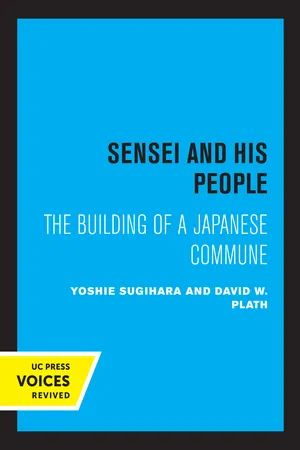
Sensei and His People: The Building of a Japanese Commune by Yoshie Sugihara and David W. Plath offers a rare and deeply textured account of an alternative community in modern Japan, seen through the lives of its charismatic leader, Ozaki Masutaro, and his followers. Ostracized from the Tenri church as heretics and rejected by their village of origin, Ozaki and a small circle of families built Shinkyō, a commune whose existence embodied both defiance and resilience. Sugihara, Ozaki's partner and chronicler, narrates the commune's history from its formative struggles in the 1930s through wartime emigration to Manchuria, postwar return, and eventual consolidation as a thriving collective enterprise. Her account foregrounds the intimate tensions of leadership, devotion, and communal solidarity, while situating Shinkyō against the broader backdrop of Japanese rural life and the national traumas of war, defeat, and reconstruction. More than a local history, this book reveals how Shinkyō's communal ideals were rooted in mainstream Japanese values yet tested against the pressures of ostracism, modernization, and political upheaval. Sugihara's narrative, rendered into English by anthropologist David W. Plath, provides an ethnographic immediacy often absent from conventional sociological studies. Through family histories, anecdotes of ritual and labor, and depictions of ordinary endurance, the text illuminates both the utopian impulses and the pragmatic strategies that enabled a marginal group to survive and flourish. With its combination of biography, ethnography, and memoir, Sensei and His People invites comparisons to American communal experiments such as Oneida, yet insists on the distinctively Japanese texture of paternalistic leadership, farmer virtues, and the reworking of tradition. For scholars of religion, modernization, and comparative communalism, the book offers an unparalleled case study in the lived realities of Japanese social experimentation. This title is part of UC Press's Voices Revived program, which commemorates University of California Press's mission to seek out and cultivate the brightest minds and give them voice, reach, and impact. Drawing on a backlist dating to 1893, Voices Revived makes high-quality, peer-reviewed scholarship accessible once again using print-on-demand technology. This title was originally published in 1969.
Many titles in the Voices Revived program are also newly available as ebooks, offered at a discounted price to support wider access to scholarly work.
- 208 pages
- English
- ePUB (mobile friendly)
- Available on iOS & Android
eBook - ePub
About this book
Information
Publisher
University of California PressYear
2023Print ISBN
9780520335677
Edition
1eBook ISBN
9780520335684
Table of contents
- Cover
- Title
- Copyright
- FOREWORD Ordinary life, extraordinary people
- Contents
- List of major dates and events
- CHAPTER ONE The white commune
- CHAPTER TWO Encounters with Ozaki Sensei
- CHAPTER THREE We smash altars
- CHAPTER FOUR The village leaders react
- CHAPTER FIVE Abandoning a corpse
- CHAPTER SIX Ostracism
- CHAPTER SEVEN To build an imperial shrine
- CHAPTER EIGHT We emigrate to Manchuria
- CHAPTER NINE The end of a lost War
- CHAPTER TEN We return and rebuild
- CHAPTER ELEVEN Trial after trial
- CHAPTER TWELVE A new Eve
- AFTERWORD The unintentional utopia
Trusted by 375,005 students
Access to over 1.5 million titles for a fair monthly price.
Study more efficiently using our study tools.
Frequently asked questions
Yes, you can cancel anytime from the Subscription tab in your account settings on the Perlego website. Your subscription will stay active until the end of your current billing period. Learn how to cancel your subscription
No, books cannot be downloaded as external files, such as PDFs, for use outside of Perlego. However, you can download books within the Perlego app for offline reading on mobile or tablet. Learn how to download books offline
Perlego offers two plans: Essential and Complete
- Essential is ideal for learners and professionals who enjoy exploring a wide range of subjects. Access the Essential Library with 800,000+ trusted titles and best-sellers across business, personal growth, and the humanities. Includes unlimited reading time and Standard Read Aloud voice.
- Complete: Perfect for advanced learners and researchers needing full, unrestricted access. Unlock 1.5M+ books across hundreds of subjects, including academic and specialized titles. The Complete Plan also includes advanced features like Premium Read Aloud and Research Assistant.
We are an online textbook subscription service, where you can get access to an entire online library for less than the price of a single book per month. With over 1.5 million books across 990+ topics, we’ve got you covered! Learn about our mission
Look out for the read-aloud symbol on your next book to see if you can listen to it. The read-aloud tool reads text aloud for you, highlighting the text as it is being read. You can pause it, speed it up and slow it down. Learn more about Read Aloud
Yes! You can use the Perlego app on both iOS and Android devices to read anytime, anywhere — even offline. Perfect for commutes or when you’re on the go.
Please note we cannot support devices running on iOS 13 and Android 7 or earlier. Learn more about using the app
Please note we cannot support devices running on iOS 13 and Android 7 or earlier. Learn more about using the app
Yes, you can access Sensei and His People by Yoshie Sugihara,David W. Plath in PDF and/or ePUB format, as well as other popular books in History & Asian History. We have over 1.5 million books available in our catalogue for you to explore.