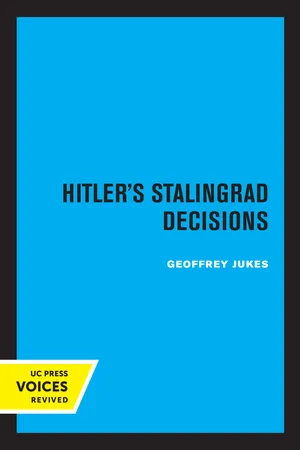
Hitler's Stalingrad Decisions is an incisive examination of one of the most pivotal moments in World War II, focusing not on the military tactics of the Battle of Stalingrad but on Adolf Hitler's decision-making during this extraordinary crisis. Framed within the concept of an "Intra-War Crisis" (IWC), the book explores the escalating perceptions of threat, time constraints, and shifts in military balance that defined German leadership's response to the unfolding catastrophe. Jukes uses a multidisciplinary approach, integrating historical analysis with political science methodologies to shed light on how centralized Nazi decision-making, heavily dominated by Hitler, shaped the outcome of this historic confrontation. Relying on rich primary sources, including the multi-volume War Diary of the High Command of the Armed Forces, the book meticulously analyzes three distinct phases of the Stalingrad crisis: the pre-crisis period marked by strategic misjudgments, the peak crisis when the German forces became besieged, and the post-crisis phase characterized by efforts to salvage what remained of the German position. Jukes evaluates these periods through detailed accounts of Führer Directives, High Command conferences, and the interplay of escalating stress and cognitive performance under Hitler's autocratic leadership. By comparing these events to other international crises, both wartime and peacetime, the book provides a nuanced understanding of decision-making under extreme pressure, offering valuable insights into the dynamics of leadership, strategy, and crisis behavior. This work is an essential resource for historians, political scientists, and readers intrigued by the interplay of military and political decision-making during moments of historical significance. This title is part of UC Press's Voices Revived program, which commemorates University of California Press's mission to seek out and cultivate the brightest minds and give them voice, reach, and impact. Drawing on a backlist dating to 1893, Voices Revived makes high-quality, peer-reviewed scholarship accessible once again using print-on-demand technology. This title was originally published in 1985.
Many titles in the Voices Revived program are also newly available as ebooks, offered at a discounted price to support wider access to scholarly work.
- 280 pages
- English
- ePUB (mobile friendly)
- Available on iOS & Android
eBook - ePub
Hitler's Stalingrad Decisions
About this book
Information
Publisher
University of California PressYear
1985Print ISBN
9780520336971
Edition
1eBook ISBN
9780520336988
Table of contents
- Cover
- Title
- Copyright
- Contents
- Maps
- Foreword
- Acknowledgments
- Introduction
- CHAPTER ONE The Pre-crisis Period
- CHAPTER TWO August-September 1942: Failures and Dismissals
- CHAPTER THREE Transition to the Crisis Period
- CHAPTER FOUR The Beginning of the Crisis Period: November 1942
- CHAPTER FIVE The Crisis Continued: December 1942—2 February 1943
- CHAPTER SIX The Post-crisis Period
- CHAPTER SEVEN Overall Conclusions
- CHAPTER EIGHT Hitler and Stalin Compared
- Appendix
- Bibliography
- Index
Trusted by 375,005 students
Access to over 1.5 million titles for a fair monthly price.
Study more efficiently using our study tools.
Frequently asked questions
Yes, you can cancel anytime from the Subscription tab in your account settings on the Perlego website. Your subscription will stay active until the end of your current billing period. Learn how to cancel your subscription
No, books cannot be downloaded as external files, such as PDFs, for use outside of Perlego. However, you can download books within the Perlego app for offline reading on mobile or tablet. Learn how to download books offline
Perlego offers two plans: Essential and Complete
- Essential is ideal for learners and professionals who enjoy exploring a wide range of subjects. Access the Essential Library with 800,000+ trusted titles and best-sellers across business, personal growth, and the humanities. Includes unlimited reading time and Standard Read Aloud voice.
- Complete: Perfect for advanced learners and researchers needing full, unrestricted access. Unlock 1.5M+ books across hundreds of subjects, including academic and specialized titles. The Complete Plan also includes advanced features like Premium Read Aloud and Research Assistant.
We are an online textbook subscription service, where you can get access to an entire online library for less than the price of a single book per month. With over 1.5 million books across 990+ topics, we’ve got you covered! Learn about our mission
Look out for the read-aloud symbol on your next book to see if you can listen to it. The read-aloud tool reads text aloud for you, highlighting the text as it is being read. You can pause it, speed it up and slow it down. Learn more about Read Aloud
Yes! You can use the Perlego app on both iOS and Android devices to read anytime, anywhere — even offline. Perfect for commutes or when you’re on the go.
Please note we cannot support devices running on iOS 13 and Android 7 or earlier. Learn more about using the app
Please note we cannot support devices running on iOS 13 and Android 7 or earlier. Learn more about using the app
Yes, you can access Hitler's Stalingrad Decisions by Geoffrey Jukes in PDF and/or ePUB format, as well as other popular books in History & Military & Maritime History. We have over 1.5 million books available in our catalogue for you to explore.