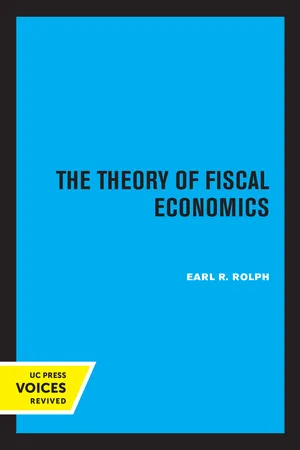
The Theory of Fiscal Economics, by Earl R. Rolph, develops a comprehensive framework for understanding how government financial activity influences the private economy. Rolph argues that all such activity can be categorized as either market operations—purchases and sales of goods, services, or claims—or transfer payments, both positive and negative. Subsidies and interest on debt provide cash inflows to private groups, while taxes extract it. These mechanisms do more than alter monetary balances; they shape incentives through eligibility rules, tax bases, and rate structures, thereby affecting how resources are employed. Central to the book is the claim that, despite their legal variety, taxes are fundamentally similar in that they reduce private money incomes by the amount of revenue raised. In this view, so-called indirect taxation is not a unique burden on consumers in a monetary, price-rationed economy. Excises and import duties, often treated separately from other levies, are tested as cases where a consistent theory can replace fragmented traditions of thought. If a single explanation can clarify their incidence, Rolph contends, it can extend to income and other taxes as well. In pursuing this framework, Rolph emphasizes method as much as substance. He advocates the "clarification" of hidden premises, noting that many disputes arise from unexamined assumptions, such as believing an itemized tax line on a receipt proves who bears the burden. He employs simplified models—two-good economies or competitive pricing—to derive core results before gradually relaxing assumptions, always warning against oversimplifications that erase monetary and fiscal realities. Against theorists who insist taxes must always be paired with expenditures, Rolph holds that tax effects can be studied in isolation, since governments finance spending through multiple channels, including borrowing and asset sales. The book is not prescriptive but evaluative, highlighting where fiscal policies rest on faulty or ambiguous theories. By offering a logically consistent approach across tax types and grounding incidence analysis in monetary economies, The Theory of Fiscal Economics provides a durable template for analyzing government finance and its role in shaping economic behavior. This title is part of UC Press's Voices Revived program, which commemorates University of California Press's mission to seek out and cultivate the brightest minds and give them voice, reach, and impact. Drawing on a backlist dating to 1893, Voices Revived makes high-quality, peer-reviewed scholarship accessible once again using print-on-demand technology. This title was originally published in 1954.
Many titles in the Voices Revived program are also newly available as ebooks, offered at a discounted price to support wider access to scholarly work.
- 326 pages
- English
- ePUB (mobile friendly)
- Available on iOS & Android
eBook - ePub
The Theory of Fiscal Economics
About this book
Information
Table of contents
- Cover
- Title
- Copyright
- Contents
- I Introduction
- 2 Government Ends versus Private Ends
- 3 Social Costs of Government
- 4 Government and Social Accounting
- 5 Monetary Basis of Fiscal Theory
- 6 Excise Taxes and Subsidies: Competitive Pricing
- 7 Excise Taxes and Subsidies: Noncompetitive Pricing
- 8 Import Duties: Self-adjusting Exchanges
- 9 Import Duties: Fixed Exchange Rates
- 10 Taxes and the Incentive to Work
- CONCLUSIONS
- 11 Effects of Taxes on Investment and Capital Values
- 12 Uncertainty, Taxes, and Investment
- Index
Trusted by 375,005 students
Access to over 1.5 million titles for a fair monthly price.
Study more efficiently using our study tools.
Frequently asked questions
Yes, you can cancel anytime from the Subscription tab in your account settings on the Perlego website. Your subscription will stay active until the end of your current billing period. Learn how to cancel your subscription
No, books cannot be downloaded as external files, such as PDFs, for use outside of Perlego. However, you can download books within the Perlego app for offline reading on mobile or tablet. Learn how to download books offline
Perlego offers two plans: Essential and Complete
- Essential is ideal for learners and professionals who enjoy exploring a wide range of subjects. Access the Essential Library with 800,000+ trusted titles and best-sellers across business, personal growth, and the humanities. Includes unlimited reading time and Standard Read Aloud voice.
- Complete: Perfect for advanced learners and researchers needing full, unrestricted access. Unlock 1.5M+ books across hundreds of subjects, including academic and specialized titles. The Complete Plan also includes advanced features like Premium Read Aloud and Research Assistant.
We are an online textbook subscription service, where you can get access to an entire online library for less than the price of a single book per month. With over 1.5 million books across 990+ topics, we’ve got you covered! Learn about our mission
Look out for the read-aloud symbol on your next book to see if you can listen to it. The read-aloud tool reads text aloud for you, highlighting the text as it is being read. You can pause it, speed it up and slow it down. Learn more about Read Aloud
Yes! You can use the Perlego app on both iOS and Android devices to read anytime, anywhere — even offline. Perfect for commutes or when you’re on the go.
Please note we cannot support devices running on iOS 13 and Android 7 or earlier. Learn more about using the app
Please note we cannot support devices running on iOS 13 and Android 7 or earlier. Learn more about using the app
Yes, you can access The Theory of Fiscal Economics by Earl R. Rolph in PDF and/or ePUB format, as well as other popular books in Economia & Teoria economica. We have over 1.5 million books available in our catalogue for you to explore.