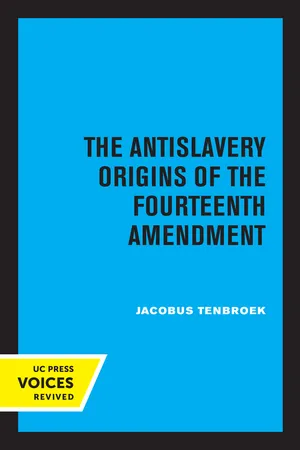
This title explores the constitutional foundations and antislavery principles that influenced the Fourteenth Amendment to the United States Constitution. The book traces the legal, political, and philosophical roots of this critical amendment, which ensures citizenship, due process, and equal protection to all persons born or naturalized in the U.S. This study delves into the motivations behind the Fourteenth Amendment, examining historical debates, particularly within the abolitionist movement, which pioneered concepts like equal protection and due process. These principles gained widespread support through political advocacy, public discourse, and minor and major political parties before the Civil War. The work argues that abolitionist ideas significantly shaped the constitutional language and theories embedded in the amendment. It further situates the Fourteenth Amendment within a broader framework that includes the Thirteenth Amendment's abolition of slavery and the subsequent Fifteenth Amendment, which aimed to secure voting rights for Black men. The book highlights three major questions about the Fourteenth Amendment's interpretation: whether its clauses (privileges, equal protection, and due process) should be understood as procedural or substantive, whether it was meant to extend the Bill of Rights to states, and the scope of Congress's enforcement powers. By linking these to antislavery doctrine, the study sheds light on how the amendment was intended not merely as a procedural safeguard but as an affirmation of universal rights, moving toward a more inclusive federalism in the U.S. This title is part of UC Press's Voices Revived program, which commemorates University of California Press's mission to seek out and cultivate the brightest minds and give them voice, reach, and impact. Drawing on a backlist dating to 1893, Voices Revived makes high-quality, peer-reviewed scholarship accessible once again using print-on-demand technology. This title was originally published in 1951.
Many titles in the Voices Revived program are also newly available as ebooks, offered at a discounted price to support wider access to scholarly work.
- 238 pages
- English
- ePUB (mobile friendly)
- Available on iOS & Android
eBook - ePub
The Antislavery Origins of the Fourteenth Amendment
About this book
Information
Publisher
University of California PressYear
1951Print ISBN
9780520344839
Edition
1eBook ISBN
9780520344846
Table of contents
- Cover
- Title
- Copyright
- Contents
- Introduction
- Introduction to Part One
- CHAPTER I The District of Columbia
- CHAPTER II The Fugitive Slave Law
- CHAPTER III The Power and Duty of Congress
- CHAPTER IV Paramount National Citizenship
- CHAPTER Y Conclusions; the Antislavery Origin
- Introduction to Part Two
- CHAPTER VI Party Platforms and Resolutions
- CHAPTER VII John A. Bingham
- CHAPTER VIII The Victory of the Republican Party
- Introduction to Part Three
- CHAPTER IX The First Two Congressional Debates
- CHAPTER X The Third Congressional Debate
- CHAPTER XI The Fourteenth Amendment
- CHAPTER XII The Fourteenth Amendment (Continued)
- CHAPTER XIII Conclusions
- Table of Cases
- Source Materials
- Index
Trusted by 375,005 students
Access to over 1.5 million titles for a fair monthly price.
Study more efficiently using our study tools.
Frequently asked questions
Yes, you can cancel anytime from the Subscription tab in your account settings on the Perlego website. Your subscription will stay active until the end of your current billing period. Learn how to cancel your subscription
No, books cannot be downloaded as external files, such as PDFs, for use outside of Perlego. However, you can download books within the Perlego app for offline reading on mobile or tablet. Learn how to download books offline
Perlego offers two plans: Essential and Complete
- Essential is ideal for learners and professionals who enjoy exploring a wide range of subjects. Access the Essential Library with 800,000+ trusted titles and best-sellers across business, personal growth, and the humanities. Includes unlimited reading time and Standard Read Aloud voice.
- Complete: Perfect for advanced learners and researchers needing full, unrestricted access. Unlock 1.5M+ books across hundreds of subjects, including academic and specialized titles. The Complete Plan also includes advanced features like Premium Read Aloud and Research Assistant.
We are an online textbook subscription service, where you can get access to an entire online library for less than the price of a single book per month. With over 1.5 million books across 990+ topics, we’ve got you covered! Learn about our mission
Look out for the read-aloud symbol on your next book to see if you can listen to it. The read-aloud tool reads text aloud for you, highlighting the text as it is being read. You can pause it, speed it up and slow it down. Learn more about Read Aloud
Yes! You can use the Perlego app on both iOS and Android devices to read anytime, anywhere — even offline. Perfect for commutes or when you’re on the go.
Please note we cannot support devices running on iOS 13 and Android 7 or earlier. Learn more about using the app
Please note we cannot support devices running on iOS 13 and Android 7 or earlier. Learn more about using the app
Yes, you can access The Antislavery Origins of the Fourteenth Amendment by Jacobus tenBroek in PDF and/or ePUB format, as well as other popular books in History & North American History. We have over 1.5 million books available in our catalogue for you to explore.