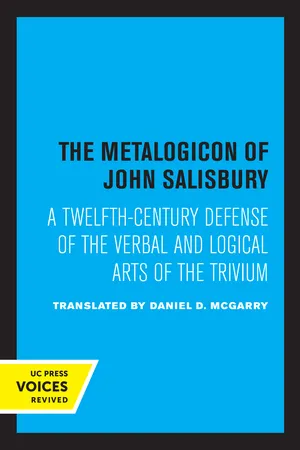
Metalogicon of John of Salisbury: A Twelfth-Century Defense of the Verbal and Logical Arts of the Trivium stands as a seminal work in the history of medieval educational theory. Completed in 1159, this treatise passionately defends the liberal arts, specifically the Trivium—grammar, logic, and rhetoric—arguing for their fundamental role in intellectual development and societal progress. Written against the backdrop of the twelfth-century intellectual renaissance, the Metalogicon champions the application of reason and eloquence in education, advocating a rigorous and systematic study of these disciplines. John of Salisbury's insights resonate as he critiques pedagogical shortcomings of his era while providing a robust framework for intellectual inquiry, which later shaped scholasticism and informed modern scientific reasoning. Beyond its educational arguments, the Metalogicon is a treasure trove of historical and philosophical reflection. It offers a vivid snapshot of twelfth-century academic and intellectual life, interweaving classical and early Christian thought with medieval perspectives. John's erudition and stylistic grace illuminate his vision of education as a blend of theoretical knowledge and practical wisdom, vital for cultivating not only intellectual excellence but also moral and civic virtues. This work not only marks a turning point in Western pedagogy but also cements John's legacy as a critical figure in the evolution of educational and philosophical traditions. This title is part of UC Press's Voices Revived program, which commemorates University of California Press's mission to seek out and cultivate the brightest minds and give them voice, reach, and impact. Drawing on a backlist dating to 1893, Voices Revived makes high-quality, peer-reviewed scholarship accessible once again using print-on-demand technology. This title was originally published in 1955.
Many titles in the Voices Revived program are also newly available as ebooks, offered at a discounted price to support wider access to scholarly work.
eBook - ePub
The Metalogicon of John of Salisbury
A Twelfth-Century Defense of the Verbal and Logical Arts of the Trivium
- 334 pages
- English
- ePUB (mobile friendly)
- Available on iOS & Android
eBook - ePub
The Metalogicon of John of Salisbury
A Twelfth-Century Defense of the Verbal and Logical Arts of the Trivium
About this book
Information
Table of contents
- Cover
- Title
- Copyright
- CONTENTS
- INTRODUCTION
- PROLOGUE
- CHAPTER 1. The false accusation that has evoked this rejoinder to Cornificius.
- CHAPTER 2. A description of Cornificius, without giving his name.
- CHAPTER 3. When, how, and by whom Cornificius was educated.
- CHAPTER 4. The lot of his companions in error.
- CHAPTER 5. What great men that tribe dares defame, and why they do this.
- CHAPTER 6. The arguments on which Cornificius bases his contention.
- CHAPTER 7. Praise of Eloquence.
- CHAPTER 8. The necessity of helping nature by use and exercise.
- CHAPTER 9. That one who attacks logic is trying to rob mankind of eloquence.228
- CHAPTER 10. What “logic” means, and how we should endeavor to acquire all arts that are not reprobate.
- CHAPTER 11. The nature of art, the various kinds of innate abilities, and the fact that natural talents should be cultivated and developed by the arts.
- CHAPTER 12. Why some arts are called “liberal.”
- CHAPTER 13. Whence grammar gets its name.
- CHAPTER 14. Although it is not natural, grammar imitates nature.
- CHAPTER 15. That adjectives of secondary application should not be copulated with nouns of primary application,277 as in the example “a patronymic horse!"
- CHAPTER 16. That adjectives of primary origin are copulated with nouns of primary309 application.
- CHAPTER 17. That grammar also imitates nature in poetry.
- CHAPTER 18. What grammar should prescribe, and what it should forbid.
- CHAPTER 19. That a knowledge of figures [of speech] is most useful.
- CHAPTER 20. With what the grammarian should concern himself.
- CHAPTER 21. By what great men grammar has been appreciated, and the fact that ignorance of this art is as much a handicap in philosophy as is deafness and dumbness.
- CHAPTER 22. That Cornificius invokes the authority of Seneca to defend his erroneous contentions.
- CHAPTER 23. The chief aids to philosophical inquiry and the practice of virtue; as well as how grammar is the foundation of both philosophy and virtue.
- CHAPTER 24. Practical observations on reading and lecturing,425 together with [an account of] the method employed by Bernard of Chartres and his followers.
- CHAPTER 25. A short conclusion concerning the value of grammar.
- [PROLOGUE]
- CHAPTER 1. Because its object is to ascertain the truth, logic is a valuable asset in all fields of philosophy.494
- CHAPTER 2. The Peripatetic school, and the origin and founder of logic.
- CHAPTER 3. That those who would philosophize should be taught logic514 Also the distinction between demonstrative, probable, and sophistical logic.
- CHAPTER 4. What dialectic is, and whence it gets its name.
- CHAPTER 5. The subdivisions of the dialectical art,537 and the objective of logicians.
- CHAPTER 6. That all seek after logic, yet not all are successful in their quest.
- CHAPTER 7. That those who are verbal jugglers of irrelevant nonsense584 must first be disabused of their erring ways585 before they can come to know anything.
- CHAPTER 8. If they had but heeded Aristotle, he would have prevented them from going to extremes.
- CHAPTER 9. That dialectic is ineffective when it is divorced from other studies.
- CHAPTER 10. On whose authority the foregoing and following are based.
- CHAPTER 11. The limited extent of the efficacy of dialectic by itself.
- CHAPTER 12. The subject matter of dialectic, and the means it uses.
- CHAPTER 13. The tremendous value of a scientific knowledge of probable principles; and the difficulties involved in determining what principles are absolutely necessary.
- Chapter 14. More on the same subject.
- Chapter 15. What is a dialectical proposition, and what is a dialectical problem.
- CHAPTER 16. That all other teachers of this art [of dialectic] acknowledge Aristotle as their master.
- CHAPTER 17. In what a pernicious manner logic is sometimes taught; and the ideas of moderns about [the nature of] genera and species745
- CHAPTER 18. That men always alter the opinions of their predecessors.
- CHAPTER 19. Wherein teachers of this kind are not to be forgiven.
- CHAPTER 20. Aristotle’s opinion concerning genera and species, supported by numerous confirmatory reasons and references to written worlds.
- [PROLOGUE]
- CHAPTER 1. How one should lecture on984 Porphyry and other books.
- CHAPTER 2. The utility of the Categories,1019 [some remarks concerning] their instruments.
- CHAPTER 3. What is the scope of the predicaments,1062 and with what the prudent moderation of those who philosophize should rest content.
- CHAPTER 4. The scope and usefulness of the Periermenie [Interpretation],1137 or more correctly of the Periermenias.
- CHAPTER 5. What constitutes the body of the art, and [some remarks on] the utility of the Book of the Topics.
- CHAPTER 6. The utility and scope of the [first] three books of the Topics.
- CHAPTER 7. A brief account of the fourth and fifth books [of the Topics].
- CHAPTER 8. Of definition, the subject of the sixth book [of the Topics].
- CHAPTER 9. The problem of identity and diversity, which is treated in the seventh book; together with some general observations concerning the Topics.
- CHAPTER 10. The utility of the eighth book [of the Topics].
- [PROLOGUE]
- CHAPTER 1. The book of the Analytics1439 examines1440 reasoning.
- CHAPTER 2. The universal utility of this science [of the Analytics], and the etymology of its title.
- CHAPTER 3. The books utility does not include the provision of rhetorical expression.
- CHAPTER 4. The scope of the first book [of the Analytics].
- CHAPTER 5. The scope of the second book [of the Analytics].
- CHAPTER 6. The difficulty of the Posterior Analytics, and whence this difficulty proceeds.
- CHAPTER 7. Why Aristotle has come to be called1500 “the philosopher” par excellence.
- CHAPTER 8. The [proper] junction of demonstrative logic, as well as the sources and techniques of demonstration. Also the fact that sensation is the basis1505 of science, and how this is true.
- CHAPTER 9. What sensation is,1516 and how it, together with imagination, is the foundation of every branch of philosophy.
- CHAPTER 10. The imagination, and the fact that it is the source of affections that either compose and order, or disturb and deform the soul.
- CHAPTER 11. The nature of imagination, together with remarks on opinion. Also how opinion or sensation may be deceived, and the origin of fronesis, which we call “prudence.”
- CHAPTER 12. The nature, subject matter, and activities of prudence; and how science1564 originates from sensation.
- CHAPTER 13. The difference between “science” and “wisdom” and what is “faith.” 1572
- CHAPTER 14. The relationship of prudence and truth, the origins of prudence, and the nature of reason.
- CHAPTER 15. More about what reason is, as well as the fact that the word “reason” has several different meanings, and that reasons are everlasting.
- CHAPTER 16. A distinction of various meanings [of the word “reason”], and the fact that brute animals do not possess reason, even though they may seem to have discernment.1601 Also the origin of human reason according to the Hebrews.
- CHAPTER 17. Reason’s function; why sensation,1623 which reason supervises, is situated in the head; and who are philology’s servants.
- CHAPTER 18. The distinction between reason and [intuitive] understanding1634 and the nature of the latter.
- CHAPTER 19. The nature of wisdom, and the fact that, with the help of grace, wisdom derives [originally] from sense perception.
- CHAPTER 20. The cognition, simplicity, and immortality of the soul, according to Cicero.
- CHAPTER 21. Although Aristotle has not sufficiently discussed hypothetical [conditional] reasoning1674 in the foregoing books, he has, at it were, sowed seed for such a treatment.
- CHAPTER 22. Sophistry and its utility.
- CHAPTER 23. The Sophistical Refutations.1698
- CHAPTER 24. A word about those who disparage the worlds of Aristotle.
- CHAPTER 25. The fact that Cornificus is even more contemptible than Bromius, the buffoon of the gods. Also how Augustine and other philosophers praise logic.
- CHAPTER 26. What tactics we should employ against Cornificius and [other like] perverse calumniators [of logic].
- CHAPTER 27. Although he has been mistaken on several points, Aristotle is preeminent in logic.
- CHAPTER 28. How logic should be employed.
- CHAPTER 29. That the temerity of adolescence should be restrained; why eloquence1748 weds philology; and what should be our main objectives.
- CHAPTER 30. The fact that philology precedes its two sisters.1765 Also what investigation by categories1766 is appropriate in a discussion of reason and truth.
- CHAPTER 31. The nature of original reason, and some observations concerning philosophical sects.
- CHAPTER 32. What is opposed to reason, and the fact that the word “reason” has several diÿerent senses, as well as that reasons are eternal.
- CHAPTER 33. The imperfection of human reason; and the fact that the word “true” has various senses.
- CHAPTER 34. The etymology of the word uerum [“true”], the nature of truth, and what is contrary to truth.
- CHAPTER 35. More about truths, and the fact that things, words, and truths are said to exist in different ways, with an explanation of the latter.
- CHAPTER 36. The difference between things that are true and things that only seem to be true,1874 according to the Platonists.
- CHAPTER 37. That things, opinions, and speech are called “true” or “false” in different senses; and why such expressions are called “modal.” 1884
- CHAPTER 38. The intimate connection1901 between reason and truth, with a brief explanation of the nature of each.
- CHAPTER 39. A continuation of the aforesaid [discussion]. Also [the fact] that neither reason nor truth has contraries.
- CHAPTER 40. The proper aim of the Peripatetics, as well as of all who philosophize correctly, and the eight obstacles to understanding.
- CHAPTER 41.1933 [The limitations of reason and the function of faith.]1934
- CHAPTER 42. How the fact that the world is subject to vanity is confirmed by visible proofs, and why this book is now concluded.
- BIBLIOGRAPHY
- INDEX
Trusted by 375,005 students
Access to over 1.5 million titles for a fair monthly price.
Study more efficiently using our study tools.
Frequently asked questions
Yes, you can cancel anytime from the Subscription tab in your account settings on the Perlego website. Your subscription will stay active until the end of your current billing period. Learn how to cancel your subscription
No, books cannot be downloaded as external files, such as PDFs, for use outside of Perlego. However, you can download books within the Perlego app for offline reading on mobile or tablet. Learn how to download books offline
Perlego offers two plans: Essential and Complete
- Essential is ideal for learners and professionals who enjoy exploring a wide range of subjects. Access the Essential Library with 800,000+ trusted titles and best-sellers across business, personal growth, and the humanities. Includes unlimited reading time and Standard Read Aloud voice.
- Complete: Perfect for advanced learners and researchers needing full, unrestricted access. Unlock 1.5M+ books across hundreds of subjects, including academic and specialized titles. The Complete Plan also includes advanced features like Premium Read Aloud and Research Assistant.
We are an online textbook subscription service, where you can get access to an entire online library for less than the price of a single book per month. With over 1.5 million books across 990+ topics, we’ve got you covered! Learn about our mission
Look out for the read-aloud symbol on your next book to see if you can listen to it. The read-aloud tool reads text aloud for you, highlighting the text as it is being read. You can pause it, speed it up and slow it down. Learn more about Read Aloud
Yes! You can use the Perlego app on both iOS and Android devices to read anytime, anywhere — even offline. Perfect for commutes or when you’re on the go.
Please note we cannot support devices running on iOS 13 and Android 7 or earlier. Learn more about using the app
Please note we cannot support devices running on iOS 13 and Android 7 or earlier. Learn more about using the app
Yes, you can access The Metalogicon of John of Salisbury by Daniel D. McGarry in PDF and/or ePUB format, as well as other popular books in Philosophy & Philosophy History & Theory. We have over 1.5 million books available in our catalogue for you to explore.