Political Crime in Europe: A Comparative Study of France, Germany, and England explores the complex dynamics of political offenses and the legal and societal responses they provoke. Focusing on France, Germany, and England, the book examines the historical evolution of political crime laws over two centuries, offering a theoretical framework for understanding these offenses as defined by governmental reactions rather than static legal categories. The author challenges subjective and inconsistent definitions of political crime and instead identifies recurring patterns in how liberal democracies balance repression and civil liberties. Through a detailed analysis, the book explores the tensions between the need to protect state authority and the principles of due process and individual freedom, emphasizing the ideological and moral factors shaping legal measures. This comparative study sheds light on how states address politically deviant behaviors while avoiding the erosion of democratic values. It argues that restrained use of repressive measures has historically subdued political threats without leading to the feared rise of authoritarian regimes. By examining preventive and punitive approaches, the book highlights the influence of political philosophy on the development of legal responses and underscores the broader implications of managing dissent in democratic societies. This work is an essential resource for understanding the delicate interplay between state power, the rule of law, and the protection of political freedoms. This title is part of UC Press's Voices Revived program, which commemorates University of California Press's mission to seek out and cultivate the brightest minds and give them voice, reach, and impact. Drawing on a backlist dating to 1893, Voices Revived makes high-quality, peer-reviewed scholarship accessible once again using print-on-demand technology. This title was originally published in 1979.
Many titles in the Voices Revived program are also newly available as ebooks, offered at a discounted price to support wider access to scholarly work.
eBook - ePub
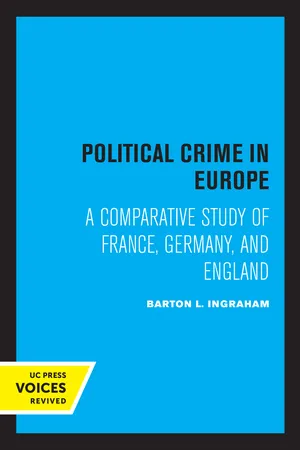
Political Crime in Europe
A Comparative Study of France, Germany, and England
- 398 pages
- English
- ePUB (mobile friendly)
- Available on iOS & Android
eBook - ePub
About this book
Information
Publisher
University of California PressYear
1979Print ISBN
9780520373358
Edition
1eBook ISBN
9780520347069
Table of contents
- Cover
- Title
- Copyright
- Contents 1
- Preface
- Acknowledgments
- CHAPTER 1
- The Positivist Definition of Crime
- The Repressive Response
- Functions of Criminal Law
- Analytical Definition of “Crime”
- CHAPTER 2
- Political Crimes in Western Civilization—Nature of the Offense
- Why Acts of Betrayal and Acts Challenging or Hindering Political Authority in the Past Have Been Regarded as Crimes
- The Preventive Aspects of Laws Dealing with Political Crime
- The Switch from Prevention through Repression to Prevention by Regulation
- Conclusion
- section one: Prologue CHAPTER 3
- The Monarch as the Object of Protection versus the State as the Object of Protection
- The Enlightenment and the Doctrines of Liberalism
- France
- Germany
- Great Britain
- Conclusion
- section two: The French Revolution and the Period of Reaction (1789-1830)
- CHAPTER 4 France (1789-1830) The French Revolution, 1789-1795:
- The Napoleonic Period, 1799-1814
- The Restoration of the Monarchy and Its Problems in an Age of Revolution, 1815-1830
- Francois Guizot—The Liberal View of Political Crime
- Summary
- CHAPTER 5 Germany (1789-1830) Counterrevolutionary Laws of the 1790s
- Revolutionary Activity and Measures Adopted to Maintain the Status Quo
- Treatment of Political Crime in the Bavarian Penal Code of 16 May 1813
- Legal and Philosophical Views Concerning Political Crime
- Summary
- CHAPTER 6
- Measures Taken to Immunize England from the Effects of the French Revolution, 1790-1800
- Postwar Repression of Early Labor Riots and Rebellions, 1816-1820
- The Growth of Liberalism in the Decade Preceding the Passage of the Reform Bill of 1832
- Trials for Treason, Sedition, and Other Political Crimes, 1792-1831
- The Liberalism of Jeremy Bentham
- Summary
- SECTION three: /4 Time of Ferment (1830-1851): Springtime of the Policy of Leniency
- CHAPTER 7
- Reforms in the Law on Political and Press Crimes
- The Law of 28 April 1832 and the Lenient Penal Treatment of Political Offenders
- The Testing of These Laws
- The Second Republic (1848-1851)—Return to Repression
- CHAPTER 8
- The Disturbances Triggered by the July Revolution of 1830 and the Second Wave of Repression
- The Penal Code Revisions of Wiirttemberg, Hesse, Baden, Nassau, Saxony, and the Thuringian States
- The Penal Code of the Prussian States, 14 April 1851
- The 1848 Revolution and Its Aftermath
- CHAPTER 9 Great Britain (1830-1848) Period of Ferment, 1830-1848
- Legal Developments
- The Policy of Leniency
- Summary
- section four: A Time of Consolidation (1852-1914): The Summer of the Policy of Leniency
- CHAPTER 10
- Louis Napoleon and the Second Empire (1851-1870)
- The Third Republic until the First World War (1870-1914)
- CHAPTER 11
- The Nature of the System Established by Bismarck
- The German Penal Code of 15 May 1871
- Subsequent Legislation and Political Repression
- Summary
- CHAPTER 12
- The Period of Quiescence, 1849-1905
- Political Crime in Ireland, 1858-1891, and Measures Taken for Its Suppression
- Aliens, Anarchists, and Extradition
- Further Developments in the Law of Sedition
- The Policy of Leniency—Continued
- The Last Days of Liberalism: 1906-1914
- Summary
- SECTION FIVE: Political Crime in an Age of Ideology (1914-1970): The Autumn and Withering of the Policy of Leniency
- Major Changes in the Twentieth Century and Contributing Causes
- Positivism and Political Crime: The Early Positivists (Lombroso, Ferri, and Garofalo)
- Fascism and Political Crime
- Decline of Positivism
- CHAPTER 13 France (1914-1970) The Third Republic and the Interbellum Years, 1918-1939
- The Fourth and Fifth Republics, 1945-1970
- CHAPTER 14 Germany (1914-1970) The Weimar Republic, 1919-1933
- Control of Political Crime in Nazi Germany, 1933-1945
- The Federal Republic of (West) Germany, 1949-197067
- Summary
- CHAPTER 15 Great Britain (1914-1970)
- War and Postwar Emergency Legislation
- Control of Speech and Press Offenses, Public Meetings, and Demonstrations of a Violent or Seditious Nature
- Decline of the Policy of Leniency toward Political Offenders
- Summary
- CHAPTER 16
- Review
- “Lessons”
- Conclusion
- APPENDIX A
- — APPENDIX B
- Bibliography
- Table of Statutes Cited
- Index
Trusted by 375,005 students
Access to over 1.5 million titles for a fair monthly price.
Study more efficiently using our study tools.
Frequently asked questions
Yes, you can cancel anytime from the Subscription tab in your account settings on the Perlego website. Your subscription will stay active until the end of your current billing period. Learn how to cancel your subscription
No, books cannot be downloaded as external files, such as PDFs, for use outside of Perlego. However, you can download books within the Perlego app for offline reading on mobile or tablet. Learn how to download books offline
Perlego offers two plans: Essential and Complete
- Essential is ideal for learners and professionals who enjoy exploring a wide range of subjects. Access the Essential Library with 800,000+ trusted titles and best-sellers across business, personal growth, and the humanities. Includes unlimited reading time and Standard Read Aloud voice.
- Complete: Perfect for advanced learners and researchers needing full, unrestricted access. Unlock 1.5M+ books across hundreds of subjects, including academic and specialized titles. The Complete Plan also includes advanced features like Premium Read Aloud and Research Assistant.
We are an online textbook subscription service, where you can get access to an entire online library for less than the price of a single book per month. With over 1.5 million books across 990+ topics, we’ve got you covered! Learn about our mission
Look out for the read-aloud symbol on your next book to see if you can listen to it. The read-aloud tool reads text aloud for you, highlighting the text as it is being read. You can pause it, speed it up and slow it down. Learn more about Read Aloud
Yes! You can use the Perlego app on both iOS and Android devices to read anytime, anywhere — even offline. Perfect for commutes or when you’re on the go.
Please note we cannot support devices running on iOS 13 and Android 7 or earlier. Learn more about using the app
Please note we cannot support devices running on iOS 13 and Android 7 or earlier. Learn more about using the app
Yes, you can access Political Crime in Europe by Barton L. Ingraham in PDF and/or ePUB format, as well as other popular books in Politics & International Relations & Terrorism. We have over 1.5 million books available in our catalogue for you to explore.