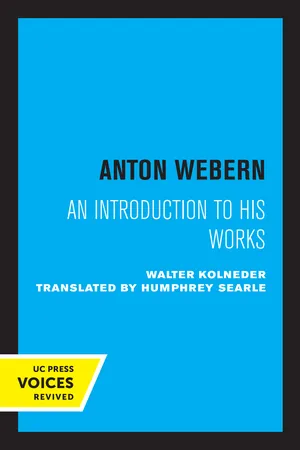
This book offers a comprehensive study of Webern's life, influences, and music, charting his significance as a pioneering figure in modern music. Kolneder, a respected musicologist and director of the Badische Hochschule für Musik, Karlsruhe, presents Webern not only as an avant-garde composer but also as a figure deeply rooted in musical tradition. This book, rooted in Kolneder's lectures and talks, covers Webern's complete body of work, provides biographical context, and examines his stylistic evolution and influence on younger generations of composers. Kolneder aims to counteract myths surrounding Webern, using personal accounts and Webern's own letters to paint an accurate picture of him as both an artist and individual. The book further includes an analysis of Webern's unique twelve-tone technique, his innovations in musical structure, and his distinctive emphasis on concise, transparent textures. Kolneder also addresses Webern's polarizing reputation, contrasting Stravinsky's praise of Webern's "dazzling diamonds" with critics who saw his work as incomprehensible or overly intellectual. Kolneder argues that understanding Webern's music requires an immersive study of his works, emphasizing both the analysis of scores and listening to recordings. The book advocates for a balanced perspective that acknowledges both Webern's revolutionary techniques and his grounding in musical traditions, showing how his legacy as a "father of modern music" has inspired subsequent generations to explore new realms of musical expression. This title is part of UC Press's Voices Revived program, which commemorates University of California Press's mission to seek out and cultivate the brightest minds and give them voice, reach, and impact. Drawing on a backlist dating to 1893, Voices Revived makes high-quality, peer-reviewed scholarship accessible once again using print-on-demand technology. This title was originally published in 1968.
Many titles in the Voices Revived program are also newly available as ebooks, offered at a discounted price to support wider access to scholarly work.
- 232 pages
- English
- ePUB (mobile friendly)
- Available on iOS & Android
eBook - ePub
About this book
Information
Table of contents
- Cover
- Title
- Copyright
- CONTENTS 1
- TRANSLATOR’S PREFACE
- AUTHOR’S PREFACE
- BIOGRAPHICAL SKETCH1
- WORKS
- Passacaglia, Op. 1 for Orchestra (1908)
- Entflieht auf leichten Kähnen, Op. 2 1908 for four-part unaccompanied mixed chorus. Text by Stefan George,
- THE STEP INTO NEW TERRITORY
- THE SCHEME OF WEBERN’S TECHNIQUES OF SOUND
- Five Songs from Der Siebente Ring by Stefan George, Op. j, for voice and piano (1907-8)
- Five Songs on texts of Stefan George, Op. 4,, for voice and piano (1908-9) To Herr Werner Reinhart10 cordially
- Five Movements for String Quartet, Op. 5 (1909)
- Four Pieces for Violin and Piano, Op. 7 (1910)
- Two Songs on poems by Rainer Maria Rilke Op. 8, for voice, clarinet (also bass clarinet), horn, trumpet, celesta, harp, violin, viola and cello (1910)
- THE INSTRUMENTAL MINIATURES Six Bagatelles for String Quartet, Op. 9 (1913)
- Five Pieces for Orchestra,, Op. 10 (1911-13)
- Three Little Pieces for Cello and Piano, Op. n (1914)
- THE SONGS OPP. 12-15
- Five Canons on Latin Texts, Op. 16 for high soprano, clarinet and bass clarinet (1924)
- THE ADOPTION OF SCHOENBERG’S ‘METHOD OF COMPOSITION WITH TWELVE SEMITONES RELATED ONLY TO ONE ANOTHER’ Three Traditional Rhymes, Op. ij (1924) for voice, violin (also viola), clarinet in B flat and bass clarinet in B flat
- String Trio, Op. 20 (1927)
- Symphony, Op. 21 (1928) for clarinet, bass clarinet, two horns, harp, 1 st and 2nd violins, viola and cello
- Quartet, Op. 22 (1930) for violin, clarinet, tenor saxophone and
- Three Songs, Op. 25 (1934-5) on poems of Hildegard Jone for
- Concerto, Op. 24 (1934) for flute, oboe, clarinet, horn, trumpet, trombone, violin, viola and piano
- Das Augenlicht, Op. 26 (1935) for mixed chorus and orchestra To my daughter Amalie Wallner
- String Quartet, Op. 28 (1937-8)
- First Cantata, Op. 29 (1938/9) for soprano solo, mixed chorus and orchestra Text by Hildegard Jone
- Variations for Orchestra Op. jo, (1940)
- Second Cantata,, Op. 31 (1941-3) for soprano and bass soli, mixed chorus and orchestra
- THE ARRANGEMENTS
- WEBERN’S PERSONALITY AS REFLECTED IN HIS WORKS
- THE AFTERMATH
- WEBERN BIBLIOGRAPHY
- WEBERN'S WORKS
- INDEX
Trusted by 375,005 students
Access to over 1.5 million titles for a fair monthly price.
Study more efficiently using our study tools.
Frequently asked questions
Yes, you can cancel anytime from the Subscription tab in your account settings on the Perlego website. Your subscription will stay active until the end of your current billing period. Learn how to cancel your subscription
No, books cannot be downloaded as external files, such as PDFs, for use outside of Perlego. However, you can download books within the Perlego app for offline reading on mobile or tablet. Learn how to download books offline
Perlego offers two plans: Essential and Complete
- Essential is ideal for learners and professionals who enjoy exploring a wide range of subjects. Access the Essential Library with 800,000+ trusted titles and best-sellers across business, personal growth, and the humanities. Includes unlimited reading time and Standard Read Aloud voice.
- Complete: Perfect for advanced learners and researchers needing full, unrestricted access. Unlock 1.5M+ books across hundreds of subjects, including academic and specialized titles. The Complete Plan also includes advanced features like Premium Read Aloud and Research Assistant.
We are an online textbook subscription service, where you can get access to an entire online library for less than the price of a single book per month. With over 1.5 million books across 990+ topics, we’ve got you covered! Learn about our mission
Look out for the read-aloud symbol on your next book to see if you can listen to it. The read-aloud tool reads text aloud for you, highlighting the text as it is being read. You can pause it, speed it up and slow it down. Learn more about Read Aloud
Yes! You can use the Perlego app on both iOS and Android devices to read anytime, anywhere — even offline. Perfect for commutes or when you’re on the go.
Please note we cannot support devices running on iOS 13 and Android 7 or earlier. Learn more about using the app
Please note we cannot support devices running on iOS 13 and Android 7 or earlier. Learn more about using the app
Yes, you can access Anton Webern by Walter Kolneder in PDF and/or ePUB format, as well as other popular books in Media & Performing Arts & Music. We have over 1.5 million books available in our catalogue for you to explore.