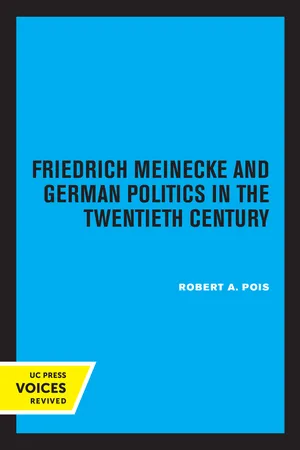
Friedrich Meinecke and German Politics in the Twentieth Century examines the evolution of Friedrich Meinecke's political thought against the backdrop of two world wars and the social and political upheavals in Germany. Meinecke, an influential historian and intellectual, witnessed and reflected on the monumental changes in his country during the early 20th century, navigating the aftermath of World War I, the rise of Nazism, and the eventual collapse of the Weimar Republic. His intellectual journey—from an advocate of statism in his early work Weltbürgertum und Nationalstaat (1907) to a postwar rejection of state absolutism—has been studied primarily through its ethical and philosophical implications. However, this work aims to explore Meinecke's political responses to the crises of his time, specifically focusing on his views regarding Nazism, the Weimar Republic, and his relationship with the ideas of Friedrich Naumann. Meinecke's rejection of the unchecked statism of his youth, particularly in Weltbürgertum und Nationalstaat, ultimately prevented him from fully grasping the complex political realities that led to the rise of Nazi ideology. His devotion to a super-political cosmopolitanism, especially during the Weimar period, resulted in a failure to understand the deep cultural and political changes that shaped the modern German state. This essay highlights how Meinecke's retreat into the idealized concept of Kultur (culture) created a chasm between his theoretical understanding and the political realities that faced his countrymen. Despite being positioned as part of the intellectual elite, Meinecke's tendency to separate politics from cultural realities ultimately distanced him from the forces that fueled Nazi extremism. Through his examination of Meinecke's political writings, the essay sheds light on the historical missteps of the German Bildungsbürgertum and its role in the wider tragedy of 20th-century German history. This title is part of UC Press's Voices Revived program, which commemorates University of California Press's mission to seek out and cultivate the brightest minds and give them voice, reach, and impact. Drawing on a backlist dating to 1893, Voices Revived makes high-quality, peer-reviewed scholarship accessible once again using print-on-demand technology. This title was originally published in 1972.
Many titles in the Voices Revived program are also newly available as ebooks, offered at a discounted price to support wider access to scholarly work.
- 174 pages
- English
- ePUB (mobile friendly)
- Available on iOS & Android
eBook - ePub
Friedrich Meinecke and German Politics in the Twentieth Century
About this book
Information
Publisher
University of California PressYear
1972Print ISBN
9780520347496
Edition
1eBook ISBN
9780520347502
Table of contents
- Cover
- Title
- Copyright
- Contents
- 1 Introduction
- 2 Friedrich Naumann and Friedrich Meinecke
- 3 Statism Triumphant: Meinecke up to November, 1918
- 4 Nach der Revolution
- 5 The Clash between Power and Kultur
- 6 Friedrich Meinecke and the Weimar Republic
- 7 The Rejection of Power
- 8 The Rejection of Politics
- 9 Summary
- Postscript
- Bibliography
- Index
Trusted by 375,005 students
Access to over 1.5 million titles for a fair monthly price.
Study more efficiently using our study tools.
Frequently asked questions
Yes, you can cancel anytime from the Subscription tab in your account settings on the Perlego website. Your subscription will stay active until the end of your current billing period. Learn how to cancel your subscription
No, books cannot be downloaded as external files, such as PDFs, for use outside of Perlego. However, you can download books within the Perlego app for offline reading on mobile or tablet. Learn how to download books offline
Perlego offers two plans: Essential and Complete
- Essential is ideal for learners and professionals who enjoy exploring a wide range of subjects. Access the Essential Library with 800,000+ trusted titles and best-sellers across business, personal growth, and the humanities. Includes unlimited reading time and Standard Read Aloud voice.
- Complete: Perfect for advanced learners and researchers needing full, unrestricted access. Unlock 1.5M+ books across hundreds of subjects, including academic and specialized titles. The Complete Plan also includes advanced features like Premium Read Aloud and Research Assistant.
We are an online textbook subscription service, where you can get access to an entire online library for less than the price of a single book per month. With over 1.5 million books across 990+ topics, we’ve got you covered! Learn about our mission
Look out for the read-aloud symbol on your next book to see if you can listen to it. The read-aloud tool reads text aloud for you, highlighting the text as it is being read. You can pause it, speed it up and slow it down. Learn more about Read Aloud
Yes! You can use the Perlego app on both iOS and Android devices to read anytime, anywhere — even offline. Perfect for commutes or when you’re on the go.
Please note we cannot support devices running on iOS 13 and Android 7 or earlier. Learn more about using the app
Please note we cannot support devices running on iOS 13 and Android 7 or earlier. Learn more about using the app
Yes, you can access Friedrich Meinecke and German Politics in the Twentieth Century by Robert A. Pois in PDF and/or ePUB format, as well as other popular books in History & German History. We have over 1.5 million books available in our catalogue for you to explore.