Eugene Bardach's The Skill Factor in Politics: Repealing the Mental Commitment Laws in California uses the 1965–67 overhaul of California's involuntary commitment system to explore what political skill actually is—and how it determines outcomes. Tracking a reform coalition that most observers initially rated as long-shots (and briefly wrote off for dead) before it ultimately prevailed, Bardach argues that standard political science couldn't explain the win because it lacked a workable theory of "skill." Rather than treating skill as a personality trait, he defines it as a quality of action in problem-solving—timely, efficient, inventive maneuvers tailored to the structure of a policy contest. His evidence comes from close observation of the commitment reform and four comparative cases in California mental health politics (an interdepartmental turf struggle, an internal DMH controversy, a licensing fight over psychotherapy, and a state-hospital budget battle), supplemented by interviews, documents, and a survey of the "attentive public." From these cases Bardach sketches a pragmatic model of policy entrepreneurship. Success equals authorization by relevant authorities, which depends on assembling "enough" support from strategically weighted interests. The entrepreneur's four core problems are: (1) designing proposals and plausible alternatives that can attract the right mix of interests; (2) recruiting and activating a coalition with resources (persuasion, information, venues, procedural leverage) to build that support; (3) defending and countering opposition through timing, sabotage, and agenda control; and (4) sustaining organizational capacity—managing attention, sequencing moves, and adapting doctrine as events unfold. Bardach's aim isn't to rank skill above other forces, but to make it visible and teachable as craft. He closes by urging broader diffusion of these skills—among analysts, citizen-advocates, and officials—arguing that representative institutions work best when more participants can map the field, diagnose leverage points, and execute creative, well-timed political action. This title is part of UC Press's Voices Revived program, which commemorates University of California Press's mission to seek out and cultivate the brightest minds and give them voice, reach, and impact. Drawing on a backlist dating to 1893, Voices Revived makes high-quality, peer-reviewed scholarship accessible once again using print-on-demand technology. This title was originally published in 1972.
Many titles in the Voices Revived program are also newly available as ebooks, offered at a discounted price to support wider access to scholarly work.
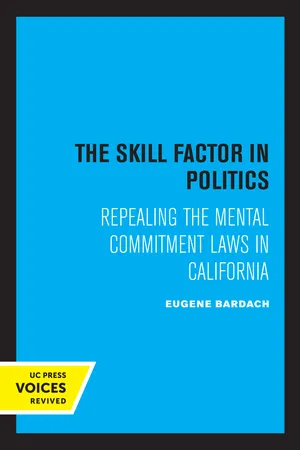
eBook - ePub
The Skill Factor in Politics
Repealing the Mental Commitment Laws in California
- 302 pages
- English
- ePUB (mobile friendly)
- Available on iOS & Android
eBook - ePub
About this book
Information
Publisher
University of California PressYear
1972Print ISBN
9780520373617
Edition
1eBook ISBN
9780520347663
Table of contents
- Cover
- Title
- Copyright
- Contents
- Acknowledgments
- Introduction: Political Skill and the Problems of Politics
- 1 Mapping Existing Policies and Their Audiences
- 2 Mapping Ideological Consensus and Cleavage
- 3 Mapping Factions, Interests, and Alliances
- 4 Civil Commitment and the Medical Model
- 5 The Great Budget Controversy
- 6 The Psychology Licensing Act of 1967
- 7 The Mendocino Plan
- 8 The Bureau of Social Work Transfer
- 9 The Entrepreneur Designs a Proposal and Seeks Support
- 10 The Entrepreneur Builds a Coalition
- 11 The Entrepreneur Meets an Opposition
- 12 The Essential Entrepreneur
- Appendix A Mental Health Survey
- Appendix B Sampling Procedure and Rationale
- Index
Trusted by 375,005 students
Access to over 1.5 million titles for a fair monthly price.
Study more efficiently using our study tools.
Frequently asked questions
Yes, you can cancel anytime from the Subscription tab in your account settings on the Perlego website. Your subscription will stay active until the end of your current billing period. Learn how to cancel your subscription
No, books cannot be downloaded as external files, such as PDFs, for use outside of Perlego. However, you can download books within the Perlego app for offline reading on mobile or tablet. Learn how to download books offline
Perlego offers two plans: Essential and Complete
- Essential is ideal for learners and professionals who enjoy exploring a wide range of subjects. Access the Essential Library with 800,000+ trusted titles and best-sellers across business, personal growth, and the humanities. Includes unlimited reading time and Standard Read Aloud voice.
- Complete: Perfect for advanced learners and researchers needing full, unrestricted access. Unlock 1.5M+ books across hundreds of subjects, including academic and specialized titles. The Complete Plan also includes advanced features like Premium Read Aloud and Research Assistant.
We are an online textbook subscription service, where you can get access to an entire online library for less than the price of a single book per month. With over 1.5 million books across 990+ topics, we’ve got you covered! Learn about our mission
Look out for the read-aloud symbol on your next book to see if you can listen to it. The read-aloud tool reads text aloud for you, highlighting the text as it is being read. You can pause it, speed it up and slow it down. Learn more about Read Aloud
Yes! You can use the Perlego app on both iOS and Android devices to read anytime, anywhere — even offline. Perfect for commutes or when you’re on the go.
Please note we cannot support devices running on iOS 13 and Android 7 or earlier. Learn more about using the app
Please note we cannot support devices running on iOS 13 and Android 7 or earlier. Learn more about using the app
Yes, you can access The Skill Factor in Politics by Eugene Bardach in PDF and/or ePUB format, as well as other popular books in Law & Medical Law. We have over 1.5 million books available in our catalogue for you to explore.