eBook - ePub
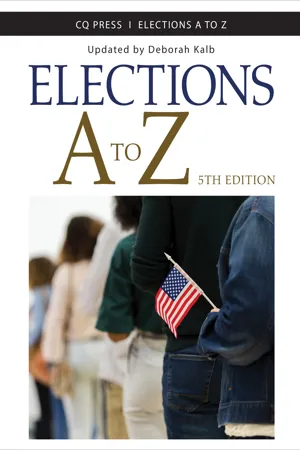
Elections A to Z
About this book
Elections A to Z is a highly respected legacy title that has long been a staple in the CQ Press reference list. It provides readers with ready reference insight into how campaigns and elections, the hallmark of any democracy, are conducted in the United States. The new fifth edition has been redesigned and updated with new entries covering the vital current elections topics that readers want to know about, especially given the focus on elections over the past year, and the resulting threat to American democracy. Entries range from short definitions of terms such as "at-large" and "front-runner" to in-depth essays exploring vital aspects of campaigns and elections, such as the right to vote, turnout trends, and the history, evolution, and current state of House, Senate, presidential, and some state-level elections. As with the prior edition, coverage will continue to entail the stages in the campaign process and the general election; the roles of political consultants, the media, and political parties; debates around term limits, majority-minority districts, and campaign finance; amendments, legislation, and court cases that have shaped electoral, campaign, and voting matters; voter turnout and voting rights in the United States; and highlights of presidential elections throughout U.S. history. Since the last edition published in 2012, there are many pertinent topics and events to explore from recent years, especially surrounding the 2020 elections. New to this edition will be entries discussing social media and communication, political and racial gerrymandering, districting and disenfranchisement, absentee and mail-in voting, new and revised state-by-state election and voter laws, foreign interference and misinformation campaigns, election-related violence, and minority and diverse group candidates and voter participation. Additionally, the book will address recent SCOTUS decisions that have impacted election law, including Citizens United v. Federal Election Commission (2010), Arizona v. Inter Tribal Council of Arizona, Inc. (2013), Shelby County, Alabama, v. Holder, Attorney General (2013), McCutcheon v. Federal Election Commission (2014), Arizona State Legislature v. Arizona Independent Redistricting Commission (2015), Harris v. Arizona Independent Redistricting Commission (2016), Husted, Ohio Secretary of State v. A. Philip Randolph Institute (2018), Minnesota Voters Alliance v. Mansky (2018), Gill v. Whitford (2018), Abbott, Governor of Texas v. Perez (2018), Virginia House of Delegates v. Bethune-Hill (2019), Rucho v. Common Cause (2019), Colorado Department of State v. Baca (2020), Chiafalo v. Washington (2020), and Texas v. Pennsylvania (2020). The proposed update to Elections A to Z will reflect these changes as it captures an undergraduate-level audience that understands the basics of campaigns and elections but is seeking an understanding of related topics, trends, and current events.
Information
Table of contents
- Cover
- Half Title
- Publisher Note
- Title Page
- Copyright Page
- Contents
- Introduction
- A
- Absentee Voting
- Absolute Majority
- American Independent Party (1968–) and American Party (1972–)
- Anti-Federalists (1789–1796)
- Anti-Masonic Party (1832–1836)
- Asian American and Pacific Islander Candidates
- Asian American and Pacific Islander Voters
- At-Large
- B
- Ballot Access
- Ballot Types
- Bandwagon Effect
- Bellwether
- Bicameral
- Bilingual Voters
- Black Candidates
- Black Voters
- Blue Dog Democrats
- Border States
- Brokered Convention
- Bundling
- C
- Campaign Buttons
- Campaign Finance
- Campaign Slogans
- Campaign Strategies
- Campaign, Basic Stages of
- Campaigning
- Candidate-Centered Campaigns
- Canvassing Board
- Caucus
- Census
- Citizens Party (1979–1984)
- Citizenship and Voting
- Civil Rights Acts
- Coalition
- Coattails
- Communist Party U.S.A. (1924–)
- Congressional District
- Congressional Elections
- Constituency
- Constitution Party (U.S. Taxpayers Party) (1992–)
- Constitutional Union Party (1860)
- Contested Elections
- Crossover Voting
- Cumulative Voting
- D
- Dark Horse
- Debates
- Delegates
- Democracy
- Democratic Leadership Council
- Democratic National Committee
- Democratic Party (1832–)
- Democratic Socialists
- Democratic-Republican Party (1796–1828)
- Direct Election
- Disenfranchisement
- District of Columbia
- Districts, Wards, and Precincts
- E
- Election Cycle
- Election Day
- Election Fraud
- Election Violence
- Electoral Anomalies
- Electoral Behavior
- Electoral College and Votes
- Equal Time and Rebuttal Rules
- Exit Polls
- F
- Favorite Son
- Federal Election Commission
- Federal Workers’ Political Activity
- Federalist Party (1789–1816)
- Forecasting Election Results
- Foreign Interference in Elections
- Franchise
- Free Soil Party (1848–1852)
- Freeholder
- Front-Loading
- Front-Runner
- Fusionism
- G
- Gerrymander
- Get Out the Vote
- Governor
- Grandfather Clause
- Green Party (1996–)
- Greenback Party (1876–1884)
- H
- Hard Money
- Help America Vote Act of 2002
- House of Representatives, Electing
- House of Representatives, Qualifications
- I
- Ideology
- Impeachment
- Incumbency
- Independent
- Initiatives and Referendums
- Interest Group
- Iowa Caucus
- Issue Voting
- J
- Judicial System
- K
- Know Nothing (American) Party (1856)
- L
- Lame Duck
- Landslide
- LaRouche Movement (U.S. Labor Party, 1973–)
- Latino Candidates
- Latino Voters
- LGBTQ Candidates
- LGBTQ Voters
- Liberal Republican Party (1872)
- Libertarian Party (1971–)
- Liberty Party (1839–1848)
- Lieutenant Governor
- Literacy Tests
- M
- Mandate
- Media Coverage of Campaigns
- Media Use by Campaigns
- Mid-decade Redistricting
- Midterm Election
- Minority-Majority District
- Misinformation Campaigns
- Motor Voter Act
- Multimember Districts
- N
- National Democratic Party (1896)
- National Election Studies
- National Party Conventions
- National Republican Party (1828–1832)
- National Unity Party (1980–1988)
- Native American Candidates
- Native American Voters
- Natural Law Party (1992–2004)
- Nature of Representation
- Negative Campaigning
- New Hampshire Primary
- O
- One Person, One Vote
- P
- Party Endorsement of Candidates
- Party Identification by Voters
- Peace and Freedom Party (1967–)
- People’s Party (1970s)
- Platform
- Plurality
- Pocketbook Voting
- Political Action Committees
- Political Advertising
- Political Consultants
- Political Culture in America
- Political Party Development
- Political Radicalization
- Political Socialization of the Public
- Poll Taxes
- Polling
- Popular Vote
- Populism
- Populist (People’s) Party (1891–1908, 1984–)
- Postconvention Bounce
- President, Nominating and Electing
- President, Qualifications
- Presidential Draft
- Presidential Elections Chronology
- Presidential Primaries
- Presidential Selection Reforms
- Primary Types
- Progressive Party (1924)
- Progressive Party (1948)
- Progressive Party–Bull Moose (1912)
- Prohibition Party (1869–)
- Proportional Representation
- Public Financing of Campaigns
- Public Opinion
- Push Poll
- R
- Racial Redistricting
- Ranked-Choice Voting
- Realignments and Dealignments
- Reapportionment and Redistricting
- Recall
- Recount
- Reform Party (1995–)
- Republican Government
- Republican Main Street Partnership
- Republican National Committee
- Republican Party (1854–)
- Retrospective Voting
- Right to Vote
- Running Mate
- Runoff and Preference Primary
- S
- Scandals
- Second Midterm Elections (“The Six-Year Itch”)
- Senate, Electing
- Senate, Qualifications
- Single-Issue Voting
- Single-Member Districts
- Social Media and Elections
- Socialist Labor Party (1874–)
- Socialist Party (1901–)
- Socialist Workers Party (1938–)
- Soft Money
- Sore Loser Laws
- Southern Democrats (1860)
- Special Elections
- Split-Ticket and Straight-Ticket Voting
- State and Federal Election Responsibilities
- State Legislatures
- States’ Rights Democratic Party (1948)
- Straw Vote
- Super Tuesday
- Superdelegate
- Supreme Court and Campaign Finance
- Supreme Court and Political Speech
- Supreme Court and Reapportionment and Redistricting
- Supreme Court and Recounts
- Supreme Court and the Electoral College
- Supreme Court and Voter Registration
- Supreme Court and Voting Rights
- T
- Term Limits
- Third Parties
- Threshold Rules
- Two-Party System
- Two-Thirds Rule
- U
- Unicameral
- Union Party (1936)
- Unit Rule
- United We Stand America (1992–1995)
- V
- Vice President
- Voter Apathy
- Voter Identification
- Voter Registration
- Voter Turnout
- Voting Age
- Voting Machines
- Voting Rights Act
- W
- Watershed Elections
- Whig Party (1834–1856)
- Whistle Stop
- Winner Take All
- Women Candidates
- Women Voters
- Workers World Party (1959–)
- Write-In Vote
- Y
- Youth Voters
- Index
Trusted by 375,005 students
Access to over 1.5 million titles for a fair monthly price.
Study more efficiently using our study tools.
Frequently asked questions
Yes, you can cancel anytime from the Subscription tab in your account settings on the Perlego website. Your subscription will stay active until the end of your current billing period. Learn how to cancel your subscription
No, books cannot be downloaded as external files, such as PDFs, for use outside of Perlego. However, you can download books within the Perlego app for offline reading on mobile or tablet. Learn how to download books offline
Perlego offers two plans: Essential and Complete
- Essential is ideal for learners and professionals who enjoy exploring a wide range of subjects. Access the Essential Library with 800,000+ trusted titles and best-sellers across business, personal growth, and the humanities. Includes unlimited reading time and Standard Read Aloud voice.
- Complete: Perfect for advanced learners and researchers needing full, unrestricted access. Unlock 1.5M+ books across hundreds of subjects, including academic and specialized titles. The Complete Plan also includes advanced features like Premium Read Aloud and Research Assistant.
We are an online textbook subscription service, where you can get access to an entire online library for less than the price of a single book per month. With over 1.5 million books across 990+ topics, we’ve got you covered! Learn about our mission
Look out for the read-aloud symbol on your next book to see if you can listen to it. The read-aloud tool reads text aloud for you, highlighting the text as it is being read. You can pause it, speed it up and slow it down. Learn more about Read Aloud
Yes! You can use the Perlego app on both iOS and Android devices to read anytime, anywhere — even offline. Perfect for commutes or when you’re on the go.
Please note we cannot support devices running on iOS 13 and Android 7 or earlier. Learn more about using the app
Please note we cannot support devices running on iOS 13 and Android 7 or earlier. Learn more about using the app
Yes, you can access Elections A to Z by Deborah Kalb in PDF and/or ePUB format, as well as other popular books in Politics & International Relations & Political Campaigns & Elections. We have over 1.5 million books available in our catalogue for you to explore.