Examines Jewish-German "tropes" in Hélène Cixous's oeuvre and life and their impact on her work as a feminist, poet, and playwright.
Hélène Cixous is a poet, philosopher, and activist known worldwide for her manifesto on Écriture feminine (feminine writing) and for her influential literary texts, plays, and essays. While the themes were rarely present in her earlier writings, Germany and Jewish-German family figures and topics have significantly informed most of Cixous's late works. Born in Algeria in June 1937, she grew up with a mother who had escaped Germany after the rise of Nazism and a grandmother who fled the racial laws of the Third Reich in 1938. In her writing, Cixous refines the primitive scene of a "German" upbringing in French-occupied colonial, antisemitic Algeria.
Scholar and filmmaker Olivier Morel delves into the signs and influences that "Germany," "German," and "Osnabrück" have exerted over Cixous's work. Featuring an exclusive interview with Hélène Cixous and stills from their travel together to Osnabrück in Morel's 2018 documentary, Ever, Rêve, Hélène Cixous, Morel's The "German Illusion" examines the unique literary meditation on the Holocaust sustained throughout her later texts.
Morel helps us to understand an uncannily original oeuvre that embodies the complexities of modernity's genocidal history in a new way.
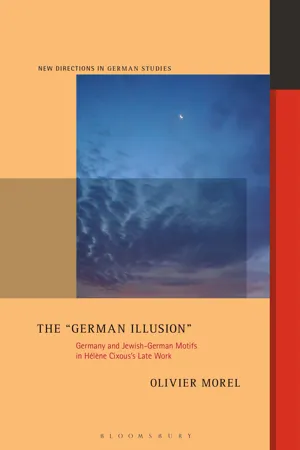
eBook - ePub
The "German Illusion"
Germany and Jewish-German Motifs in Hélène Cixous’s Late Work
- 288 pages
- English
- ePUB (mobile friendly)
- Available on iOS & Android
eBook - ePub
The "German Illusion"
Germany and Jewish-German Motifs in Hélène Cixous’s Late Work
About this book
Information
Table of contents
- Cover
- Title Page
- Dedication Page
- Contents
- List of Figures
- List of Abbreviations
- Introduction: “An Originary Exile”
- I Germany is calling: The landline (1916–2016)
- II “Os, na, brück”: The capital of Memory (1933–1935)
- III An originary move: The move of the origin (1938)
- IV Zugehör: The Jewish-German psyche
- Conclusion: Frauenprotest
- Afterword: A filmed-interrupted interview with Hélène Cixous
- Gratitude
- Bibliography
- Index
- Imprint
Trusted by 375,005 students
Access to over 1.5 million titles for a fair monthly price.
Study more efficiently using our study tools.
Frequently asked questions
Yes, you can cancel anytime from the Subscription tab in your account settings on the Perlego website. Your subscription will stay active until the end of your current billing period. Learn how to cancel your subscription
No, books cannot be downloaded as external files, such as PDFs, for use outside of Perlego. However, you can download books within the Perlego app for offline reading on mobile or tablet. Learn how to download books offline
Perlego offers two plans: Essential and Complete
- Essential is ideal for learners and professionals who enjoy exploring a wide range of subjects. Access the Essential Library with 800,000+ trusted titles and best-sellers across business, personal growth, and the humanities. Includes unlimited reading time and Standard Read Aloud voice.
- Complete: Perfect for advanced learners and researchers needing full, unrestricted access. Unlock 1.5M+ books across hundreds of subjects, including academic and specialized titles. The Complete Plan also includes advanced features like Premium Read Aloud and Research Assistant.
We are an online textbook subscription service, where you can get access to an entire online library for less than the price of a single book per month. With over 1.5 million books across 990+ topics, we’ve got you covered! Learn about our mission
Look out for the read-aloud symbol on your next book to see if you can listen to it. The read-aloud tool reads text aloud for you, highlighting the text as it is being read. You can pause it, speed it up and slow it down. Learn more about Read Aloud
Yes! You can use the Perlego app on both iOS and Android devices to read anytime, anywhere — even offline. Perfect for commutes or when you’re on the go.
Please note we cannot support devices running on iOS 13 and Android 7 or earlier. Learn more about using the app
Please note we cannot support devices running on iOS 13 and Android 7 or earlier. Learn more about using the app
Yes, you can access The "German Illusion" by Olivier Morel, Imke Meyer in PDF and/or ePUB format, as well as other popular books in Literature & Holocaust History. We have over 1.5 million books available in our catalogue for you to explore.