This contributed volume explores equity and social justice within the field of mathematics education. In part one, Helga Jungwirth's introductory chapter provides a strong theoretical overview that is based in actual classroom behaviors and a typology that classifies the various interpretations found within this volume. Also in part one, Laurie Hart discusses developments in equity research in the United States. Part two focuses on results of studies about social justice and their impact on learning in mathematics classrooms in various parts of the world. For example, in a chapter on Peru, social justice does not just encompass gender, but also inequalities in opportunities to learn, such as problems of resources, living and social conditions, communal demands and language needs. And, part three focuses on computers as a resource to mathematics teaching.
The contributors raise several important social justice issues which have previously remained unresearched. Although there are a number of chapters specifically dealing with gender, many of the authors use one of the following strategies: their gender-specific questions are set in a wider socio-cultural context, they challenge what have threatened to become false orthodoxies, or they raise other important issues. These other issues include the meaning of democratic citizenship for mathematics classrooms, the links between parents and children learning mathematics, and the preconceptions of some teachers of underprivileged students in Australia. Other chapters explore different forms of classroom communication, participation, and assessment. The pieces on computers state that there is still not enough research to conclude whether computers in the mathematics classrooms are supportive of, or detrimental to, the learning of all students. The one thing on which every author in this volume does agree is that social justice in mathematics education has still not been attained, but that we must strive toward it to improve educational practices and society in general.
- 342 pages
- English
- PDF
- Available on iOS & Android
eBook - PDF
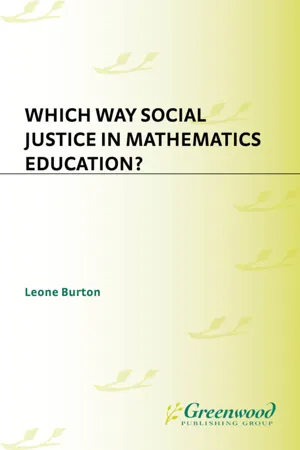
Which Way Social Justice in Mathematics Education?
About this book
Information
Table of contents
- Contents
- Figures and Tables
- Series Editor’s Preface
- Introduction
- I: Setting the Scene
- II: What Does Social Justice Mean in Classrooms?
- III: Computers and Mathematics Learning
- Index
- About the Contributors
Trusted by 375,005 students
Access to over 1.5 million titles for a fair monthly price.
Study more efficiently using our study tools.
Frequently asked questions
Yes, you can cancel anytime from the Subscription tab in your account settings on the Perlego website. Your subscription will stay active until the end of your current billing period. Learn how to cancel your subscription
No, books cannot be downloaded as external files, such as PDFs, for use outside of Perlego. However, you can download books within the Perlego app for offline reading on mobile or tablet. Learn how to download books offline
Perlego offers two plans: Essential and Complete
- Essential is ideal for learners and professionals who enjoy exploring a wide range of subjects. Access the Essential Library with 800,000+ trusted titles and best-sellers across business, personal growth, and the humanities. Includes unlimited reading time and Standard Read Aloud voice.
- Complete: Perfect for advanced learners and researchers needing full, unrestricted access. Unlock 1.5M+ books across hundreds of subjects, including academic and specialized titles. The Complete Plan also includes advanced features like Premium Read Aloud and Research Assistant.
We are an online textbook subscription service, where you can get access to an entire online library for less than the price of a single book per month. With over 1.5 million books across 990+ topics, we’ve got you covered! Learn about our mission
Look out for the read-aloud symbol on your next book to see if you can listen to it. The read-aloud tool reads text aloud for you, highlighting the text as it is being read. You can pause it, speed it up and slow it down. Learn more about Read Aloud
Yes! You can use the Perlego app on both iOS and Android devices to read anytime, anywhere — even offline. Perfect for commutes or when you’re on the go.
Please note we cannot support devices running on iOS 13 and Android 7 or earlier. Learn more about using the app
Please note we cannot support devices running on iOS 13 and Android 7 or earlier. Learn more about using the app
Yes, you can access Which Way Social Justice in Mathematics Education? by Leone Burton in PDF and/or ePUB format, as well as other popular books in Education & Education General. We have over 1.5 million books available in our catalogue for you to explore.