Despite its rise in the global market, recent political progress, and a surging interest worldwide, Korean films are relatively unknown and rarely studied. This new work begins by investigating the history, industry structure, and trends of filmmaking in Korea, going on to examine how Hollywood films have affected both Korean mainstream and nonmainstream film industries in terms of both means of production and narrative. Moreover, the authors analyze the ways in which Korean films of recent years have represented the modernization process in Korea itself, as well as the ideological implications that arise from the cinematic constructions of Korean imagination.
More than a mere chronological account of Korean cinematic history, ^IKorean Film^R attempts to consider the films as a popular cultural form that have a life beyond their theatrical runs: stars, genres, and key movies become part of any culture's identity, and in their narratives and meanings can be located evidence of the ways in which a culture makes sense of itself. Korea has never before been given such an extensive treatment of this central idea, and here for the first time, the nation's culture and cinema are merged into one discussion that both reflects and shapes our understanding of it.
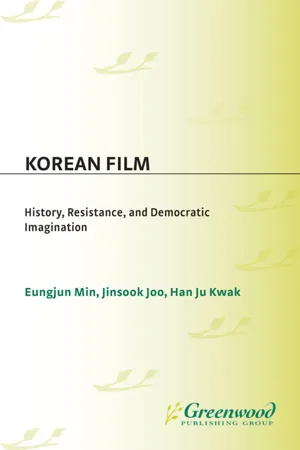
eBook - PDF
Korean Film
History, Resistance, and Democratic Imagination
- 210 pages
- English
- PDF
- Available on iOS & Android
eBook - PDF
About this book
Information
Table of contents
- Contents
- Preface
- 1 Korean Cinema: Philosophical Foundations and Theoretical Frameworks
- 2 Oppression, Liberation, Censorship, and Depression: History and Major Trends of Korean Cinema from the 1910s to the 1970s
- 3 Korean National Cinema in the 1980s: Enlightenment, Political Struggle, Social Realism, and Defeatism
- 4 Auteur Criticism: The Case of Sunwoo Jang's Taste of Heaven
- 5 Discourses of Modernity and Postmodernity in Contemporary Korean Cinema
- 6 Hollywood Imagination, Foreign Films, and Korean Identity: Resistance, Assimilation, and Articulation
- 7 Contemporary Korean Cinema: A Boom or a Renaissance?
- References
- Index
Trusted by 375,005 students
Access to over 1.5 million titles for a fair monthly price.
Study more efficiently using our study tools.
Frequently asked questions
Yes, you can cancel anytime from the Subscription tab in your account settings on the Perlego website. Your subscription will stay active until the end of your current billing period. Learn how to cancel your subscription
No, books cannot be downloaded as external files, such as PDFs, for use outside of Perlego. However, you can download books within the Perlego app for offline reading on mobile or tablet. Learn how to download books offline
Perlego offers two plans: Essential and Complete
- Essential is ideal for learners and professionals who enjoy exploring a wide range of subjects. Access the Essential Library with 800,000+ trusted titles and best-sellers across business, personal growth, and the humanities. Includes unlimited reading time and Standard Read Aloud voice.
- Complete: Perfect for advanced learners and researchers needing full, unrestricted access. Unlock 1.5M+ books across hundreds of subjects, including academic and specialized titles. The Complete Plan also includes advanced features like Premium Read Aloud and Research Assistant.
We are an online textbook subscription service, where you can get access to an entire online library for less than the price of a single book per month. With over 1.5 million books across 990+ topics, we’ve got you covered! Learn about our mission
Look out for the read-aloud symbol on your next book to see if you can listen to it. The read-aloud tool reads text aloud for you, highlighting the text as it is being read. You can pause it, speed it up and slow it down. Learn more about Read Aloud
Yes! You can use the Perlego app on both iOS and Android devices to read anytime, anywhere — even offline. Perfect for commutes or when you’re on the go.
Please note we cannot support devices running on iOS 13 and Android 7 or earlier. Learn more about using the app
Please note we cannot support devices running on iOS 13 and Android 7 or earlier. Learn more about using the app
Yes, you can access Korean Film by Eungjun Min,Jinsook Joo,Han Ju Kwak in PDF and/or ePUB format, as well as other popular books in Médias et arts de la scène & Film et vidéo. We have over 1.5 million books available in our catalogue for you to explore.