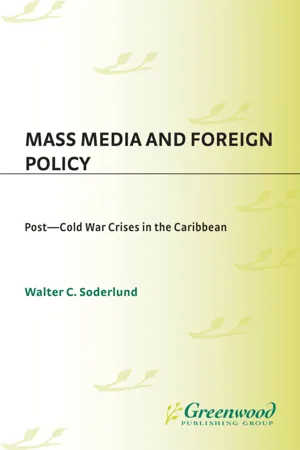
The terrorist attacks on the United States that occurred on September 11 marked the end of an historical era known as the post-Cold War period. During this time, the U.S. government produced no clear media guidelines for dealing with world crises, and media coverage increasingly came to be focused on domestic conflicts rather than international ones. In the absence of a clearly defined threat, no dominant media frame replaced the time-worn Cold War in media reporting. Mass media has been recognized as an important intermediary between the government and the population. In this context, this study examines network coverage of seven post-Cold War crises, ranging from Cuba to Mexico, occurring in the Caribbean Basin between 1990 and 1996 to evaluate the framing of these events by the various media covering them.
In providing context for understanding these crises, this examination reviews U.S. policy in each case and discovers a strong correlation between the level of U.S. involvement in the crisis and the amount of media attention generated. By appearing on the news or not, the president along with key Cabinet members were able to define whether an event constituted a crisis for the United States. In instances where the media received little guidance from Washington officials on the implications for the United States, the media did attempt to provide explanations of events, however, coverage tended to be minimal. Case studies include the recording and coding of language used as positive, negative, and neutral/ambiguous.
- 196 pages
- English
- PDF
- Available on iOS & Android
eBook - PDF
About this book
Information
Table of contents
- Contents
- Acknowledgments
- 1 Introduction
- 2 The Jamaat-al-Muslimeen Coup in Trinidad and Tobago, 1990
- 3 The Military Coup in Haiti, 1991
- 4 The Attempted Restoration of Jean-Bertrand Aristide to the Presidency of Haiti, 1993
- 5 The Restoration of Democracy to Haiti, 1994
- 6 The Zapatista Rebellion in Chiapas, 1994
- 7 The Cuban Balsero Crisis, 1994
- 8 The Cuban Shoot-Down of "Brothers to the Rescue" Aircraft, 1996
- 9 Conclusion
- References
- Author Index
- Subject Index
- About the Editor and Contributors
Trusted by 375,005 students
Access to over 1.5 million titles for a fair monthly price.
Study more efficiently using our study tools.
Frequently asked questions
Yes, you can cancel anytime from the Subscription tab in your account settings on the Perlego website. Your subscription will stay active until the end of your current billing period. Learn how to cancel your subscription
No, books cannot be downloaded as external files, such as PDFs, for use outside of Perlego. However, you can download books within the Perlego app for offline reading on mobile or tablet. Learn how to download books offline
Perlego offers two plans: Essential and Complete
- Essential is ideal for learners and professionals who enjoy exploring a wide range of subjects. Access the Essential Library with 800,000+ trusted titles and best-sellers across business, personal growth, and the humanities. Includes unlimited reading time and Standard Read Aloud voice.
- Complete: Perfect for advanced learners and researchers needing full, unrestricted access. Unlock 1.5M+ books across hundreds of subjects, including academic and specialized titles. The Complete Plan also includes advanced features like Premium Read Aloud and Research Assistant.
We are an online textbook subscription service, where you can get access to an entire online library for less than the price of a single book per month. With over 1.5 million books across 990+ topics, we’ve got you covered! Learn about our mission
Look out for the read-aloud symbol on your next book to see if you can listen to it. The read-aloud tool reads text aloud for you, highlighting the text as it is being read. You can pause it, speed it up and slow it down. Learn more about Read Aloud
Yes! You can use the Perlego app on both iOS and Android devices to read anytime, anywhere — even offline. Perfect for commutes or when you’re on the go.
Please note we cannot support devices running on iOS 13 and Android 7 or earlier. Learn more about using the app
Please note we cannot support devices running on iOS 13 and Android 7 or earlier. Learn more about using the app
Yes, you can access Mass Media and Foreign Policy by Walter C. Soderlund in PDF and/or ePUB format, as well as other popular books in Politics & International Relations & International Relations. We have over 1.5 million books available in our catalogue for you to explore.