From the destruction of Hiroshima to the conclusion of the Nuclear Non-Proliferation Treaty in 1968, the international community struggled to halt the nuclear arms race and to prevent the annihilation of humanity. This study offers an accessible and authoritative account of European policy in this critical dimension of world politics. How much influence did Europeans exert in Washington? Why were European objectives often at variance with U.S. expectations? To what extent did differing national agendas on non-proliferation cause friction within the Western Alliance? Schrafstetter and Twigge examine five initiatives designed to prevent or restrain the nuclear arms race: the international option, the commercial option, the moral option, the multilateral option, and the legal option. Their conclusions show the extent to which non-proliferation policy dominated European politics and the transatlantic relationship.
The international option focuses on early UN plans for international control of atomic energy (1946-48). The commercial option assesses the influence of Eisenhower's Atoms for Peace proposal of 1953 and the impact of civil nuclear power. The moral option charts international attempts to outlaw the testing of nuclear weapons, resulting in the 1963 Partial Test Ban Treaty. The multilateral option discusses the role of collective nuclear forces in addressing West German demands for nuclear equality within NATO. The legal option explores British, French, and West German attitudes to nuclear disarmament and charts the international drive to stop the spread of nuclear weapons culminating in the signing of the Non-Proliferation Treaty in 1968. Throughout the analysis, attention is focused on the role of the European powers and their influence on both Washington and Moscow.
eBook - PDF
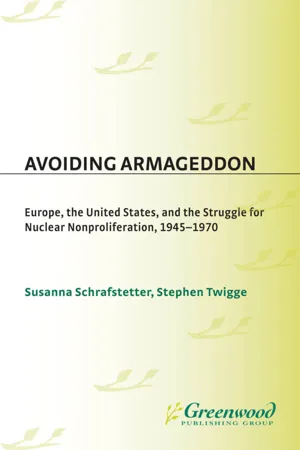
Avoiding Armageddon
Europe, the United States, and the Struggle for Nuclear Non-Proliferation, 1945-1970
- 257 pages
- English
- PDF
- Available on iOS & Android
eBook - PDF
Avoiding Armageddon
Europe, the United States, and the Struggle for Nuclear Non-Proliferation, 1945-1970
About this book
Information
Table of contents
- Contents
- Acknowledgments
- Disarmament Fable
- Abbreviations
- Introduction
- 1 The International Option: UN Control of Nuclear Weapons, 1945–1948
- 2 The Commercial Option: Nuclear Welfare or Nuclear Warfare? Atoms for Peace and the UN Disarmament Commission, 1948–1958
- 3 The Moral Option: Western Europe and the Test Ban Treaty Negotiations, 1954–1963
- 4 The Multilateral Option: Alliance Cohesion and Collective Nuclear Forces, 1957–1965
- 5 The Legal Option: Negotiations for the Nuclear Nonproliferation Treaty, 1964–1969
- Conclusion
- Bibliography
- Index
Trusted by 375,005 students
Access to over 1.5 million titles for a fair monthly price.
Study more efficiently using our study tools.
Frequently asked questions
Yes, you can cancel anytime from the Subscription tab in your account settings on the Perlego website. Your subscription will stay active until the end of your current billing period. Learn how to cancel your subscription
No, books cannot be downloaded as external files, such as PDFs, for use outside of Perlego. However, you can download books within the Perlego app for offline reading on mobile or tablet. Learn how to download books offline
Perlego offers two plans: Essential and Complete
- Essential is ideal for learners and professionals who enjoy exploring a wide range of subjects. Access the Essential Library with 800,000+ trusted titles and best-sellers across business, personal growth, and the humanities. Includes unlimited reading time and Standard Read Aloud voice.
- Complete: Perfect for advanced learners and researchers needing full, unrestricted access. Unlock 1.5M+ books across hundreds of subjects, including academic and specialized titles. The Complete Plan also includes advanced features like Premium Read Aloud and Research Assistant.
We are an online textbook subscription service, where you can get access to an entire online library for less than the price of a single book per month. With over 1.5 million books across 990+ topics, we’ve got you covered! Learn about our mission
Look out for the read-aloud symbol on your next book to see if you can listen to it. The read-aloud tool reads text aloud for you, highlighting the text as it is being read. You can pause it, speed it up and slow it down. Learn more about Read Aloud
Yes! You can use the Perlego app on both iOS and Android devices to read anytime, anywhere — even offline. Perfect for commutes or when you’re on the go.
Please note we cannot support devices running on iOS 13 and Android 7 or earlier. Learn more about using the app
Please note we cannot support devices running on iOS 13 and Android 7 or earlier. Learn more about using the app
Yes, you can access Avoiding Armageddon by Susanna Schrafstetter,Stephen Twigge in PDF and/or ePUB format, as well as other popular books in Politics & International Relations & International Relations. We have over 1.5 million books available in our catalogue for you to explore.