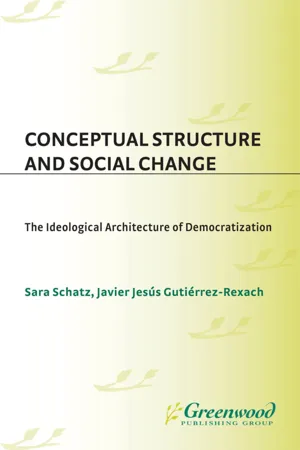
Sociopolitical changes are often associated with ideological shifts at the individual and mass level. The study of how sociopolitical and ideological change interrelate has been the subject of debate for decades. Here, however, the authors develop and defend a new theory that treats ideologies as complex cognitive systems that are internally articulated around prioritized principles and values. Focusing on the transition to democracy in Latin America, the book examines the changes in mass beliefs that accompany democratization in an effort to offer a more sophisticated theory of the relationship between belief, ideology, and action in social change. Ultimately, the authors argue for a cognitive-based model that can account for how social actors come to define democracy in current contexts.
Taking democratization as a case study, ^IConceptual Structure and Social Change^R focuses on third-wave transitions to democracy of the 1990s because they are evidence of very complex ideological changes and alignments. Using comparative survey data as a tool to track ideological shifts, several ideological uniformities are identified, such as the rise of a unified opposition, the paradoxical support of the masses to the authoritarian party in power, and the ideological shifts and strategies used by ruling and opposition elites to gain mass support. Viewing these changes as the mechanics of ideological systems in flux paves the way for a general theory of ideological change.
eBook - PDF
Conceptual Structure and Social Change
The Ideological Architecture of Democratization
- 236 pages
- English
- PDF
- Available on iOS & Android
eBook - PDF
Conceptual Structure and Social Change
The Ideological Architecture of Democratization
About this book
Information
Table of contents
- Contents
- Introduction
- 1. Categorization and Social Agents: The Case of Democratization
- 2. A Cognitive Model of Concepts and Ideology
- 3. Ideological Systems, Dynamics, and Constraints
- 4. Mass Attitudes in the Transition to Electoral Democracy
- 5.Governing Elites, Counterelites, and the Struggle to Shape Mass Opinion
- Conclusions
- Bibliography
- Index
Trusted by 375,005 students
Access to over 1.5 million titles for a fair monthly price.
Study more efficiently using our study tools.
Frequently asked questions
Yes, you can cancel anytime from the Subscription tab in your account settings on the Perlego website. Your subscription will stay active until the end of your current billing period. Learn how to cancel your subscription
No, books cannot be downloaded as external files, such as PDFs, for use outside of Perlego. However, you can download books within the Perlego app for offline reading on mobile or tablet. Learn how to download books offline
Perlego offers two plans: Essential and Complete
- Essential is ideal for learners and professionals who enjoy exploring a wide range of subjects. Access the Essential Library with 800,000+ trusted titles and best-sellers across business, personal growth, and the humanities. Includes unlimited reading time and Standard Read Aloud voice.
- Complete: Perfect for advanced learners and researchers needing full, unrestricted access. Unlock 1.5M+ books across hundreds of subjects, including academic and specialized titles. The Complete Plan also includes advanced features like Premium Read Aloud and Research Assistant.
We are an online textbook subscription service, where you can get access to an entire online library for less than the price of a single book per month. With over 1.5 million books across 990+ topics, we’ve got you covered! Learn about our mission
Look out for the read-aloud symbol on your next book to see if you can listen to it. The read-aloud tool reads text aloud for you, highlighting the text as it is being read. You can pause it, speed it up and slow it down. Learn more about Read Aloud
Yes! You can use the Perlego app on both iOS and Android devices to read anytime, anywhere — even offline. Perfect for commutes or when you’re on the go.
Please note we cannot support devices running on iOS 13 and Android 7 or earlier. Learn more about using the app
Please note we cannot support devices running on iOS 13 and Android 7 or earlier. Learn more about using the app
Yes, you can access Conceptual Structure and Social Change by Sara Schatz,Javier Jesús Gutiérrez-Rexach in PDF and/or ePUB format, as well as other popular books in Social Sciences & Sociology. We have over 1.5 million books available in our catalogue for you to explore.