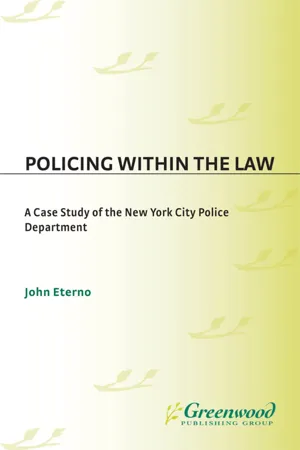
At a time when police abuses and errors make the headlines, it is important to understand just what goes into the decisions that police make when they are confronted with various crime scenarios in the line of duty. Required to respond within the law, many officers are able to respond in a legal manner to crime situations in which court decisions are written clearly and with easily applied guidelines. But what happens when those decisions and laws are written in a way that invites interpretation and varies from situation to situation? Based on a case study of New York City police officers, this important volume analyzes how officers contend with often-ambiguous laws in the face of specific crime scenarios. In addition, the author explores other influences on police decision making, including officer characteristics and attitudes, and makes policy recommendations in an effort to encourage the reinforcement of legal guidelines so that the rights of individuals are appropriately balanced with the duty to control crime.
Based on a survey of nearly 1,300 officers' responses to specially designed hypothetical crime scenarios, this study illustrates how police officers are likely to react with regard to the law in these situations. While officers tend to act legally where the laws are clear, less clearly articulated laws leave the police with a variety of different options for action in ambiguous situations. For instance, in weapons scenarios, the survey showed that officers would often take advantage of ambiguity in the law with regard to how they may respond. In drug scenarios, officers will increase their tendency to do a search if the situation is slightly ambiguous, though they will decrease their search responses when the situation appears to be highly ambiguous. Eterno carefully examines the various responses and the laws that are meant to guide what police may or may not do in given situations, concluding that better laws and bright-line rules will help to check and balance the need to fight crime aggressively while preventing the abuse of authority that may arise in questionable circumstances.
- 168 pages
- English
- PDF
- Available on iOS & Android
eBook - PDF
About this book
Information
Table of contents
- Contents
- Acknowledgments
- Preface
- Introduction
- 1 The Police, the Law, and Behavior
- 2 Studying Legal Issues and Policing
- 3 The Influence of Courts on Police Power
- 4 The Impact on Police of Ambiguity in the Law
- 5 Extralegal Influences
- 6 Learning from the New York City Experience
- Appendix: Questionnaire Wording
- References
- Index
Trusted by 375,005 students
Access to over 1.5 million titles for a fair monthly price.
Study more efficiently using our study tools.
Frequently asked questions
Yes, you can cancel anytime from the Subscription tab in your account settings on the Perlego website. Your subscription will stay active until the end of your current billing period. Learn how to cancel your subscription
No, books cannot be downloaded as external files, such as PDFs, for use outside of Perlego. However, you can download books within the Perlego app for offline reading on mobile or tablet. Learn how to download books offline
Perlego offers two plans: Essential and Complete
- Essential is ideal for learners and professionals who enjoy exploring a wide range of subjects. Access the Essential Library with 800,000+ trusted titles and best-sellers across business, personal growth, and the humanities. Includes unlimited reading time and Standard Read Aloud voice.
- Complete: Perfect for advanced learners and researchers needing full, unrestricted access. Unlock 1.5M+ books across hundreds of subjects, including academic and specialized titles. The Complete Plan also includes advanced features like Premium Read Aloud and Research Assistant.
We are an online textbook subscription service, where you can get access to an entire online library for less than the price of a single book per month. With over 1.5 million books across 990+ topics, we’ve got you covered! Learn about our mission
Look out for the read-aloud symbol on your next book to see if you can listen to it. The read-aloud tool reads text aloud for you, highlighting the text as it is being read. You can pause it, speed it up and slow it down. Learn more about Read Aloud
Yes! You can use the Perlego app on both iOS and Android devices to read anytime, anywhere — even offline. Perfect for commutes or when you’re on the go.
Please note we cannot support devices running on iOS 13 and Android 7 or earlier. Learn more about using the app
Please note we cannot support devices running on iOS 13 and Android 7 or earlier. Learn more about using the app
Yes, you can access Policing within the Law by John Eterno in PDF and/or ePUB format, as well as other popular books in Social Sciences & Law Theory & Practice. We have over 1.5 million books available in our catalogue for you to explore.