Social change advocates won a remarkable series of victories during the 20th century. This study examines both successful and unsuccessful efforts, ranging from the women's suffrage movement of the 1910s to the divisive debate between Gore and Nader supporters during the 2000 election. Halpern details the ingredients essential to shaping progressive campaigns. While left-wing activists sustained grass roots movements and worked with allies in left-center coalitions, trade unions energized by progressive activists gave the efforts institutional weight with crucial assistance from Democratic presidents committed to liberalism.
Frequently facing repression, left-wingers nevertheless managed to pass their values on to their children, who in turn sustained new sets of social movements. Leftists worked alongside other progressives to form left-center coalitions on issues such as Civil Rights and labor law reform. Influenced by liberalism, Roosevelt, Johnson, and Kennedy gave crucial assistance to the social change process. Shying away from liberalism, Carter and Clinton and Vice President Gore failed to provide comparable assistance, disappointing progressive activists and unions and leading to important setbacks. Whether the Democratic Party will once again seek to elect a president with a liberal vision to assist a revitalized labor movement, a newly energized left, and left-center coalitions in the social change process remains to be seen.
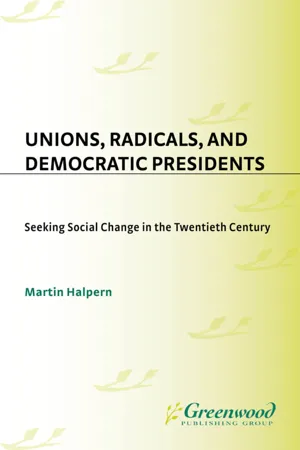
eBook - PDF
Unions, Radicals, and Democratic Presidents
Seeking Social Change in the Twentieth Century
- 302 pages
- English
- PDF
- Available on iOS & Android
eBook - PDF
Unions, Radicals, and Democratic Presidents
Seeking Social Change in the Twentieth Century
About this book
Information
Table of contents
- Contents
- Preface
- Abbreviations
- Introduction
- 1 The Labor Movement: Leader of Social Change or Just Another Interest Group?
- 2 Children of the Left: Sharing Values Across the Generations
- 3 When Henry Met Franklin
- 4 “I’m Fighting for Freedom”: Coleman Young, HUAC, and the Detroit African American Community
- 5 “From the Top Down or from the Bottom Up?” John F. Kennedy, Executive Order 10988, and the Rise of Public Employee Unionism
- 6 Jimmy Carter and the UAW: Failure of an Alliance
- 7 Arkansas and the Defeat of Labor Law Reform in 1978 and 1994
- 8 The Crisis of the Labor Movement in the United States and the Search for a New Vision in Domestic and Foreign Affairs
- 9 Gore or Nader? Progressives, Radicals, Labor, and the 2000 Election
- Conclusion
- Bibliography
- Index
- Photo essay follows page 145
Trusted by 375,005 students
Access to over 1.5 million titles for a fair monthly price.
Study more efficiently using our study tools.
Frequently asked questions
Yes, you can cancel anytime from the Subscription tab in your account settings on the Perlego website. Your subscription will stay active until the end of your current billing period. Learn how to cancel your subscription
No, books cannot be downloaded as external files, such as PDFs, for use outside of Perlego. However, you can download books within the Perlego app for offline reading on mobile or tablet. Learn how to download books offline
Perlego offers two plans: Essential and Complete
- Essential is ideal for learners and professionals who enjoy exploring a wide range of subjects. Access the Essential Library with 800,000+ trusted titles and best-sellers across business, personal growth, and the humanities. Includes unlimited reading time and Standard Read Aloud voice.
- Complete: Perfect for advanced learners and researchers needing full, unrestricted access. Unlock 1.5M+ books across hundreds of subjects, including academic and specialized titles. The Complete Plan also includes advanced features like Premium Read Aloud and Research Assistant.
We are an online textbook subscription service, where you can get access to an entire online library for less than the price of a single book per month. With over 1.5 million books across 990+ topics, we’ve got you covered! Learn about our mission
Look out for the read-aloud symbol on your next book to see if you can listen to it. The read-aloud tool reads text aloud for you, highlighting the text as it is being read. You can pause it, speed it up and slow it down. Learn more about Read Aloud
Yes! You can use the Perlego app on both iOS and Android devices to read anytime, anywhere — even offline. Perfect for commutes or when you’re on the go.
Please note we cannot support devices running on iOS 13 and Android 7 or earlier. Learn more about using the app
Please note we cannot support devices running on iOS 13 and Android 7 or earlier. Learn more about using the app
Yes, you can access Unions, Radicals, and Democratic Presidents by Martin Halpern in PDF and/or ePUB format, as well as other popular books in Politics & International Relations & Political History & Theory. We have over 1.5 million books available in our catalogue for you to explore.