Since 1986, Chinese film circles have turned from their study of Chinese film in terms of aesthetics and have begun to explore film in terms of ideological, political and cultural concerns. In particular, this concern has centered on matters of the marketplace, with much debate between film scholars and filmmakers over the qualities of entertainment. Film In Contemporary China draws together the first English translations of recent articles written by the most respected critics, theorists and filmmakers in China who discuss this significant new direction.
Parts One and Two discuss the ideological problems now facing Chinese film scholars and filmmakers, focusing on the Fifth Generation filmmakers whose works brought Chinese filmmaking to international prominence. Part Three is a critical study of the relationship of traditional culture to contemporary aesthetics. The fourth part follows the theoretical and critical debate over the entertainment film which forms the basis for the Third Movement of Chinese film during the New Era. The fifth part concerns the ongoing debate over the values of film theory in relationship to filmmaking, and the final section summarizes developments in film scholarship following the events in Tiananmen Square in 1989. Film In COntemporary China is designed primarily for film scholars, especially those concerned with China, with international film more generally, and with the relationship between film and society.
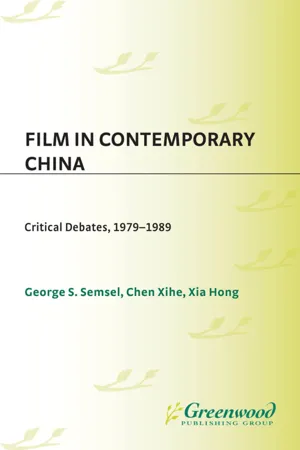
eBook - PDF
Film in Contemporary China
Critical Debates, 1979-1989
- 231 pages
- English
- PDF
- Available on iOS & Android
eBook - PDF
Film in Contemporary China
Critical Debates, 1979-1989
About this book
Information
Table of contents
- Contents
- Foreword
- Preface
- Acknowledgments
- Introduction
- Part I: The Call for New Social Concepts
- Part II: The Issue of Culture
- Part III: Yingxi
- Part IV: The Entertainment Film
- Part V: The Debate on New Chinese Film Theory
- Part VI: The New Era and Afterward
- Conclusion
- Bibliography
- Index
- Contributors, Translators and Editors
Trusted by 375,005 students
Access to over 1.5 million titles for a fair monthly price.
Study more efficiently using our study tools.
Frequently asked questions
Yes, you can cancel anytime from the Subscription tab in your account settings on the Perlego website. Your subscription will stay active until the end of your current billing period. Learn how to cancel your subscription
No, books cannot be downloaded as external files, such as PDFs, for use outside of Perlego. However, you can download books within the Perlego app for offline reading on mobile or tablet. Learn how to download books offline
Perlego offers two plans: Essential and Complete
- Essential is ideal for learners and professionals who enjoy exploring a wide range of subjects. Access the Essential Library with 800,000+ trusted titles and best-sellers across business, personal growth, and the humanities. Includes unlimited reading time and Standard Read Aloud voice.
- Complete: Perfect for advanced learners and researchers needing full, unrestricted access. Unlock 1.5M+ books across hundreds of subjects, including academic and specialized titles. The Complete Plan also includes advanced features like Premium Read Aloud and Research Assistant.
We are an online textbook subscription service, where you can get access to an entire online library for less than the price of a single book per month. With over 1.5 million books across 990+ topics, we’ve got you covered! Learn about our mission
Look out for the read-aloud symbol on your next book to see if you can listen to it. The read-aloud tool reads text aloud for you, highlighting the text as it is being read. You can pause it, speed it up and slow it down. Learn more about Read Aloud
Yes! You can use the Perlego app on both iOS and Android devices to read anytime, anywhere — even offline. Perfect for commutes or when you’re on the go.
Please note we cannot support devices running on iOS 13 and Android 7 or earlier. Learn more about using the app
Please note we cannot support devices running on iOS 13 and Android 7 or earlier. Learn more about using the app
Yes, you can access Film in Contemporary China by George S. Semsel, Xia Hong, Chen Xihe, George S. Semsel,Xia Hong,Chen Xihe in PDF and/or ePUB format, as well as other popular books in Media & Performing Arts & Film & Video. We have over 1.5 million books available in our catalogue for you to explore.