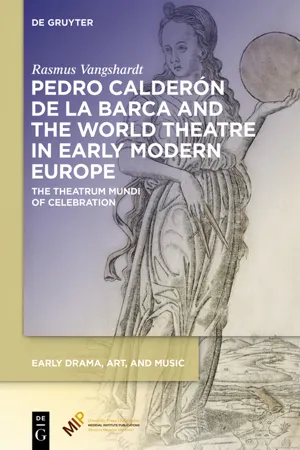
Pedro Calderón de la Barca and the World Theatre in Early Modern Europe
eBook - ePub

Pedro Calderón de la Barca and the World Theatre in Early Modern Europe

The Theatrum Mundi of Celebration

  1. English
  2. ePUB (mobile friendly)
  3. Available on iOS & Android
eBook - ePub

Pedro Calderón de la Barca and the World Theatre in Early Modern Europe

The Theatrum Mundi of Celebration

About this book

Rasmus Vangshardt offers an original interpretation of one of the most famous images of literary history, the theatrum mundi. By applying methods of comparative literature, hispanic studies, and theology, he reconsiders the world theatre's historical peak in early modern Europe in general and the Spanish Golden Age in particular.

The author presents a new close reading of Pedro Calderón's El gran teatro del mundo (c. 1633–36) and outlines the historical and systematic framework for a theatrum mundi of celebration. This concept entails using art to justify human existence in the face of changing conceptions of the cosmos: an early modern aesthetic theodicy and a justification of the world in that liminal space between drama and ritual.

By discussing historiographical theories of early modern Europe, especially those of Hans Blumenberg and Bruno Latour, and through conversations with Shakespearean drama and Spanish Golden Age classics, Vangshardt also argues that the theatrum mundi of celebration questions traditional assumptions of great divides between the Middle Ages and Early Modernity and challenges theories of a European-wide early modern sense of crisis.

Frequently asked questions

Yes, you can cancel anytime from the Subscription tab in your account settings on the Perlego website. Your subscription will stay active until the end of your current billing period. Learn how to cancel your subscription.
At the moment all of our mobile-responsive ePub books are available to download via the app. Most of our PDFs are also available to download and we're working on making the final remaining ones downloadable now. Learn more here.
Perlego offers two plans: Essential and Complete
  • Essential is ideal for learners and professionals who enjoy exploring a wide range of subjects. Access the Essential Library with 800,000+ trusted titles and best-sellers across business, personal growth, and the humanities. Includes unlimited reading time and Standard Read Aloud voice.
  • Complete: Perfect for advanced learners and researchers needing full, unrestricted access. Unlock 1.4M+ books across hundreds of subjects, including academic and specialized titles. The Complete Plan also includes advanced features like Premium Read Aloud and Research Assistant.
Both plans are available with monthly, semester, or annual billing cycles.
We are an online textbook subscription service, where you can get access to an entire online library for less than the price of a single book per month. With over 1 million books across 1000+ topics, we’ve got you covered! Learn more here.
Look out for the read-aloud symbol on your next book to see if you can listen to it. The read-aloud tool reads text aloud for you, highlighting the text as it is being read. You can pause it, speed it up and slow it down. Learn more here.
Yes! You can use the Perlego app on both iOS or Android devices to read anytime, anywhere — even offline. Perfect for commutes or when you’re on the go.
Please note we cannot support devices running on iOS 13 and Android 7 or earlier. Learn more about using the app.
Yes, you can access Pedro Calderón de la Barca and the World Theatre in Early Modern Europe by Rasmus Vangshardt in PDF and/or ePUB format, as well as other popular books in Literature & Early Modern History. We have over one million books available in our catalogue for you to explore.

Table of contents

  1. Title Page
  2. Copyright
  3. Contents
  4. Acknowledgements
  5. Texts and Translations
  6. Introduction: Plaything or Purpose
  7. Chapter 1 A Poetics of Festivity
  8. Chapter 2 A Circular Colosseum: The Loa
  9. Chapter 3 El gran teatro del mundo
  10. Chapter 4 Aesthetic Theodicy
  11. Conclusion: “The Modern Age Begins with an Act of Theodicy”
  12. Index of Names