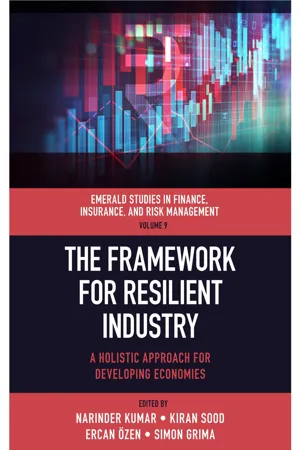
The Framework for Resilient Industry
eBook - ePub

The Framework for Resilient Industry

A Holistic Approach for Developing Economies

  1. 420 pages
  2. English
  3. ePUB (mobile friendly)
  4. Available on iOS & Android
eBook - ePub

The Framework for Resilient Industry

A Holistic Approach for Developing Economies

About this book

Countries such as India, Pakistan, Bangladesh, and Sri Lanka have economies that are categorised as capital deficit, whereas economies with abundant capital – such as those in Western Europe and North America – have lost little value in comparison during the global pandemic and other economic periods of this downturn. It is therefore a question of resilience that separates these developing economies.

The Framework for Resilient Industry examines the historical background of the Indian industry, its current status, and future opportunities and challenges. The chapters frame the historical context of the Indian industry and delves into region-specific issues such as micro, small, and medium enterprises (MSMEs), economic policy, risk management and sustainable industries.

The findings are valuable to policymakers, industrialists, and governments, both state and central, through efficient analysis. Academics, researchers, and students will also benefit from this discourse on economic resiliency.

Emerald Studies in Finance, Insurance, and Risk Management provides a platform for authors to explore, analyse and discuss current and new financial models and theories, and engage with innovative research on an international scale. Subjects of interest may include banking, accounting, auditing, compliance, sustainability, behaviour, management, and business economics.

Frequently asked questions

Yes, you can cancel anytime from the Subscription tab in your account settings on the Perlego website. Your subscription will stay active until the end of your current billing period. Learn how to cancel your subscription.
No, books cannot be downloaded as external files, such as PDFs, for use outside of Perlego. However, you can download books within the Perlego app for offline reading on mobile or tablet. Learn more here.
Perlego offers two plans: Essential and Complete
  • Essential is ideal for learners and professionals who enjoy exploring a wide range of subjects. Access the Essential Library with 800,000+ trusted titles and best-sellers across business, personal growth, and the humanities. Includes unlimited reading time and Standard Read Aloud voice.
  • Complete: Perfect for advanced learners and researchers needing full, unrestricted access. Unlock 1.4M+ books across hundreds of subjects, including academic and specialized titles. The Complete Plan also includes advanced features like Premium Read Aloud and Research Assistant.
Both plans are available with monthly, semester, or annual billing cycles.
We are an online textbook subscription service, where you can get access to an entire online library for less than the price of a single book per month. With over 1 million books across 1000+ topics, we’ve got you covered! Learn more here.
Look out for the read-aloud symbol on your next book to see if you can listen to it. The read-aloud tool reads text aloud for you, highlighting the text as it is being read. You can pause it, speed it up and slow it down. Learn more here.
Yes! You can use the Perlego app on both iOS or Android devices to read anytime, anywhere — even offline. Perfect for commutes or when you’re on the go.
Please note we cannot support devices running on iOS 13 and Android 7 or earlier. Learn more about using the app.
Yes, you can access The Framework for Resilient Industry by Narinder Kumar,Kiran Sood,Ercan Özen,Simon Grima,Ercan Ozen in PDF and/or ePUB format, as well as other popular books in Economics & Business Development. We have over one million books available in our catalogue for you to explore.

Table of contents

  1. Cover
  2. Title
  3. Chapter 1. Clustering National Innovation Capability: Positioning of Ukraine
  4. Chapter 2. Unleashing the Challenges of Chatbots and ChatGPT in the Banking Industry: Evidence from an Emerging Economy
  5. Chapter 3. Diversity Management as an Approach Enhancing the Formation of Intellectual Capital (Including Human Capital) in Organisations in Order to Build Their Competitive Advantage
  6. Chapter 4. Contemporary Issues and Challenges Facing the Hospitality Industry
  7. Chapter 5. Empowering the Unbanked: The Intersection of Financial Inclusion and CBDC
  8. Chapter 6. Dream of Five Trillion-dollar GDP with Reference to Five Key Industries
  9. Chapter 7. Exploring the Impact of Risk Factors on Profitability in Commercial Banking in India: A PLS-SEM Analysis Approach
  10. Chapter 8. Examining the Interconnectedness of Corporate Governance (CG), Non-performing Loans (NPLs), and Bank Size (BS) on the Financial Performance (FP) of Banks in Kosovo
  11. Chapter 9. The Ethical Considerations of DNA Profiling for Resilience in a Forensic Setting in India: A Comparative Study with International Guidelines
  12. Chapter 10. Recovery or Resilience During Off-job Time and its Association with Police Burnout
  13. Chapter 11. Impact of Cultural Marketing on Buying Behaviour of the Consumers
  14. Chapter 12. The Future Consequences of Artificial Intelligence in Context to Employability in Resilient Industry
  15. Chapter 13. Mental Accounting and Sunk Cost Biases: A Social Experiment with a Food and Beverage Experience
  16. Chapter 14. Study of Problems of Credit Availability for MSME Finance in India
  17. Chapter 15. Reinsurance: A Risk Management Tool for the Insurance Sector
  18. Chapter 16. Effectiveness of the Udaan Scheme in Addressing Career Development Challenges for Educated Youth in Jammu and Kashmir
  19. Chapter 17. A Holistic Framework for Resilient Rural Energy for Developing Economies
  20. Chapter 18. Issues and Challenges of Large-Scale Industries: A Study Contributing to Industry Resilience
  21. Chapter 19. The Implications for Economic and Industrial Strategies Due to Characteristics of Albanian Language Phonemes in the Balkans
  22. Chapter 20. Women Entrepreneurship – A Way Towards Sustainability
  23. Chapter 21. The Role of the Manufacturing Sector in Driving India’s Long-Term Growth
  24. Index