Develops and expands current research into the concept of economic circularity, whereby societies reduce waste by recycling, reusing, and repairing raw materials and finished products.
Economic circularity is the ability of a society to reduce waste by recycling, reusing, and repairing raw materials and finished products. This concept has gained momentum in academia, in part due to contemporary environmental concerns. Although the blurry conceptual boundaries of this term are open to a wide array of interpretations, the scholarly community generally perceives circular economy as a convenient umbrella definition that encompasses a vast array of regenerative and preservative processes.
Despite the recent surge of interest, economic circularity has not been fully addressed as a macrophenomenon by historical and archaeological studies. The limitations of data and the relatively new formulation of targeted research questions mean that several processes and agents involved in ancient circular economies are still invisible to the eye of modern scholarship. Examples include forms of curation, maintenance, and repair, which must have had an influence on the economic systems of premodern societies but are rarely accounted for. Moreover, the people behind these processes, such as collectors and scavengers, are rarely investigated and poorly understood. Even better-studied mechanisms, like reuse and recycling, are not explored to their full potential within the broader picture of ancient urban economies.
This volume stems from a conference held at Moesgaard Museum supported by the Carlsberg Foundation and the Centre for Urban Networks Evolutions (UrbNet) at Aarhus University. To enhance our understanding of circular economic processes, the contributions in this volume aim to expand the framework of the discussion by exploring circular economy over the longue durée and by integrating an interdisciplinary perspective. Furthermore, the volume wants to give prominence to classes of material, processes, agents, and methodologies generally overlooked or ignored in modern scholarship.
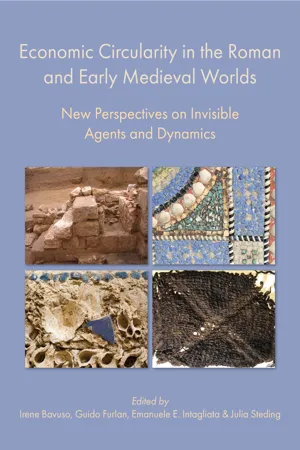
eBook - ePub
Economic Circularity in the Roman and Early Medieval Worlds
New Perspectives on Invisible Agents and Dynamics
- 304 pages
- English
- ePUB (mobile friendly)
- Available on iOS & Android
eBook - ePub
Economic Circularity in the Roman and Early Medieval Worlds
New Perspectives on Invisible Agents and Dynamics
About this book
Information
Subtopic
British HistoryIndex
Social SciencesTable of contents
- Cover page
- Title page
- Copyright
- Contents
- List of contributors
- Introduction: approaching invisible circular economies through archaeological and historical sources
- 1. The ragpicker’s dream: notes on the continuous role of junk dealers in past urban economies from the Roman period onwards
- 2. Laws, letters and graves: the organisation of scavenging in the early medieval period
- 3. Exploring reuse in a prestige environment: the palace city of Samarra
- 4. Through glass: recycling and reuse practices brought out by archaeometry and history
- 5. Beauty, utility and value: examples of glass reuse from the Roman period to the early Middle Ages
- 6. Identifying episodes of recycling in the archaeological record
- 7. Textile reuse in Roman naval contexts
- 8. Functional, spiritual or aesthetic? Investigating reuse in high-status 7th-century necklace pendants from early medieval England
- 9. Stars aligned: tracking the use and reuse of Viking Age metal-casting models for star-shaped brooches through 3D visualisation
- 10. Seeking the invisible with legacy data: notes on the use of archives for the study of ancient circular economies
- 11. Evolutionary design processes in thermal architecture of the Roman Empire
- 12. Reused columns in an ancient circular economy
- 13. Mind the gap: researching reuse practices in Palmyra. The example of reused inscriptions
Trusted by 375,005 students
Access to over 1.5 million titles for a fair monthly price.
Study more efficiently using our study tools.
Frequently asked questions
Yes, you can cancel anytime from the Subscription tab in your account settings on the Perlego website. Your subscription will stay active until the end of your current billing period. Learn how to cancel your subscription
No, books cannot be downloaded as external files, such as PDFs, for use outside of Perlego. However, you can download books within the Perlego app for offline reading on mobile or tablet. Learn how to download books offline
We are an online textbook subscription service, where you can get access to an entire online library for less than the price of a single book per month. With over 1.5 million books across 990+ topics, we’ve got you covered! Learn about our mission
Look out for the read-aloud symbol on your next book to see if you can listen to it. The read-aloud tool reads text aloud for you, highlighting the text as it is being read. You can pause it, speed it up and slow it down. Learn more about Read Aloud
Yes! You can use the Perlego app on both iOS and Android devices to read anytime, anywhere — even offline. Perfect for commutes or when you’re on the go.
Please note we cannot support devices running on iOS 13 and Android 7 or earlier. Learn more about using the app
Please note we cannot support devices running on iOS 13 and Android 7 or earlier. Learn more about using the app
Yes, you can access Economic Circularity in the Roman and Early Medieval Worlds by Jonathan Wood, Irene Bavuso,Guido Furlan,Emanuele E. Intagliata,Julia Steding in PDF and/or ePUB format, as well as other popular books in Social Sciences & British History. We have over 1.5 million books available in our catalogue for you to explore.