Was heißt »Lehre« in den lutherischen Kirchen? Woran orientiert sie sich? Wie entsteht Verbindlichkeit? Welche Instanzen und Prozesse der Lehrbeurteilung haben sich entwickelt? Wer kann Lehrfragen wie entscheiden? Die vorliegende Studie stellt zunächst gegenwärtige Strukturen der Lehrverständigung im deutschen Luthertum dar und entfaltet exemplarisch historische Fallstudien lutherischer Lehrverantwortung (Bultmann-Kontroverse; Frauenordination; Apartheid; Rechtfertigungslehre). Ein zweiter Teil skizziert die Entstehung lutherischer Lehr- und Bekenntnisnormen im 16. Jh. und verfolgt im historischen Längsschnitt die Entwicklung von Konzepten kirchlicher Lehrverbindlichkeit bis in die Gegenwart. Abschließende Thesen erschließen die Relevanz lutherischer Lehrverantwortung für die ökumenischen Dialoge.[Doctrinal Responsibility – a Lutheran Perspective]What does »doctrine« mean in Lutheran churches? What is it based upon? How is it made binding? What instances and processes of doctrinal judgment have developed? Who can decide doctrinal questions and how? This study first presents current structures of doctrinal understanding in German Lutheranism and unfolds exemplary historical case studies of Lutheran doctrinal responsibility (Bultmann controversy; ordination of women; apartheid; doctrine of justification). A second part outlines the emergence of Lutheran doctrinal and confessional norms in the 16th century and traces the development of concepts of ecclesial doctrinal commitment in a historical cross-section up to the present. Concluding theses explore the relevance of Lutheran doctrinal responsibility for ecumenical dialogues.
eBook - PDF
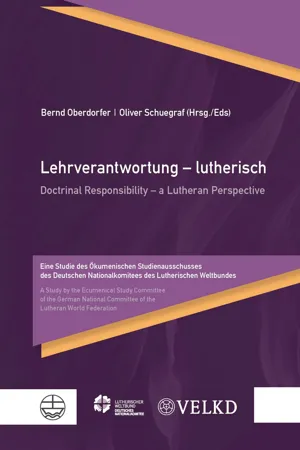
Lehrverantwortung – lutherisch / Doctrinal Responsibility – a Lutheran Perspective
Eine Studie des Ökumenischen Studienausschusses des Deutschen Nationalkomitees des Lutherischen Weltbundes / A Study by the Ecumenical Study Committee of the German National Committee of the Lutheran World Federation
- 234 pages
- English
- PDF
- Available on iOS & Android
eBook - PDF
Lehrverantwortung – lutherisch / Doctrinal Responsibility – a Lutheran Perspective
Eine Studie des Ökumenischen Studienausschusses des Deutschen Nationalkomitees des Lutherischen Weltbundes / A Study by the Ecumenical Study Committee of the German National Committee of the Lutheran World Federation
About this book
Information
Table of contents
- Frontmatter
- PART A: Case studies: Structures and areas of doctrinal formation and authority
- TEIL A: Fallstudien: Strukturen und Orte von Lehrbildung und Lehrautorität
- PART B: Lutheran doctrine in the context of theological history and systematics
- TEIL B: Lutherische Lehre in ihrer theologiegeschichtlichen und systematischen Dimension
- PART C: Lutheran doctrinal responsibility against the ecumenical horizon – Nine theses
- TEIL C: Lutherische Lehrverantwortung im ökumenischen Horizont – Neun Thesen
- Backmatter
Trusted by 375,005 students
Access to over 1.5 million titles for a fair monthly price.
Study more efficiently using our study tools.
Frequently asked questions
Yes, you can cancel anytime from the Subscription tab in your account settings on the Perlego website. Your subscription will stay active until the end of your current billing period. Learn how to cancel your subscription
No, books cannot be downloaded as external files, such as PDFs, for use outside of Perlego. However, you can download books within the Perlego app for offline reading on mobile or tablet. Learn how to download books offline
Perlego offers two plans: Essential and Complete
- Essential is ideal for learners and professionals who enjoy exploring a wide range of subjects. Access the Essential Library with 800,000+ trusted titles and best-sellers across business, personal growth, and the humanities. Includes unlimited reading time and Standard Read Aloud voice.
- Complete: Perfect for advanced learners and researchers needing full, unrestricted access. Unlock 1.5M+ books across hundreds of subjects, including academic and specialized titles. The Complete Plan also includes advanced features like Premium Read Aloud and Research Assistant.
We are an online textbook subscription service, where you can get access to an entire online library for less than the price of a single book per month. With over 1.5 million books across 990+ topics, we’ve got you covered! Learn about our mission
Look out for the read-aloud symbol on your next book to see if you can listen to it. The read-aloud tool reads text aloud for you, highlighting the text as it is being read. You can pause it, speed it up and slow it down. Learn more about Read Aloud
Yes! You can use the Perlego app on both iOS and Android devices to read anytime, anywhere — even offline. Perfect for commutes or when you’re on the go.
Please note we cannot support devices running on iOS 13 and Android 7 or earlier. Learn more about using the app
Please note we cannot support devices running on iOS 13 and Android 7 or earlier. Learn more about using the app
Yes, you can access Lehrverantwortung – lutherisch / Doctrinal Responsibility – a Lutheran Perspective by Bernd Oberdorfer, Oliver Schuegraf in PDF and/or ePUB format, as well as other popular books in Theology & Religion & Religious Ecumenism & Interfaith. We have over 1.5 million books available in our catalogue for you to explore.