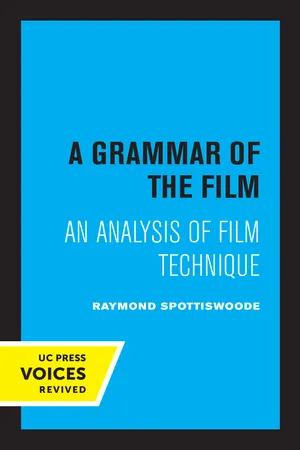
Originally published in England in 1935, this book is an attempt to isolate the fundamental principles of film art and to teach in concrete detail how these principles are well or badly applied in the production of films. This essential task, shirked or derided by most film critics today, Spottiswoode executed with skill and perception. He traced the history of the new medium, analyzed the aesthetic factors governing proper use of camera angle and movement, cuts, dissolves, sound, and other elements of film construction. He also examined the proces by which films produce their special effects upon audiences. A Grammar of the Film contains some predictions that history has belied, and as the author remarks in his preface, parts of it abound in distinctions without differences. Yet its analytic perspective remains sound and useful, because the passage of years has brought little significant experimentation and little change in the basic aesthetic problems of the medium. This title is part of UC Press's Voices Revived program, which commemorates University of California Press's mission to seek out and cultivate the brightest minds and give them voice, reach, and impact. Drawing on a backlist dating to 1893, Voices Revived makes high-quality, peer-reviewed scholarship accessible once again using print-on-demand technology. This title was originally published in 1950.
Many titles in the Voices Revived program are also newly available as ebooks, offered at a discounted price to support wider access to scholarly work.
- 334 pages
- English
- ePUB (mobile friendly)
- Available on iOS & Android
eBook - ePub
About this book
Information
Table of contents
- Cover
- Title
- Copyright
- Contents 1
- Chapter I Introductory
- 1. Confusions of film controversy
- 2. Aims of the present study
- 3. The purpose of illustrations and examples
- 4. The balance between assumption and verification
- 5. The value of distinctions
- 6. The domains of scientific and philosophical definition.
- Chapter II Definitions
- A. THE VISUAL FILM
- B. THE SOUND FACTOR
- C. THE TOTAL FILM
- Chapter III An Outline of Film History
- 1. Absence of film classics related to historical and economic causes
- 2. The earliest developments.
- 3. Germany (1919-1925)
- 4. Russia (1920-1930)
- 5. Germany (Pabst)
- 6. America (Chaplin)
- 7. France (Clair)
- 8. England (Asquith)
- 9. Hollywood and the advent of sound
- 10. America
- 11. Germany (1929—1934—Pabst)
- 12. France (1929-1934)
- 13. Russia (1950-1934)
- 14. The advance-guard (1920-1933)
- 15. The G.P.O. Film Unit
- 16. The interaction of personal, economic and political factors in film production
- Chapter IV Categories of the Film: a. Distinctions
- 1. The method of investigation involves a considerable recourse to abstraction
- 2. The relation of cinema to stage
- 3. The film based on their similarity
- 4. The film based on their difference
- 5. The abandonment of drama
- 6. The film based on the cinema’s independent properties, but borrowing where necessary from other arts, which is the subject of Chapters V and VI.
- Chapter V Technique of the Film: 1. Analysis
- 1. Visual and aural material of the cinema
- 2. Analysis of structure and synthesis of effect
- 3. Separation of the cut from its substitutes, and consideration of the latter: fade, dissolve, wipe
- 4. Credit and continuity titles
- 5. Introduction of the divergencesfrom realistic reproduction to be found within the shot’. differentiating factors
- 6. The non-optical factors: the coen- aesthesis.
- 7. The static factors: camera angle and position
- 8. The close-up
- 9. Delimitation of the screen
- 10. The expanding screen
- 11. Colour and lighting
- 12. Applied to the syntheticfilm
- 13. Flatness
- 14. The stereoscopic film
- 15. The dynamic factors: camera movement
- 16. The mechanism of attention
- 17. Tilting
- 18. The filmic factors: camera speed
- 19. Fast motion
- 20. Slow motion
- 21. The temporal close up
- 22. Reversal
- 23. Optical distortion
- 24. Focus
- 25. Superimposition
- 26. Reduplication
- 27. Sound: classification
- 28. Realism—unrealism
- 29. Counterpoint
- 30. Realistic counterpoint
- 31. Unrealism
- 32. Parallelism—contrast
- 33. Examples
- 34. The internal monologue
- 35. The imitative use of music
- 36. The evocative use of music
- 37. The dynamic use of music
- 38. The relation of the scenario to montage: the denial of montage
- Chapter VI Technique of the Film: 2. Synthesis
- 1. Summary and scope of this and the previous chapter
- 2. Previous definitions of montage: Mr. Dalton, Mr. Braun
- 3. The cut
- 4. Antithesis, implication and obliquity
- 5. The dialectical process in life and personal experience
- 6. Rhythmical montage
- 7. Summary
- 8. Contrastive rhythmical montage
- 9. The main function of montage
- 10. Primary montage
- 11. Simultaneous montage
- 12. Secondary montage and implicational montage
- 13. Ideological montage
- 14. An example illustrating every type of montage
- 15. Factors adverse to montage
- 16. Realism of sounds solidity, delayed transference
- 17. Camera movement
- 18. Abstraction
- 19. Speech
- 20. Titles
- 21. The visual simile
- 22. Relations
- 23. “Like”
- 24. Modes and components of the appreciation of films
- 25. The relation of technique to subject matter
- 26. Teleological theories: Marx
- 27. Deontological theories: Croce
- 28. Contrasts and comparisons.
- Chapter VII Categories of the Film: b. Descriptions
- 1. Origin of the documentary movement in the class struggle
- 2. The film symphony and the documentary movement
- 3. Definition of the documentary: Mr. Grierson
- 4. Mr. Braun
- 5. Mr. Blakeston
- 6. A new definition suggested and tested by several criteria
- 7. Characteristics of the documentary
- 8. The danger of categories in making films: their necessity in criticizing them
- 9. The imagist film
- 10. The synthetic film: description by degrees of naturalismo
- 11. The silhouette film
- 12. The model film
- 13. The drawn film
- 14. The limitations of the synthetic film in respect of unrealism
- 15. Conclusions
- Chapter VIII Conclusion
- 1. The denunciation of the cinema: reply to Mr. Ervine
- 2. The extravagant praise of the cinema: reply to Eisenstein and Pudovkin
- 3. The function of criticism in the advancement of the cinema.
- 4. The scope of training studios.
- CHART
- Index
Trusted by 375,005 students
Access to over 1.5 million titles for a fair monthly price.
Study more efficiently using our study tools.
Frequently asked questions
Yes, you can cancel anytime from the Subscription tab in your account settings on the Perlego website. Your subscription will stay active until the end of your current billing period. Learn how to cancel your subscription
No, books cannot be downloaded as external files, such as PDFs, for use outside of Perlego. However, you can download books within the Perlego app for offline reading on mobile or tablet. Learn how to download books offline
We are an online textbook subscription service, where you can get access to an entire online library for less than the price of a single book per month. With over 1.5 million books across 990+ topics, we’ve got you covered! Learn about our mission
Look out for the read-aloud symbol on your next book to see if you can listen to it. The read-aloud tool reads text aloud for you, highlighting the text as it is being read. You can pause it, speed it up and slow it down. Learn more about Read Aloud
Yes! You can use the Perlego app on both iOS and Android devices to read anytime, anywhere — even offline. Perfect for commutes or when you’re on the go.
Please note we cannot support devices running on iOS 13 and Android 7 or earlier. Learn more about using the app
Please note we cannot support devices running on iOS 13 and Android 7 or earlier. Learn more about using the app
Yes, you can access A Grammar of the Film by Raymond Spottiswoode in PDF and/or ePUB format, as well as other popular books in Media & Performing Arts & Film & Video. We have over 1.5 million books available in our catalogue for you to explore.