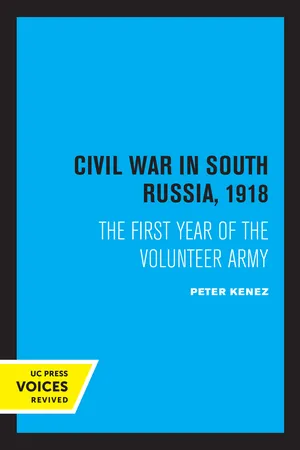
The Soviet Union was created as uch by the Civil War as by the revolutions of 1917; indeed, the revolutions and hte struggle which followed them are inseparable. Perhaps communism in Russia would have evolved differently had the bitter necessities of the Civil War not force the regime to develop features which had nothing to do with the Marxist ideology. Aside from the obvious historical significance of the Civil War, it is also a subject with great intrinsic interest: modern European history provides no better example of anarchy and its effects on social institutions and on human beings. The approach which is followed her is tha of a case study. Extrapolating from one part of Russia to the entire country is perhaps the best way to become aware of the many different issues that were at stake and of the difficulty in reducing the problems of the Civil War to simple formulae. South Russia is of special interest because it is a microcosm in which one can see most of the ills of Russia and because the events there were of great importance: it was in South Russia that foreign intervention assumed greatest magnitude; there the Whites put in their field their most substantial and persistent armies; and perhaps nowhere else di the anti-Bolshevik movement suffer more from dissension and from competing claims of national minorities. Kenez contends that the events of 1918 contained the seeds of ultimate disaster for the Whites.While the soldiers of the Volunteer Army showed exceptional valor and the generals proved themselves able military leaders, they failed politically. Because Denikin and his fellow leaders wrongly believed that politics could simply be avoided, they did not develop a positive program. They also failed to bring unity to eh anti-Bolshevik camp. It would have required a common ideology and exceptional wisdom to rise above the petty issues which separated the competing anti-Bolshevik groups, and the leader of the Whites processed neither. This title is part of UC Press's Voices Revived program, which commemorates University of California Press's mission to seek out and cultivate the brightest minds and give them voice, reach, and impact. Drawing on a backlist dating to 1893, Voices Revived makes high-quality, peer-reviewed scholarship accessible once again using print-on-demand technology. This title was originally published in 1971.
Many titles in the Voices Revived program are also newly available as ebooks, offered at a discounted price to support wider access to scholarly work.
- 366 pages
- English
- ePUB (mobile friendly)
- Available on iOS & Android
eBook - ePub
About this book
Information
Publisher
University of California PressYear
1971Print ISBN
9780520358782
Edition
1eBook ISBN
9780520312265
Table of contents
- Cover
- Title
- Copyright
- Acknowledgments
- Contents
- Introduction
- CHAPTER 1 Dramatis Personae: Jhe Officers and the Cossacks
- CHAPTER 2 The beginnings of the White Movement
- CHAPTER 3 The Birth of the Volunteer Army
- CHAPTER 4 The Ice March
- CHAPTER 5 Taking Stock
- CHAPTER 6 Campaigns
- CHAPTER 7 The Politics of Jhe Volunteer Army
- CHAPTER 8 "A Russia Great, United, and Indivisible”
- CHAPTER 9 The ‘Volunteer Army and the End of the World War
- CHAPTER 10 Conclusion
- NOTES
- Bibliography
- Index
Trusted by 375,005 students
Access to over 1.5 million titles for a fair monthly price.
Study more efficiently using our study tools.
Frequently asked questions
Yes, you can cancel anytime from the Subscription tab in your account settings on the Perlego website. Your subscription will stay active until the end of your current billing period. Learn how to cancel your subscription
No, books cannot be downloaded as external files, such as PDFs, for use outside of Perlego. However, you can download books within the Perlego app for offline reading on mobile or tablet. Learn how to download books offline
Perlego offers two plans: Essential and Complete
- Essential is ideal for learners and professionals who enjoy exploring a wide range of subjects. Access the Essential Library with 800,000+ trusted titles and best-sellers across business, personal growth, and the humanities. Includes unlimited reading time and Standard Read Aloud voice.
- Complete: Perfect for advanced learners and researchers needing full, unrestricted access. Unlock 1.5M+ books across hundreds of subjects, including academic and specialized titles. The Complete Plan also includes advanced features like Premium Read Aloud and Research Assistant.
We are an online textbook subscription service, where you can get access to an entire online library for less than the price of a single book per month. With over 1.5 million books across 990+ topics, we’ve got you covered! Learn about our mission
Look out for the read-aloud symbol on your next book to see if you can listen to it. The read-aloud tool reads text aloud for you, highlighting the text as it is being read. You can pause it, speed it up and slow it down. Learn more about Read Aloud
Yes! You can use the Perlego app on both iOS and Android devices to read anytime, anywhere — even offline. Perfect for commutes or when you’re on the go.
Please note we cannot support devices running on iOS 13 and Android 7 or earlier. Learn more about using the app
Please note we cannot support devices running on iOS 13 and Android 7 or earlier. Learn more about using the app
Yes, you can access Civil War in South Russia, 1918 by Peter Kenez in PDF and/or ePUB format, as well as other popular books in History & Russian History. We have over 1.5 million books available in our catalogue for you to explore.