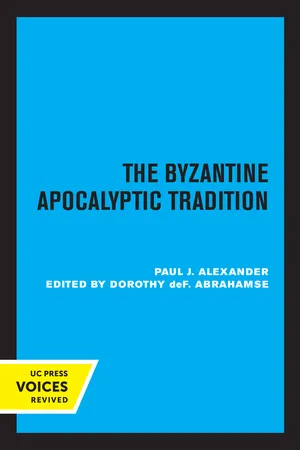
Throughout Christian history, apocalyptic visions of the approaching end of time have provided a persistent and enigmatic theme for history and prophecy. Apocalyptic literature played a particularly important role in the medieval world, where legends of the Antichrist, Gog and Magog, and the Last Roman Emperor were widely circulated. Although scholars have long recognized that a body of Byzantine prophetic literature served as the source for these ideas, the Byzantine textual tradition, its sources, and the way in which it was transmitted to the West have neve been thoroughly understood. For more than fifteen years prior to his death in 1977, Paul J. Alexander devoted his energies to the clarification of the Byzantine apocalyptic tradition. These studies, left uncompleted at his death, trace the development of a textual tradition that passed from Syriac through Greek to Slavonic and Latin literature. Using a combination of philological and historical detection, the author establishes the time, place, and circumstances of composition for each of the major surviving texts, identifying lost works known only through descriptions. In showing how Byzantine prophecy served as a bridge between ancient eschatological works and the medieval West, Alexander demonstrates that apocalyptic literature represents a creative source for the expression of political and religious thought in the medieval world. This title is part of UC Press's Voices Revived program, which commemorates University of California Press's mission to seek out and cultivate the brightest minds and give them voice, reach, and impact. Drawing on a backlist dating to 1893, Voices Revived makes high-quality, peer-reviewed scholarship accessible once again using print-on-demand technology. This title was originally published in 1985.
Many titles in the Voices Revived program are also newly available as ebooks, offered at a discounted price to support wider access to scholarly work.
- 248 pages
- English
- ePUB (mobile friendly)
- Available on iOS & Android
eBook - ePub
The Byzantine Apocalyptic Tradition
About this book
Information
Table of contents
- Cover
- Title
- Copyright
- Contents 1
- List of Abbreviations
- Introduction
- PART ONE Tex ts
- I. The Syriac Apocalypse of Pseudo -Methodius
- II. The First Greek Redaction of Pseudo-Methodius
- III. The Visions of Daniel: Extant Texts
- IV. Visions of Daniel Summarized by Liudprand of Cremona
- In conclusion, it may be said that Pseudo-Hippolytus composed his Vision of Daniel, as summarized by Liudprand and cited by Adso, in the Greek language. The Greek original was shown to and discussed with Liudprand of Cremona at Constantinople in the summer of 968 by members of the legitimist opposition to Nicephorus Phocas interested in a rapprochement with the emperor Otto I and hostile to the peace treaty recently concluded by the Byzantine emperor with the Fimid khalif, and a Latin translation of Pseudo-Hippolytus’ work reachedAdso, who cited it sometime prior to 954 in his letter De ortu et tempore Antichristi.255Pseudo-Hippolytus was a Sicilian and wrote either in Sicily or as a refugee from Sicily in southern Italy, and his tract contains some historical material relating to the Arab conquest of Sicily. Its main significance lies, however, in the fact that, unlike all earlier and most later Visions of Daniel, Pseudo-Hippolytus’ prophecies assign the primary role in defeating the Arabs and the surrender of imperial power at Jerusalem to a Western rather than to a Byzantine emperor—although the two acts were not necessarily performed by the same Western ruler. Pseudo-Hippolytus’ tract therefore has a polemical purpose and is in this respect comparable to the Syriac original of Pseudo-Methodius’ Revelation. He probably allowed for some degree of cooperation on the part of the Byzantine emperor, as is suggested by the retention of the LionWhelp oracle. His prophecy of a Western emperor conquering the Arabs and thus freeing Sicily was inspired by the achievements and plans of the Carolingian emperor Louis II. As date for the composition of the tract the months from February to August 871 would be most appropriate, for Louis II was then at the height of his power and ambition, but a date between 866 and 871, when Louis was conducting successful warfare against the Arabs in southern Italy, or even a date between October 871 and 875, when he was again fighting the Arabs, is not impossible. V. Three Conglomerate Texts
- 2. THE CENTO OF THE TRUE EMPEROR (“ANONYMOUS PARAPHRASE OF THE ORACLES OF LEO"”)
- PART TWO Themes
- I. The Last Roman Emperor
- II. Gog and Magog
- III. The Legend of the Antichrist
- Index
Trusted by 375,005 students
Access to over 1.5 million titles for a fair monthly price.
Study more efficiently using our study tools.
Frequently asked questions
Yes, you can cancel anytime from the Subscription tab in your account settings on the Perlego website. Your subscription will stay active until the end of your current billing period. Learn how to cancel your subscription
No, books cannot be downloaded as external files, such as PDFs, for use outside of Perlego. However, you can download books within the Perlego app for offline reading on mobile or tablet. Learn how to download books offline
Perlego offers two plans: Essential and Complete
- Essential is ideal for learners and professionals who enjoy exploring a wide range of subjects. Access the Essential Library with 800,000+ trusted titles and best-sellers across business, personal growth, and the humanities. Includes unlimited reading time and Standard Read Aloud voice.
- Complete: Perfect for advanced learners and researchers needing full, unrestricted access. Unlock 1.5M+ books across hundreds of subjects, including academic and specialized titles. The Complete Plan also includes advanced features like Premium Read Aloud and Research Assistant.
We are an online textbook subscription service, where you can get access to an entire online library for less than the price of a single book per month. With over 1.5 million books across 990+ topics, we’ve got you covered! Learn about our mission
Look out for the read-aloud symbol on your next book to see if you can listen to it. The read-aloud tool reads text aloud for you, highlighting the text as it is being read. You can pause it, speed it up and slow it down. Learn more about Read Aloud
Yes! You can use the Perlego app on both iOS and Android devices to read anytime, anywhere — even offline. Perfect for commutes or when you’re on the go.
Please note we cannot support devices running on iOS 13 and Android 7 or earlier. Learn more about using the app
Please note we cannot support devices running on iOS 13 and Android 7 or earlier. Learn more about using the app
Yes, you can access The Byzantine Apocalyptic Tradition by Paul J. Alexander in PDF and/or ePUB format, as well as other popular books in Theology & Religion & World History. We have over 1.5 million books available in our catalogue for you to explore.