In a new textbook designed for students new to statistics and social data, Stephen Gorard focuses on non-inferential statistics as a basis to ensure students have basic statistical literacy.
Understanding why we have to learn statistics and seeing the links between the numbers and real life is a crucial starting point. Using engaging, friendly, approachable language this book will demystify numbers from the outset, explaining exactly how they can be used as tools to understand the relationships between variables.
This text assumes no previous mathematical or statistical knowledge, taking the reader through each basic technique with step-by-step advice, worked examples, and exercises. Using non-inferential techniques, students learn the foundations that underpin all statistical analysis and will learn from the ground up how to produce theoretically and empirically informed statistical results.
- 296 pages
- English
- ePUB (mobile friendly)
- Available on iOS & Android
eBook - ePub
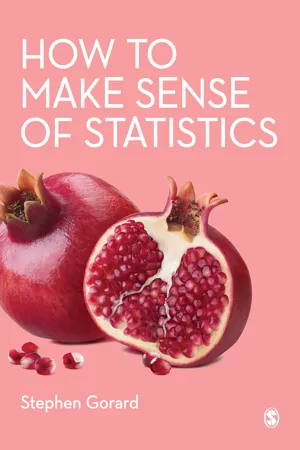
How to Make Sense of Statistics
About this book
Information
Publisher
SAGE Publications LtdYear
2021Print ISBN
9781526413826
9781526413819
Edition
1eBook ISBN
9781529755862
Table of contents
- Cover
- Half Title
- Publisher Note
- Title Page
- Copyright Page
- Acknowledgements
- Contents
- Detailed Contents
- Illustration List
- Table List
- About the Author
- Preface
- Online resources
- Part I Introduction
- 1 Why we use numbers in research
- 2 What is a number? Issues of measurement
- Part II Basic analyses
- 3 Working with one variable
- 4 Working with tables of categorical variables
- 5 Examining differences between real numbers
- 6 Significance tests: How to conduct them and what they do not mean
- 7 Significance tests: Why we should not report them
- Part III Advanced issues for analysis
- 8 The role of judgement in analysis
- 9 Research designs
- 10 Sampling and populations
- 11 What is randomness?
- 12 Handling missing data: The importance of what we do not know
- 13 Handling missing data: More complex issues
- 14 Errors in measurements
- Part IV Modelling with data
- 15 Correlating two real numbers
- 16 Predicting measurements using simple linear regression
- 17 Predicting measurements using multiple linear regression
- 18 Assumptions and limitations in regression
- 19 Predicting outcomes using logistic regression
- 20 Data reduction techniques
- Part V Conclusion
- 21 Presenting data for your audience
- Glossary
- References
- Index
Trusted by 375,005 students
Access to over 1.5 million titles for a fair monthly price.
Study more efficiently using our study tools.
Frequently asked questions
Yes, you can cancel anytime from the Subscription tab in your account settings on the Perlego website. Your subscription will stay active until the end of your current billing period. Learn how to cancel your subscription
No, books cannot be downloaded as external files, such as PDFs, for use outside of Perlego. However, you can download books within the Perlego app for offline reading on mobile or tablet. Learn how to download books offline
Perlego offers two plans: Essential and Complete
- Essential is ideal for learners and professionals who enjoy exploring a wide range of subjects. Access the Essential Library with 800,000+ trusted titles and best-sellers across business, personal growth, and the humanities. Includes unlimited reading time and Standard Read Aloud voice.
- Complete: Perfect for advanced learners and researchers needing full, unrestricted access. Unlock 1.5M+ books across hundreds of subjects, including academic and specialized titles. The Complete Plan also includes advanced features like Premium Read Aloud and Research Assistant.
We are an online textbook subscription service, where you can get access to an entire online library for less than the price of a single book per month. With over 1.5 million books across 990+ topics, we’ve got you covered! Learn about our mission
Look out for the read-aloud symbol on your next book to see if you can listen to it. The read-aloud tool reads text aloud for you, highlighting the text as it is being read. You can pause it, speed it up and slow it down. Learn more about Read Aloud
Yes! You can use the Perlego app on both iOS and Android devices to read anytime, anywhere — even offline. Perfect for commutes or when you’re on the go.
Please note we cannot support devices running on iOS 13 and Android 7 or earlier. Learn more about using the app
Please note we cannot support devices running on iOS 13 and Android 7 or earlier. Learn more about using the app
Yes, you can access How to Make Sense of Statistics by Stephen Gorard,Author in PDF and/or ePUB format, as well as other popular books in Social Sciences & Probability & Statistics. We have over 1.5 million books available in our catalogue for you to explore.