The author's starting point is the interweaving of forgiveness and resentment in the works of Jewish writers after the Holocaust, most especially Hannah Arendt and Jean Améry, to make sense of the catastrophe and to point to a way forward for both victims and perpetrators. The insights of these two writers and of several Jewish novelists and poets, including Bruno Schulz, Paul Celan, and Aharon Appelfeld, are used to develop accounts of forgiveness and resentment in other cases of mass atrocity around the world. The author offers a critical rereading of primary sources that aim to separate resentment from nonviolent resistance, and forgiveness from reconciliation. Forgiveness and resentment are not, as they might first appear, mutually exclusive. Together with Arendt, Améry, and Walter Benjamin, it is argued that it is through the interaction between them that victims of mass atrocity become agents of personal and cultural change. Together, forgiveness and resentment interrupt the present, reframe the past, and shape the future. They can reduce the chasm that separates memory and trust by fashioning new connections between identity and alterity, which can open paths to truly ethical coexistence for victims and perpetrators, and their descendants.
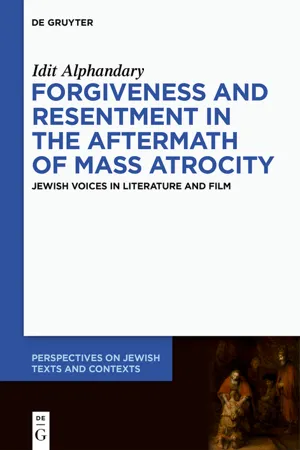
eBook - ePub
Forgiveness and Resentment in the Aftermath of Mass Atrocity
Jewish Voices in Literature and Film
- English
- ePUB (mobile friendly)
- Available on iOS & Android
eBook - ePub
Forgiveness and Resentment in the Aftermath of Mass Atrocity
Jewish Voices in Literature and Film
About this book
Information
Table of contents
- Title Page
- Copyright
- Contents
- Introduction Theorizing forgiveness and resentment in the presence of radical evil
- Chapter 1 Forgiveness, resentment and reconciliation – on W. G. Sebald
- Interchapter 1 Aesthetic falsehood and emotion – on Bruno Schulz’s The Sanatorium Under the Hourglass and Wojciech Has’s The Hourglass Sanatorium
- Chapter 2 Love and worldliness – on Hannah Arendt
- Interchapter 2 The necessary fragility of paradox – on Christian Petzold’s Phoenix
- Chapter 3 The sincerity of forgiveness – on Heinrich Böll and Jean Améry
- Interchapter 3 Negative possessions – on Wladislaw Pasikowski’s Aftermath (Poklosie)
- Chapter 4 From emotion to national renewal – on J.M. Coetzee
- Interchapter 4 Memory and nonviolence – on Raoul Peck’s I Am Not Your Negro
- Coda Forgiveness, justice, and historical responsibility
- Index
Trusted by 375,005 students
Access to over 1.5 million titles for a fair monthly price.
Study more efficiently using our study tools.
Frequently asked questions
Yes, you can cancel anytime from the Subscription tab in your account settings on the Perlego website. Your subscription will stay active until the end of your current billing period. Learn how to cancel your subscription
No, books cannot be downloaded as external files, such as PDFs, for use outside of Perlego. However, you can download books within the Perlego app for offline reading on mobile or tablet. Learn how to download books offline
Perlego offers two plans: Essential and Complete
- Essential is ideal for learners and professionals who enjoy exploring a wide range of subjects. Access the Essential Library with 800,000+ trusted titles and best-sellers across business, personal growth, and the humanities. Includes unlimited reading time and Standard Read Aloud voice.
- Complete: Perfect for advanced learners and researchers needing full, unrestricted access. Unlock 1.5M+ books across hundreds of subjects, including academic and specialized titles. The Complete Plan also includes advanced features like Premium Read Aloud and Research Assistant.
We are an online textbook subscription service, where you can get access to an entire online library for less than the price of a single book per month. With over 1.5 million books across 990+ topics, we’ve got you covered! Learn about our mission
Look out for the read-aloud symbol on your next book to see if you can listen to it. The read-aloud tool reads text aloud for you, highlighting the text as it is being read. You can pause it, speed it up and slow it down. Learn more about Read Aloud
Yes! You can use the Perlego app on both iOS and Android devices to read anytime, anywhere — even offline. Perfect for commutes or when you’re on the go.
Please note we cannot support devices running on iOS 13 and Android 7 or earlier. Learn more about using the app
Please note we cannot support devices running on iOS 13 and Android 7 or earlier. Learn more about using the app
Yes, you can access Forgiveness and Resentment in the Aftermath of Mass Atrocity by Idit Alphandary in PDF and/or ePUB format, as well as other popular books in Literature & Film & Video. We have over 1.5 million books available in our catalogue for you to explore.