Prologue. Aesthetics is the emotional perception of beauty introduced by Baumgarten (1714-1762) in Germany during the mid-18th century.
Aesthetics, with the goal of systematically interpreting aesthetic values, traces its philosophical origins back to ancient Greece.
To understand the perception of beauty in both the East and the West, we investigate the philosophical foundations of aesthetic judgment found in Greek aesthetics, Eastern Confucianism, Buddhism, Zen aesthetics, medieval aesthetics, Renaissance aesthetics, modern aesthetics, and contemporary aesthetics.
\"Gödel, Escher, Bach (1979)\" by American cognitive scientist Douglas Richard Hofstadter (1945- ) serves as the inspiration for the creation of \"Toegye, Gyeomjae, Chusa (2023).\"
Hofstadter investigates the neural mechanisms of cognition in the lives and works of Gödel, Escher, and Bach.
Austrian mathematician Kurt Gödel (1906-1978) poses profound philosophical inquiries about formal logic, mathematical logic, and the foundations of mathematical systems.
Dutch printmaker Moritz Escher (1898-1972) ventures beyond the boundaries of reality and imagination by blending mathematical principles and aesthetics within the realm of surrealism.
German composer Johann Sebastian Bach (1685-1750) translates the counter-reformation and the upheaval that affected Northern Europe after the Thirty Years\' War (1618-1648) into dynamic, unconventional, and sensuous Baroque auditory art.
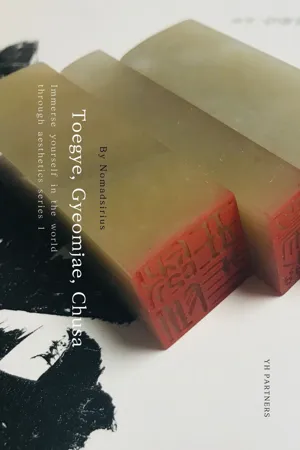
\"Toegye, Gyeomjae, Chusa (2023)\" is an encounter of philosophy and aesthetics recorded from an artist\'s monograph perspective.
Toegye Yi Hwang (1501-1570), a Confucian scholar of the Joseon Dynasty, firmly establishes the dualism of principle and vital forces based on the theory of principle superiority, which dualizes li-ki into enduring li and ephemeral qi.
Gyeomjae Jeong Seon (1676-1759), a painter from the later period of the Joseon Dynasty, reinterprets the monism of principle and vital forces, viewing it as a single attribute or order of qi\'s action, and opens up a new horizon in the world of landscape painting.
Chusa Kim Jeong-hui (1786-1856), a scholar from the later period of the Joseon Dynasty, creates an ideal new calligraphy style based on his research in Qing Dynasty classical studies, which harmonizes the monism of principle and vital forces of Yulgok and the dualism of principle and vital forces of Toegye, free from the constraints of theoretical Confucianism.
Attempting individual reflections on the lives, scholarship, philosophy, and aesthetics of Toegye, Gyeomjae, and Chusa, it approaches the fusion of clarity and universality.
Establishing a cosmology based on the dualism of principle and vital Forces, I seek to find the essence of aesthetics in the movement of qi, which is the change in the universe.
- English
- ePUB (mobile friendly)
- Available on iOS & Android
eBook - ePub
Toegye, Gyeomjae, Chusa.
About this book
Information
Topic
PhilosophieSubtopic
Esthétique en philosophieTable of contents
- Prologue.
- Publicationright
- Aesthetics is.
- 1. The Life of Toegye.
- 2. The Life of Gyeomjae.
- 3. The Life of Chusa Kim Jeong-hee.
- Greek Aesthetics.
- 4. Toegye's Scholarship.
- 5. The Scholarship of Gyeomjae.
- 6. The Scholarship of Chusa.
- Eastern Confucianism, Buddhism, Zen aesthetics
- 7. Toegye's Theory of the Four Sprouts and the Seven Emotions.
- 8. Gyeomjae's Realistic Landscape Painting.
- 9. Chusa's Calligraphy.
- Medieval Aesthetics.
- 10. Toegye's Theory of the Ten Diagrams on Sage Learning.
- 11. Gyeomjae's Diamond Mountains.
- 12. Chusa's Painting.
- Renaissance Aesthetics.
- 13. Toegye's Record of Self-Reflections.
- 14. Gyeomjae's Hanyang.
- 15. Chusa's Framed Picture and Vertical Couplet.
- Modern Aesthetics.
- 16. A Cosmology Based on The Dualism of Principle and Vital Forces.
- Contemporary Aesthetics.
- References.
Trusted by 375,005 students
Access to over 1.5 million titles for a fair monthly price.
Study more efficiently using our study tools.
Frequently asked questions
Yes, you can cancel anytime from the Subscription tab in your account settings on the Perlego website. Your subscription will stay active until the end of your current billing period. Learn how to cancel your subscription
No, books cannot be downloaded as external files, such as PDFs, for use outside of Perlego. However, you can download books within the Perlego app for offline reading on mobile or tablet. Learn how to download books offline
Perlego offers two plans: Essential and Complete
- Essential is ideal for learners and professionals who enjoy exploring a wide range of subjects. Access the Essential Library with 800,000+ trusted titles and best-sellers across business, personal growth, and the humanities. Includes unlimited reading time and Standard Read Aloud voice.
- Complete: Perfect for advanced learners and researchers needing full, unrestricted access. Unlock 1.5M+ books across hundreds of subjects, including academic and specialized titles. The Complete Plan also includes advanced features like Premium Read Aloud and Research Assistant.
We are an online textbook subscription service, where you can get access to an entire online library for less than the price of a single book per month. With over 1.5 million books across 990+ topics, we’ve got you covered! Learn about our mission
Look out for the read-aloud symbol on your next book to see if you can listen to it. The read-aloud tool reads text aloud for you, highlighting the text as it is being read. You can pause it, speed it up and slow it down. Learn more about Read Aloud
Yes! You can use the Perlego app on both iOS and Android devices to read anytime, anywhere — even offline. Perfect for commutes or when you’re on the go.
Please note we cannot support devices running on iOS 13 and Android 7 or earlier. Learn more about using the app
Please note we cannot support devices running on iOS 13 and Android 7 or earlier. Learn more about using the app
Yes, you can access Toegye, Gyeomjae, Chusa. by Nomadsirius in PDF and/or ePUB format, as well as other popular books in Philosophie & Esthétique en philosophie. We have over 1.5 million books available in our catalogue for you to explore.