This book investigates the speech of non-ethnic Fulfulde speakers in Maroua, Northern Cameroon, focussed on the Christian community, where the language is adopted as evangelistic instrument beside French. Three key reasons motivate our investigation. First: Context –Fulfulde is embedded in a multilingual contact situation with Indo-European languages (French, English) and many other local languages belonging to Afro-Asiatic, Nilo-Saharan and Niger-Congo phyla. Second: Fulfulde as lingua franca in the region. This status is unique compared to the situation in other countries such as Senegal, Chad or Sudan where it is mainly an intraethnic medium of communication. Third: In contrast to the common perception of Fulfulde as the language of a Muslim community –here we are targeting the Christian Fulfulde speakers who share the language as well as the Bible (translated into Fulfulde) as common goods for interethnic communication in their religious activities.
eBook - PDF
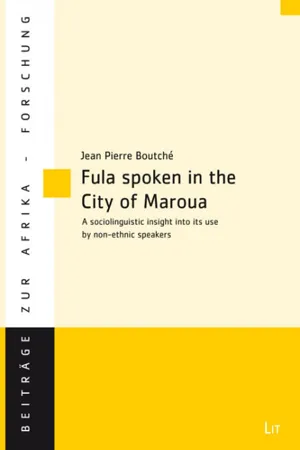
FULA SPOKEN IN THE CITY OF MAROUA (NORTHERN CAMEROON)
a sociolinguistic insight into its use by non-ethnic speakers
- 344 pages
- English
- PDF
- Available on iOS & Android
eBook - PDF
FULA SPOKEN IN THE CITY OF MAROUA (NORTHERN CAMEROON)
a sociolinguistic insight into its use by non-ethnic speakers
About this book
Information
Subtopic
LinguisticsIndex
Social SciencesTable of contents
- Cover
- I Contents
- II Acknowledgments
- III Figures
- IV Tables
- V Symbols and Abbreviations
- 1 Introduction
- 2 Historical and Sociolinguistic Background
- 3 Data and Methods
- 4 Conceptual Framework
- 5 Linguistic Features of Conservative Fula
- 6 Analysis of the Nominal System
- 7 Verbal Morphology and Syntax
- 8 Sociolinguistic Considerations
- 9 Conclusion
- 10 References
- 11 Appendices
Trusted by 375,005 students
Access to over 1.5 million titles for a fair monthly price.
Study more efficiently using our study tools.
Frequently asked questions
Yes, you can cancel anytime from the Subscription tab in your account settings on the Perlego website. Your subscription will stay active until the end of your current billing period. Learn how to cancel your subscription
No, books cannot be downloaded as external files, such as PDFs, for use outside of Perlego. However, you can download books within the Perlego app for offline reading on mobile or tablet. Learn how to download books offline
Perlego offers two plans: Essential and Complete
- Essential is ideal for learners and professionals who enjoy exploring a wide range of subjects. Access the Essential Library with 800,000+ trusted titles and best-sellers across business, personal growth, and the humanities. Includes unlimited reading time and Standard Read Aloud voice.
- Complete: Perfect for advanced learners and researchers needing full, unrestricted access. Unlock 1.5M+ books across hundreds of subjects, including academic and specialized titles. The Complete Plan also includes advanced features like Premium Read Aloud and Research Assistant.
We are an online textbook subscription service, where you can get access to an entire online library for less than the price of a single book per month. With over 1.5 million books across 990+ topics, we’ve got you covered! Learn about our mission
Look out for the read-aloud symbol on your next book to see if you can listen to it. The read-aloud tool reads text aloud for you, highlighting the text as it is being read. You can pause it, speed it up and slow it down. Learn more about Read Aloud
Yes! You can use the Perlego app on both iOS and Android devices to read anytime, anywhere — even offline. Perfect for commutes or when you’re on the go.
Please note we cannot support devices running on iOS 13 and Android 7 or earlier. Learn more about using the app
Please note we cannot support devices running on iOS 13 and Android 7 or earlier. Learn more about using the app
Yes, you can access FULA SPOKEN IN THE CITY OF MAROUA (NORTHERN CAMEROON) by Jean Pierre Boutché in PDF and/or ePUB format, as well as other popular books in Social Sciences & Linguistics. We have over 1.5 million books available in our catalogue for you to explore.