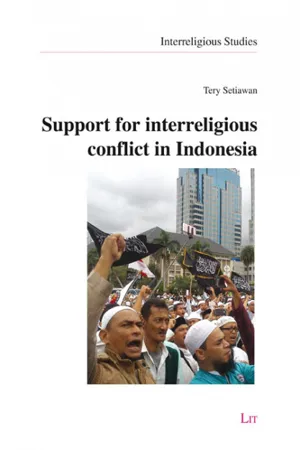
The relatively peaceful interreligious relations in Indonesia seem to be shattered ever since Suharto's fall in 1998. Religious cleavages grew and quickly became sources of conflict. Exclusive religious truth claims have led people to support interreligious violence. Yet, benevolent religious values continue to encourage people for mutual solidarity and to shy away from violence. Religious minority groups are often perceived as a threat by the religious majority. Although living side by side allows different groups to develop positive interreligious contacts, this may differ for religious majority and minorities. This study scrutinizes the role of religion in interreligious conflicts in Indonesia.
- 314 pages
- English
- PDF
- Available on iOS & Android
eBook - PDF
Support for interreligious conflict in Indonesia
About this book
Information
Publisher
LIT VerlageBook ISBN
9783643962881
Year
2020Table of contents
- Cover
- Contents
- Chapter 1. Support for interreligious conflict in Indonesia
- Chapter 2. Overview of theories
- Chapter 3. Methodology
- Chapter 4. The relation between religiosity and support for interreligious conflict in six conflict regions in Indonesia
- Chapter 5. Mediators of the relationship between religious affiliation and support for interreligious conflict
- Chapter 6. Support for interreligious conflict as collective action
- Chapter 7. Multilevel explanation of support for interreligious conflict
- Chapter 8. Summary and conclusion
- List of Abbreviations
- List of Tables
- List of Figures
- Appendices
- References
- Samenvatting (Dutch Summary)
Trusted by 375,005 students
Access to over 1.5 million titles for a fair monthly price.
Study more efficiently using our study tools.