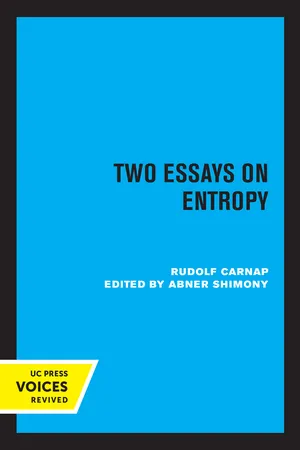
Two Essays on Entropy by Rudolf Carnap (edited with an introduction by Abner Shimony) brings a major twentieth-century philosopher of science to the front lines of thermodynamics, probability, and inductive logic. Written during Carnap's 1952–54 fellowship at the Institute for Advanced Study, these essays pursue an "abstract concept of entropy" usable for scientific inference while testing, with unusual clarity, the coherence of the physicists' own statistical notion. Carnap's guiding claim is bold and bracing: entropy belongs with temperature and pressure as an objective physical magnitude, not a merely logical or informational index. From this stance he scrutinizes the classical formulations of Boltzmann and Gibbs, rejects fashionable identifications of entropy with "negative information," and articulates a principle of physical magnitudes to require that finer descriptions of a system accord with coarser, thermodynamic attributions. Shimony's editorial introduction situates Carnap's project within postwar debates on probability (frequency, propensity, and epistemic readings), ergodicity, and coarse- versus fine-grained ensembles, clarifying both the reach and the limits of Carnap's proposal. Presented together for the first time as Carnap had originally envisioned, the essays are lightly but thoughtfully edited: overlapping prefatory sections are removed, a concise "Brief Formulation" is foregrounded, and cross-references rationalized to reveal the architecture of the program as a whole. Readers see Carnap extend Boltzmann's entropy beyond cell partitions, probe the logical pitfalls of description-dependent definitions, and sketch a continuous, geometry-based alternative aimed at eliminating arbitrary coarse-graining. The result is a rare conversation across philosophy and physics—historically grounded, methodologically incisive, and still sharply relevant to contemporary work in statistical mechanics, information theory, and the foundations of data-driven inference. A vital resource for scholars in philosophy of science, physics, and the history of analytic philosophy, Two Essays on Entropy restores a rigorous, physicalist account of order, randomness, and explanation to center stage. This title is part of UC Press's Voices Revived program, which commemorates University of California Press's mission to seek out and cultivate the brightest minds and give them voice, reach, and impact. Drawing on a backlist dating to 1893, Voices Revived makes high-quality, peer-reviewed scholarship accessible once again using print-on-demand technology. This title was originally published in 1977.
Many titles in the Voices Revived program are also newly available as ebooks, offered at a discounted price to support wider access to scholarly work.
- 146 pages
- English
- ePUB (mobile friendly)
- Available on iOS & Android
eBook - ePub
Two Essays on Entropy
About this book
Information
Table of contents
- Cover
- Contents
- Introduction
- 1. The Aim of the Investigations
- Essay I: A Critical Examination of the Statistical Concept of Entropy in Classical Physics
- Essay II: An Abstract Concept of Entropy and Its use in Inductive Logic
Trusted by 375,005 students
Access to over 1.5 million titles for a fair monthly price.
Study more efficiently using our study tools.
Frequently asked questions
Yes, you can cancel anytime from the Subscription tab in your account settings on the Perlego website. Your subscription will stay active until the end of your current billing period. Learn how to cancel your subscription
No, books cannot be downloaded as external files, such as PDFs, for use outside of Perlego. However, you can download books within the Perlego app for offline reading on mobile or tablet. Learn how to download books offline
Perlego offers two plans: Essential and Complete
- Essential is ideal for learners and professionals who enjoy exploring a wide range of subjects. Access the Essential Library with 800,000+ trusted titles and best-sellers across business, personal growth, and the humanities. Includes unlimited reading time and Standard Read Aloud voice.
- Complete: Perfect for advanced learners and researchers needing full, unrestricted access. Unlock 1.5M+ books across hundreds of subjects, including academic and specialized titles. The Complete Plan also includes advanced features like Premium Read Aloud and Research Assistant.
We are an online textbook subscription service, where you can get access to an entire online library for less than the price of a single book per month. With over 1.5 million books across 990+ topics, we’ve got you covered! Learn about our mission
Look out for the read-aloud symbol on your next book to see if you can listen to it. The read-aloud tool reads text aloud for you, highlighting the text as it is being read. You can pause it, speed it up and slow it down. Learn more about Read Aloud
Yes! You can use the Perlego app on both iOS and Android devices to read anytime, anywhere — even offline. Perfect for commutes or when you’re on the go.
Please note we cannot support devices running on iOS 13 and Android 7 or earlier. Learn more about using the app
Please note we cannot support devices running on iOS 13 and Android 7 or earlier. Learn more about using the app
Yes, you can access Two Essays on Entropy by Rudolf Carnap in PDF and/or ePUB format, as well as other popular books in Philosophy & Philosophical Essays. We have over 1.5 million books available in our catalogue for you to explore.