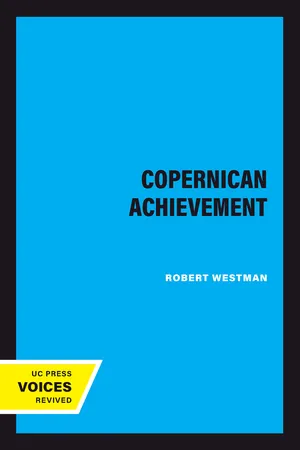
The Copernican Achievement captures the pivotal discussions and insights from the 1973 symposium at UCLA, commemorating the profound influence of Nicolaus Copernicus on science and thought. This volume presents papers from leading scholars in history and philosophy of science, including lively and incisive debates among renowned figures such as Imre Lakatos and Stephen Toulmin. Organized by John G. Burke, with contributions from scholars like Edward Rosen and Julian Schwinger, the conference delved into the transformative impact of Copernican theory and its enduring legacy. Supported by UCLA's Department of History and College of Letters and Sciences, The Copernican Achievement showcases an engaging blend of historical perspective and philosophical rigor. With diverse and often controversial perspectives, this collection explores how Copernicus's revolutionary ideas reshaped scientific paradigms and human understanding of the cosmos. Ideal for historians, philosophers, and students of science, this volume offers fresh insights into the Copernican revolution and its continued relevance to scientific inquiry.
This title was originally published in 1975.
Many titles in the Voices Revived program are also newly available as ebooks, offered at a discounted price to support wider access to scholarly work.
- English
- ePUB (mobile friendly)
- Available on iOS & Android
eBook - ePub
The Copernican Achievement
About this book
Information
Table of contents
- Cover
- Title
- Copyright
- Contents 1
- Preface
- List of Contributors
- I INTRODUCTION: THE COPERNICAN ACHIEVEMENT
- II RHETICUS, RAVETZ, AND THE “NECESSITY” OF COPERNICUS’ INNOVATION
- COMMENTARY
- III ON COPERNICUS’ THEORY OF PRECESSION
- COMMENTARY: REMARKS ON COPERNICUS’ OBSERVATIONS
- IV ERASMUS REINHOLD’S DETERMINATION OF THE DISTANCE OF THE SUN FROM THE EARTH
- COMMENTARY: THE ROLE OF ERROR IN ANCIENT METHODS FOR DETERMINING THE SOLAR DISTANCE
- V THE ARTS FACULTY AT THE UNIVERSITY OF CRACOW AT THE END OF THE FIFTEENTH CENTURY
- VI THE DIALECTICAL PREPARATION FOR SCIENTIFIC REVOLUTIONS
- COMMENTARY: DIALECTICAL ASPECTS OF THE COPERNICAN REVOLUTION: CONCEPTUAL ELUCIDATIONS AND HISTORIOGRAPHICAL PROBLEMS
- VII ANDREAS OSIANDER’S CONTRIBUTION TO THE COPERNICAN ACHIEVEMENT
- VIII THE SOLID PLANETARY SPHERES IN POST-COPERNICAN NATURAL PHILOSOPHY
- IX THREE RESPONSES TO THE COPERNICAN THEORY: JOHANNES PRAETORIUS, TYCHO BRAHE, AND MICHAEL MAESTLIN452
- COMMENTARY: FICTIONALISM AND REALISM IN 16TH CENTURY ASTRONOMY
- WHY DID COPERNICUS’ RESEARCH PROGRAM SUPERSEDE PTOLEMY’S?
- COMMENTARY
- Index
Trusted by 375,005 students
Access to over 1.5 million titles for a fair monthly price.
Study more efficiently using our study tools.
Frequently asked questions
Yes, you can cancel anytime from the Subscription tab in your account settings on the Perlego website. Your subscription will stay active until the end of your current billing period. Learn how to cancel your subscription
No, books cannot be downloaded as external files, such as PDFs, for use outside of Perlego. However, you can download books within the Perlego app for offline reading on mobile or tablet. Learn how to download books offline
Perlego offers two plans: Essential and Complete
- Essential is ideal for learners and professionals who enjoy exploring a wide range of subjects. Access the Essential Library with 800,000+ trusted titles and best-sellers across business, personal growth, and the humanities. Includes unlimited reading time and Standard Read Aloud voice.
- Complete: Perfect for advanced learners and researchers needing full, unrestricted access. Unlock 1.5M+ books across hundreds of subjects, including academic and specialized titles. The Complete Plan also includes advanced features like Premium Read Aloud and Research Assistant.
We are an online textbook subscription service, where you can get access to an entire online library for less than the price of a single book per month. With over 1.5 million books across 990+ topics, we’ve got you covered! Learn about our mission
Look out for the read-aloud symbol on your next book to see if you can listen to it. The read-aloud tool reads text aloud for you, highlighting the text as it is being read. You can pause it, speed it up and slow it down. Learn more about Read Aloud
Yes! You can use the Perlego app on both iOS and Android devices to read anytime, anywhere — even offline. Perfect for commutes or when you’re on the go.
Please note we cannot support devices running on iOS 13 and Android 7 or earlier. Learn more about using the app
Please note we cannot support devices running on iOS 13 and Android 7 or earlier. Learn more about using the app
Yes, you can access The Copernican Achievement by Robert Westman in PDF and/or ePUB format, as well as other popular books in History & Science History. We have over 1.5 million books available in our catalogue for you to explore.