Sponsored by the Brain Research Institute, University of California, Los Angeles, and the United States Air Force Office of Scientific Research This volume presents the proceedings of the Fourth Conference on Brain Function and Learning, hosted by UCLA's Brain Research Institute in collaboration with the U.S. Air Force Office of Scientific Research. The conference opened with a focus on neurochemical foundations of learning and memory, building on recent advances in biochemistry, such as the discovery of the genetic code. These discussions explored how biological memory operates at a molecular level, how it relates to the nervous system's flexibility, and the ways behavior adapts through biochemical processes. The conference featured presentations on the chemical changes underlying learning and how these changes manifest in brain function, setting the stage for further research in neurobiological and behavioral sciences. The latter half of the conference shifted toward electrophysiological and behavioral studies, offering insights into the brain's adaptive mechanisms during learning. Experts highlighted the role of mathematical models and the emerging field of artificial intelligence in simulating and understanding learning processes. This section underscored the importance of integrating theoretical and practical approaches to better understand how learning occurs both in biological systems and through computational models. Overall, this volume serves as a key resource for scientists interested in the dynamic interplay between brain function, learning, and memory.
This title was originally published in 1968.
Many titles in the Voices Revived program are also newly available as ebooks, offered at a discounted price to support wider access to scholarly work.
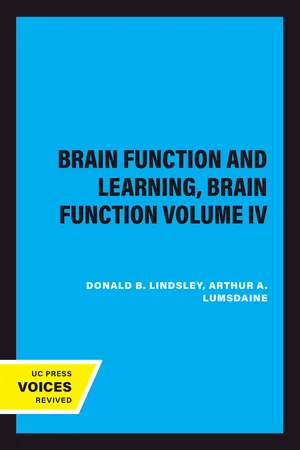
eBook - ePub
Brain Function and Learning, Brain Function Volume IV
- English
- ePUB (mobile friendly)
- Available on iOS & Android
eBook - ePub
Brain Function and Learning, Brain Function Volume IV
About this book
Information
Table of contents
- Cover
- Title
- CONTENTS
- NEUROCHEMICAL APPROACHES TO LEARNING
- ELECTRICAL EVENTS IN THE BRAIN AND LEARNING
- NEUROPHYSIOLOGY AND LEARNING
- NEW DATA AND IDEAS ON INSTRUMENTAL CONDITIONING
- CLASSICAL AND INSTRUMENTAL CONDITIONING: DO SINGLE-PROCESS OR TWO-PROCESS THEORIES EXHAUST THE ALTERNATIVES?
- MATHEMATICAL MODELS AND ARTIFICIAL INTELLIGENCE
- THE CONCEPTS OF DEVELOPMENT AND LEARNING IN CHILD BEHAVIOR
- PROGRAMMED LEARNING AND TEACHING MACHINES*********
- MENTAL RETARDATION AND LEARNING
- CREATIVITY AND LEARNING
- THE ACT OF CREATION
- NAME INDEX
- SUBJECT INDEX
Trusted by 375,005 students
Access to over 1.5 million titles for a fair monthly price.
Study more efficiently using our study tools.
Frequently asked questions
Yes, you can cancel anytime from the Subscription tab in your account settings on the Perlego website. Your subscription will stay active until the end of your current billing period. Learn how to cancel your subscription
No, books cannot be downloaded as external files, such as PDFs, for use outside of Perlego. However, you can download books within the Perlego app for offline reading on mobile or tablet. Learn how to download books offline
Perlego offers two plans: Essential and Complete
- Essential is ideal for learners and professionals who enjoy exploring a wide range of subjects. Access the Essential Library with 800,000+ trusted titles and best-sellers across business, personal growth, and the humanities. Includes unlimited reading time and Standard Read Aloud voice.
- Complete: Perfect for advanced learners and researchers needing full, unrestricted access. Unlock 1.5M+ books across hundreds of subjects, including academic and specialized titles. The Complete Plan also includes advanced features like Premium Read Aloud and Research Assistant.
We are an online textbook subscription service, where you can get access to an entire online library for less than the price of a single book per month. With over 1.5 million books across 990+ topics, we’ve got you covered! Learn about our mission
Look out for the read-aloud symbol on your next book to see if you can listen to it. The read-aloud tool reads text aloud for you, highlighting the text as it is being read. You can pause it, speed it up and slow it down. Learn more about Read Aloud
Yes! You can use the Perlego app on both iOS and Android devices to read anytime, anywhere — even offline. Perfect for commutes or when you’re on the go.
Please note we cannot support devices running on iOS 13 and Android 7 or earlier. Learn more about using the app
Please note we cannot support devices running on iOS 13 and Android 7 or earlier. Learn more about using the app
Yes, you can access Brain Function and Learning, Brain Function Volume IV by Donald B. Lindsley, Arthur A. Lumsdaine, Donald B. Lindsley,Arthur A. Lumsdaine in PDF and/or ePUB format, as well as other popular books in Medicine & Neurology. We have over 1.5 million books available in our catalogue for you to explore.