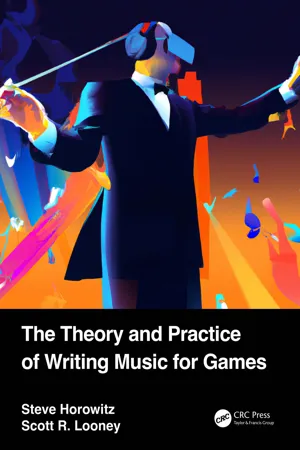
The Theory and Practice of Writing Music for Games
eBook - ePub

The Theory and Practice of Writing Music for Games

  1. 228 pages
  2. English
  3. ePUB (mobile friendly)
  4. Available on iOS & Android
eBook - ePub

The Theory and Practice of Writing Music for Games

About this book

The nature of game music charges the modern-day composer with understanding a whole host of aesthetic and technical principles unique to the medium. Based on years of working in the field, as well as teaching the subject at colleges and universities, The Theory and Practice of Writing Music for Games is an invaluable resource for those looking for a classroom tested, directed course of study.

As players and composers, themselves, authors Steve Horowitz and Scott R. Looney share the inspiration and joy of game music with an emphasis on critical thinking and the creative process, exploring the parallels and distinctions to concert music, film, TV, cartoons, and other popular forms.

Each chapter builds on the next and guides the reader step by step through the essentials. Along with all the theory, a multitude of clearly defined hands-on projects and exercises are included, designed to prepare the reader to go out into the field with a complete understanding of the art and craft of music composition for games and visual media.

Key Features:
• Discusses a variety of topics in a simple and easy-to-understand format.
• Provides a valuable resource for teachers and students, anyone who is looking to build a career in music for games.
• Breaks down the fundamentals needed to build your career.
• Includes fun and practical exercises that strengthen your composer chops.

Visit the Companion Website for additional resources: www.gameaudioinstitute.com/crc-press/

Frequently asked questions

Yes, you can cancel anytime from the Subscription tab in your account settings on the Perlego website. Your subscription will stay active until the end of your current billing period. Learn how to cancel your subscription.
No, books cannot be downloaded as external files, such as PDFs, for use outside of Perlego. However, you can download books within the Perlego app for offline reading on mobile or tablet. Learn more here.
Perlego offers two plans: Essential and Complete
  • Essential is ideal for learners and professionals who enjoy exploring a wide range of subjects. Access the Essential Library with 800,000+ trusted titles and best-sellers across business, personal growth, and the humanities. Includes unlimited reading time and Standard Read Aloud voice.
  • Complete: Perfect for advanced learners and researchers needing full, unrestricted access. Unlock 1.4M+ books across hundreds of subjects, including academic and specialized titles. The Complete Plan also includes advanced features like Premium Read Aloud and Research Assistant.
Both plans are available with monthly, semester, or annual billing cycles.
We are an online textbook subscription service, where you can get access to an entire online library for less than the price of a single book per month. With over 1 million books across 1000+ topics, we’ve got you covered! Learn more here.
Look out for the read-aloud symbol on your next book to see if you can listen to it. The read-aloud tool reads text aloud for you, highlighting the text as it is being read. You can pause it, speed it up and slow it down. Learn more here.
Yes! You can use the Perlego app on both iOS or Android devices to read anytime, anywhere — even offline. Perfect for commutes or when you’re on the go.
Please note we cannot support devices running on iOS 13 and Android 7 or earlier. Learn more about using the app.
Yes, you can access The Theory and Practice of Writing Music for Games by Steve Horowitz,Scott Looney,Scott R. Looney in PDF and/or ePUB format, as well as other popular books in Computer Science & Digital Media. We have over one million books available in our catalogue for you to explore.

Information

Publisher
CRC Press
Year
2024
Print ISBN
9781032540085
eBook ISBN
9781003811954

Table of contents

  1. Cover
  2. Half Title
  3. Title Page
  4. Copyright Page
  5. Table of Contents and Chapter Synopsis
  6. Authors
  7. Introductions
  8. Section-01
  9. Section-02 Assignments
  10. List of References
  11. Index