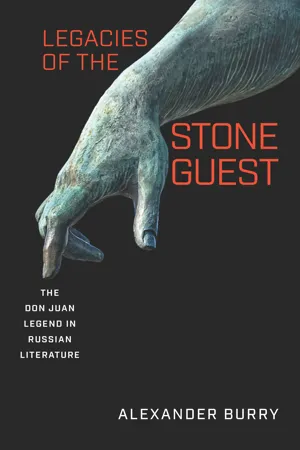
The story of Don Juan first appeared in writing in seventeenth-century Spain, reaching Russia about a century later. Its real impact, however, was delayed until Russia's most famous poet, Alexander Pushkin, put his own, unique, and uniquely inspirational, spin on the tale. Published in 1830, TheStone Guest is now recognized, with other Pushkin masterpieces, as part of the Russian literary canon. Alexander Burry traces the influence of Pushkin's brilliant innovations to the legend, which he shows have proven repeatedly fruitful through successive ages of Russian literature, from the Realist to the Silver Age, Soviet, and contemporary periods. Burry shows that, rather than creating a simple retelling of an originally religious tale about a sinful, consummate seducer, Pushkin offered open-ended scenes, re-envisioned and complicated characters, and new motifs that became recursive and productive parts of Russian literature, in ways that even Pushkin himself could never have predicted.
- 253 pages
- English
- PDF
- Available on iOS & Android
eBook - PDF
About this book
Information
Table of contents
- Contents
- Acknowledgments
- Introduction: Don Juan in Western Europe and Russia
- 1. The Artist-Seducer as Liberator: Pushkin’s Stone Guest
- 2. Don Juan in Everyday Life: The Era of Realism
- 3. Don Juan in the Silver Age
- 4. Soviet and Post-Soviet Don Juans
- Conclusion
- Notes
- Works Cited
- Index
Trusted by 375,005 students
Access to over 1.5 million titles for a fair monthly price.
Study more efficiently using our study tools.
Frequently asked questions
Yes, you can cancel anytime from the Subscription tab in your account settings on the Perlego website. Your subscription will stay active until the end of your current billing period. Learn how to cancel your subscription
No, books cannot be downloaded as external files, such as PDFs, for use outside of Perlego. However, you can download books within the Perlego app for offline reading on mobile or tablet. Learn how to download books offline
Perlego offers two plans: Essential and Complete
- Essential is ideal for learners and professionals who enjoy exploring a wide range of subjects. Access the Essential Library with 800,000+ trusted titles and best-sellers across business, personal growth, and the humanities. Includes unlimited reading time and Standard Read Aloud voice.
- Complete: Perfect for advanced learners and researchers needing full, unrestricted access. Unlock 1.5M+ books across hundreds of subjects, including academic and specialized titles. The Complete Plan also includes advanced features like Premium Read Aloud and Research Assistant.
We are an online textbook subscription service, where you can get access to an entire online library for less than the price of a single book per month. With over 1.5 million books across 990+ topics, we’ve got you covered! Learn about our mission
Look out for the read-aloud symbol on your next book to see if you can listen to it. The read-aloud tool reads text aloud for you, highlighting the text as it is being read. You can pause it, speed it up and slow it down. Learn more about Read Aloud
Yes! You can use the Perlego app on both iOS and Android devices to read anytime, anywhere — even offline. Perfect for commutes or when you’re on the go.
Please note we cannot support devices running on iOS 13 and Android 7 or earlier. Learn more about using the app
Please note we cannot support devices running on iOS 13 and Android 7 or earlier. Learn more about using the app
Yes, you can access Legacies of the Stone Guest by Alexander Burry in PDF and/or ePUB format, as well as other popular books in Literature & Russian History. We have over 1.5 million books available in our catalogue for you to explore.