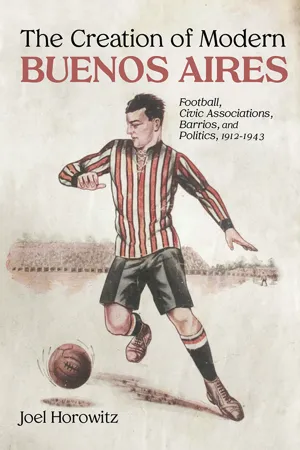
The Creation of Modern Buenos Aires
Football, Civic Associations, Barrios, and Politics, 1912–1943
- 216 pages
- English
- PDF
- Available on iOS & Android
The Creation of Modern Buenos Aires
Football, Civic Associations, Barrios, and Politics, 1912–1943
About this book
The Creation of Modern Buenos Aires examines the impact of civic associations on the culture and the society of Buenos Aires and their ties to politics in the first decades of the twentieth century. The period saw the emergence of the modern political system with true appeals to the voters, tremendous urban growth, and the solidification of a barrio identity. Historian Joel Horowitz examines four types of organizations: football clubs, bibliotecas populares (popular libraries), sociedades de fomento (development societies that pushed for barrio improvements), and universidades populares (popular universities that provided practical training beyond the primary school level). All four types became important social centers and were connected to the political world. The book focuses on the period from the passage of a voting reform law in 1912, which made male-citizen voting obligatory and fraud more difficult, to the military coup of 1943. The book shows how civic associations helped create the social world of the city, focusing especially on the part they played in the development of the sense of barrio. It demonstrates how civic associations became vital links in the system of politics that emerged, creating spaces for politicians to build connections to different communities.
Frequently asked questions
- Essential is ideal for learners and professionals who enjoy exploring a wide range of subjects. Access the Essential Library with 800,000+ trusted titles and best-sellers across business, personal growth, and the humanities. Includes unlimited reading time and Standard Read Aloud voice.
- Complete: Perfect for advanced learners and researchers needing full, unrestricted access. Unlock 1.4M+ books across hundreds of subjects, including academic and specialized titles. The Complete Plan also includes advanced features like Premium Read Aloud and Research Assistant.
Please note we cannot support devices running on iOS 13 and Android 7 or earlier. Learn more about using the app.
Information
Table of contents
- Cover
- Half title
- Title
- Copyright
- Contents
- Acknowledgments
- Introduction
- Chapter 1. The Barrio’s Place in a Growing City
- Chapter 2. Political Capital and Civic Associations
- Chapter 3. Football: Politics and Barrios
- Chapter 4. Popular Libraries as Civic Associations and Anchors of the Community
- Chapter 5. Development Societies as Lobbyists and Centers of Sociability
- Chapter 6. The Search for More Education: Universidades Populares
- Conclusion
- Notes
- Bibliography
- Index