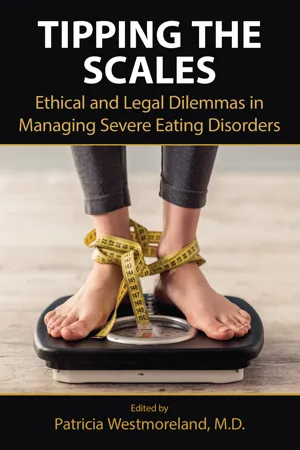
Tipping the Scales: Ethical and Legal Dilemmas in Managing Severe Eating Disorders centers on the complex and at times wrenching medicolegal and ethical challenges encountered in treating patients with severe and enduring eating disorders (SEEDs). Unlike other mental health disorders, for which the care of a medical physician is typically unnecessary, patients with eating disorders have many significant medical complications that demand careful oversight by a physician knowledgeable in treating these disorders. The tragic dearth of such expertise is made more alarming by the fact that anorexia nervosa has the highest mortality rate of any mental disorder aside from opioid abuse. Accordingly, the book addresses the medical consequences of SEEDs and explores that subgroup of patients whose illness appears intractable -- people who are no longer seeking a "cure" but, rather, enough improvement to afford them a reasonable quality of life. For such patients, depending on their age, treatment history, and support system, treatment teams may either commit to achieving a full recovery or engage in a harm reduction model.
In empathic, accessible prose, the book • Examines ethical conflicts that arise in SEEDs, in particular the critical dilemma between saving a life and reducing suffering. Although both are core values of medicine -- and eating disorders have an exceedingly high mortality rate -- relief of suffering through refeeding and other treatments can bring about both physical and emotional discomfort. • Reviews the issues of patient autonomy and mental capacity in the question of who ultimately gets to establish treatment goals. The assignment and role of medical guardianship for patients deemed incapacitated is described in detail. • Explores the perception of "futility," which may reflect burnout of the treatment team for these very challenging patients rather than no hope of success. In particular, perceived futility may contribute to the increased emergence of physician-assisted death and euthanasia in this population both internationally and in the United States. • Devotes several chapters to the differences between palliative care, harm reduction, and futility. Patients sometimes leave treatment and request palliative care, and the book addresses the role of psychiatry in such cases as well as advance care planning and other essential topics.• Describes the medical complexities and comorbidities inherent in caring for patients with SEEDs, including bone density loss, gastrointestinal complaints, and cardiac irregularities, which can result in death.• Presents numerous case studies for comparison, elucidating the thorny ethical and legal issues attendant upon caring for these patients.
Tipping the Scales assists physicians, mental health professionals, and patients in making decisions that are in the patient's best interests, whether they lead to healing and recovery or a dignified passage within the bounds of our current knowledge and the ethics of palliative end-of life care.