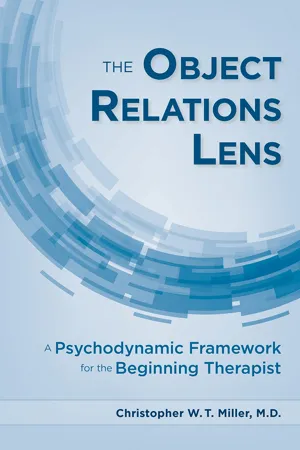
Some psychoanalytic models focus on "how" and "when" particular events may have shaped an individual's emotional and behavioral trajectories in life. In a field as accelerated as psychiatry, it's tempting to use this information to rush to a diagnosis.
The object relations model, as clearly outlined in this compelling volume from Dr. Christopher Miller, offers an attractive alternative: it emphasizes how a patient's early development has informed interpersonal relationship templates and how these play out in the here-and-now of the clinical encounter.
As accessible to the trainee as it is relevant to the experienced clinician, this guide describes how leaning into the therapist-patient dyad (including transference-countertransference dynamics) provides a fertile ground for learning about the patient's past more vividly.
Among the book's standout features are:
• Clinical vignettes that richly illustrate object relations theory as applied within therapy sessions as well as in acute care settings• Experience-near guidance on assimilating the concepts in academic settings, best practices for utilizing supervision, and extensive literature recommendations• Discussions of other theoretical approaches (e.g., attachment theory), as well as a dedicated chapter on a neuroscientific model of object relations, demonstrating how this psychodynamic framework can be harmonized within psychiatric theory and practice• A chapter focused on termination, including advice for inviting the patient into the decision-making process
With its mix of theory, practical advice, and illustrative clinical material, The Object Relations Lens is an indispensable resource for any clinician hoping to gain further knowledge of object relations thought and how this perspective can be eminently useful when conceptualizing and working with patients.