A powerful case for why majority rule—not representation—is the defining feature of democratic politics
The idea that democratic governance rests on active self-rule by citizens plays surprisingly little part in current theories of democracy, which instead stress the importance of representation by elected, appointed, or randomly selected bodies such as legislatures, courts, and juries. This would have astonished eighteenth-century theorists of democracy, who viewed universal suffrage and majoritarian voting as the sole criteria for democratic politics. Active and Passive Citizens defends the view of these earlier thinkers, asserting that individual agency is the very essence of democracy.
In this provocative and lucidly argued book, Richard Tuck draws on the distinction made by the Abbé Sieyès, a leading political theorist of the French Revolution, between “active” citizens (the electorate) and “passive” ones (those who are represented by the institutions of the state). Tuck traces our current representative view of democracy to Sieyès and contrasts him with Rousseau, a theorist of active self-rule by the people. Tuck argues that modern theories of democracy have effectively turned us into passive citizens and calls for a renewal of a majoritarian democracy that realizes the full potential of active citizenship.
Based on the prestigious Tanner Lectures delivered at Princeton University’s Center for Human Values, Active and Passive Citizens is edited and introduced by Stephen Macedo and includes commentary by political theorists Simone Chambers, Joshua Cohen, John Ferejohn, and Melissa Schwartzberg.
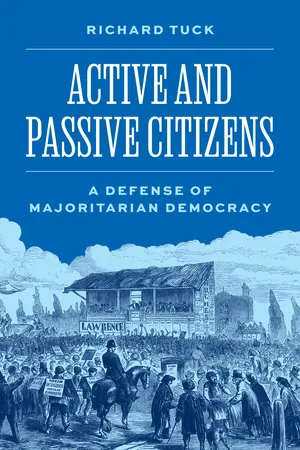
eBook - ePub
Active and Passive Citizens
A Defense of Majoritarian Democracy
- 208 pages
- English
- ePUB (mobile friendly)
- Available on iOS & Android
eBook - ePub
About this book
Information
Publisher
Princeton University PressYear
2024Print ISBN
9780691242811
9780691242798
eBook ISBN
9780691242804
Table of contents
- Cover Page
- Series Page
- Title Page
- Copyright Page
- Contents
- Introduction
- Lectures
- Comments
- Response
- Notes
- Contributors
- Index
- Series List
Trusted by 375,005 students
Access to over 1.5 million titles for a fair monthly price.
Study more efficiently using our study tools.
Frequently asked questions
Yes, you can cancel anytime from the Subscription tab in your account settings on the Perlego website. Your subscription will stay active until the end of your current billing period. Learn how to cancel your subscription
No, books cannot be downloaded as external files, such as PDFs, for use outside of Perlego. However, you can download books within the Perlego app for offline reading on mobile or tablet. Learn how to download books offline
Perlego offers two plans: Essential and Complete
- Essential is ideal for learners and professionals who enjoy exploring a wide range of subjects. Access the Essential Library with 800,000+ trusted titles and best-sellers across business, personal growth, and the humanities. Includes unlimited reading time and Standard Read Aloud voice.
- Complete: Perfect for advanced learners and researchers needing full, unrestricted access. Unlock 1.5M+ books across hundreds of subjects, including academic and specialized titles. The Complete Plan also includes advanced features like Premium Read Aloud and Research Assistant.
We are an online textbook subscription service, where you can get access to an entire online library for less than the price of a single book per month. With over 1.5 million books across 990+ topics, we’ve got you covered! Learn about our mission
Look out for the read-aloud symbol on your next book to see if you can listen to it. The read-aloud tool reads text aloud for you, highlighting the text as it is being read. You can pause it, speed it up and slow it down. Learn more about Read Aloud
Yes! You can use the Perlego app on both iOS and Android devices to read anytime, anywhere — even offline. Perfect for commutes or when you’re on the go.
Please note we cannot support devices running on iOS 13 and Android 7 or earlier. Learn more about using the app
Please note we cannot support devices running on iOS 13 and Android 7 or earlier. Learn more about using the app
Yes, you can access Active and Passive Citizens by Richard Tuck, Stephen Macedo in PDF and/or ePUB format, as well as other popular books in Politics & International Relations & Constitutions. We have over 1.5 million books available in our catalogue for you to explore.