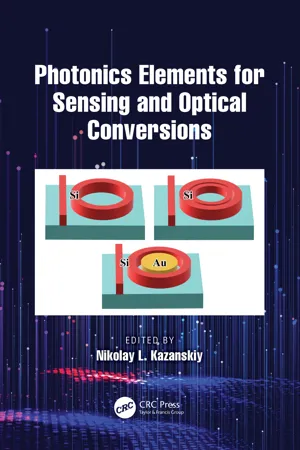
This book covers a number of a rapidly growing areas of knowledge that may be termed as diffractive nanophotonics. It also discusses in detail photonic components that may find uses in sensorics and optical transformations. Photonics Elements for Sensing and Optical Conversions, covers a number of rapidly growing areas of knowledge that may be termed as diffractive nanophotonics. The book examines the advances in computational electrodynamics and nanoelectronics that have made it possible to design and manufacture novel types of photonic components and devices boasting unique properties unattainable in the realm of classical optics. The authors discuss plasmonic sensors, and new types of wavefront sensors and nanolasers that are widely used in telecommunications, quantum informatics and optical transformations. The book also deals with the recent advances in the plasmonic sensors based on metal-insulator-metal waveguides for biochemical sensing applications. Additionally, nanolasers are examined in detail, with a focus on contemporary issues, the book also deals with the fundamentals and highly attractive applications of metamaterials and metasurfaces. The authors provide an insight into sensors based on Zernike optical decomposition using a multi-order diffractive optical element, and explore the performance advances that can be achieved with optical computing. The book is written for opticians, scientists and researchers who are interested in an interesting section of plasmonic sensors, new types of wavefront sensors and nanolasers, and optical transformations. The book will be bought by upper graduate and graduate level students looking to specialize in photonics and optics.
- 300 pages
- English
- ePUB (mobile friendly)
- Available on iOS & Android
eBook - ePub
Photonics Elements for Sensing and Optical Conversions
About this book
Information
Table of contents
- Cover Page
- Half-Title Page
- Title Page
- Copyright Page
- Contents
- Preface
- About the Author
- List of Abbreviations
- Chapter 1 Silicon Photonic Waveguides: Comparison and Utilization in Sensing Applications
- Chapter 2 Photonic Crystal Cavities in Integrated On-Chip Optical Signal Processing Components
- Chapter 3 Nanoplasmonic Sensors: Recent Advances
- Chapter 4 Plasmonic Nanolasers
- Chapter 5 Metasurfaces and Several Well-Studied Applications
- Chapter 6 Optical Fiber Sensors Based on Diffractive and Fiber Periodic Microstructures
- Chapter 7 Wave Front Aberration Sensors Based on Optical Expansion by the Zernike Basis
- Chapter 8 Optical Computing: Key Problems, Achievements, and Perspectives
- General Conclusion
- Appendix A: Listing for Calculating the Sensor Matched with the Zernike Basis Functions
- Appendix B: Listing for Calculating a Distorted Image
- Index
Trusted by 375,005 students
Access to over 1.5 million titles for a fair monthly price.
Study more efficiently using our study tools.
Frequently asked questions
Yes, you can cancel anytime from the Subscription tab in your account settings on the Perlego website. Your subscription will stay active until the end of your current billing period. Learn how to cancel your subscription
No, books cannot be downloaded as external files, such as PDFs, for use outside of Perlego. However, you can download books within the Perlego app for offline reading on mobile or tablet. Learn how to download books offline
Perlego offers two plans: Essential and Complete
- Essential is ideal for learners and professionals who enjoy exploring a wide range of subjects. Access the Essential Library with 800,000+ trusted titles and best-sellers across business, personal growth, and the humanities. Includes unlimited reading time and Standard Read Aloud voice.
- Complete: Perfect for advanced learners and researchers needing full, unrestricted access. Unlock 1.5M+ books across hundreds of subjects, including academic and specialized titles. The Complete Plan also includes advanced features like Premium Read Aloud and Research Assistant.
We are an online textbook subscription service, where you can get access to an entire online library for less than the price of a single book per month. With over 1.5 million books across 990+ topics, we’ve got you covered! Learn about our mission
Look out for the read-aloud symbol on your next book to see if you can listen to it. The read-aloud tool reads text aloud for you, highlighting the text as it is being read. You can pause it, speed it up and slow it down. Learn more about Read Aloud
Yes! You can use the Perlego app on both iOS and Android devices to read anytime, anywhere — even offline. Perfect for commutes or when you’re on the go.
Please note we cannot support devices running on iOS 13 and Android 7 or earlier. Learn more about using the app
Please note we cannot support devices running on iOS 13 and Android 7 or earlier. Learn more about using the app
Yes, you can access Photonics Elements for Sensing and Optical Conversions by Nikolay L. Kazanskiy in PDF and/or ePUB format, as well as other popular books in Technology & Engineering & Civil Engineering. We have over 1.5 million books available in our catalogue for you to explore.