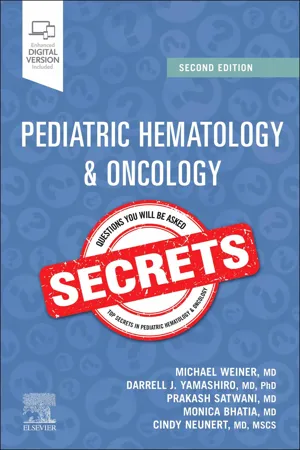
For more than 30 years, the highly regarded Secrets Series® has provided students and practitioners in all areas of health care with concise, focused, and engaging resources for quick reference and exam review. Pediatric Hematology & Oncology Secrets, 2nd Edition, offers practical, up-to-date coverage of the full range of essential topics in this dynamic field. This highly regarded resource features the Secrets' popular question-and-answer format that also includes lists, tables, pearls, memory aids, and an easy-to-read style – making inquiry, reference, and review quick, easy, and enjoyable.- The proven Secrets Series® format gives you the most return for your time – succinct, easy to read, engaging, and highly effective.- Fully revised and updated, including discussions of supportive care of children with cancer and psychosocial aspects of care.- New chapters on Precision Medicine and Systems Biology; Health Equity and Disparities in Pediatric and Adolescent/Young Adult Oncology; Transfusion Medicine; Neoplastic Hematopathology; Hemophagocytic Lymphohistiocytosis; and more.- Top 100 Secrets and Key Points boxes provide a fast overview of the secrets you must know for success in practice and on exams.- Bulleted lists, mnemonics, practical tips from global leaders in the field – all providing a concise overview of important board-relevant content.- Portable size makes it easy to carry with you for quick reference or review anywhere, anytime.
eBook - ePub
Pediatric Hematology & Oncology Secrets - E-Book
- English
- ePUB (mobile friendly)
- Available on iOS & Android
eBook - ePub
Pediatric Hematology & Oncology Secrets - E-Book
About this book
Information
Topic
MedicineSubtopic
HematologyII
Oncology
Chapter 11: Epidemiology
Michael Weiner, MD
1: Internationally there are approximately 300,000 cases of child and adolescent cancer diagnosed annually. What variables exist in childhood cancer incidence and outcome when comparing high-income countries with low-income countries?
The difference in high-income versus low-income countries resides in the inability of so-called “third-world countries” to make a proper, timely diagnosis; obstacles also exist in accessing care, abandonment of treatment, lack of supportive care, and death from toxicity. These factors contribute to higher rates of relapse and mortality. The overall cure rate of childhood cancer in high-income countries approaches 80%, but in low- and middle-income countries, only about 20% of children and adolescents are cured.
Additionally, there are differences in risk among different ethnic or racial population subgroups. Burkitt lymphoma, a type of non-Hodgkin lymphoma, affects 6 to 7 children per 100,000 in parts of sub-Saharan Africa, where it is associated with a history of infection by both Epstein-Barr virus (EBV) and malaria, whereas in industrialized countries, Burkitt lymphoma is not associated with these infectious conditions.
2: Describe the variables that distinguish cancer in children and adolescents from cancers recognized in adults.
Many studies have sought to identify the causes of childhood cancer, but unlike cancer in adults, the vast majority of childhood cancers do not have a known cause. In children, approximately 5% to 10% have an identified familial or genetic etiology and less than 5% to 10% have known environmental exposures or exogenous factors. Nevertheless, it has been established that lifestyle-related factors such as poor nutrition, alcoholism, high fat diets, tobacco use, lack of physical activity, and environmental exposure to radon, ultraviolet light, asbestos, benzene, and radioactive material predispose adults to cancer. In general, childhood cancers cannot be prevented or screened and are assumed to involve multiple risk factors and variables.
Approximately 90% of adult cancers are carcinomas derived from ectodermal epithelial tissue of the prostate, breast, lung, colorectum, uterus, and ovaries. In contradistinction, childhood malignancies are of mesenchymal origin, bone marrow, lymph glands, bone, and muscle and are almost exclusively leukemias, lymphomas, sarcomas, and cancers of the central nervous system (CNS).
National Cancer Institute (NCI) SEER (Surveillance, Epidemiology, and End Results) data indicate the incidence of cancer from birth through 14 years of age is 14 cases per 100,000 per year. For patients between 15 and 19 years, the incidence approaches 20 cases per 100,000 per year. Thus there are approximately 15,000 to 16,000 new cases of cancer per year diagnosed in children and teenagers. In the United States, there are between 1.7 to 1.8 million cases of adult cancer diagnosed each year; thus, for every case of childhood cancer, there are approximately 110 to 115 cases diagnosed in adults.
Child and adolescent cancer remains the leading cause of disease-related mortality in the United States with between 2500 to 3000 deaths per year.
3: What are the genetic and congenital disorders that predispose patients to developing pediatric malignancies?
Historically approximately 15% of the cases of childhood cancer have been associated with a genetic and/or congenital condition. Genetic disorders that have gene alterations that disrupt normal mechanisms of genomic repair, such as xeroderma pigmentosa, Bloom syndrome, and ataxia telangiectasia, are associated with skin cancer, leukemia, and lymphoma, respectively. Beckwith-Wiedemann syndrome, multiple endocrine neoplasia, and neurofibromatosis are congenital conditions with dysfunctional cellular growth and proliferation and are associated with Wilms tumor, hepatic tumors, adrenal cancers, and CNS tumors, respectively.
Recently, the Precision in Pediatric Sequencing (PIPseq) program at Columbia University Irving Medical Center has found using whole-exome and RNA sequencing of malignant tissue that approximately 90% of more than 550 cases of pediatric cancer have evidence of sequence variants, mutations, fusion transcripts, and/or copy number variation. It is thought that there are sequencing identified genes of diagnostic or prognostic significance in 45% of cases and identified genes associated with drug resistance in 5% of patients. The determination of whether these genetic alterations represent driver mutations of malignancy remains to be determined.
4: How is epidemiological data collected? What are the contemporary public health surveillance processes followed by population scientists and investigators?
Public health surveillance involves the collection, analysis, and interpretation of health data to prevent and treat disease. In the United States, cancer statistics are compiled by the NCI’s Surveillance, Epidemiology and End Results (SEER) program (http://www.seer.cancer.gov); in addition, all states have cancer registries and report data to the North American Association for Central Cancer Registries that is supported by the Centers for Disease Control and Prevention. More recently, the Children’s Oncology Group (COG) initiated a volunteer Childhood Cancer Research Network (CCRN) and Project Every Child, which not only collects data but also extends the efforts of CCRN to allow specimen collection. Collectively, because 90% of children in the United States are treated on COG protocols, the CCRN and Project Every Child make it feasible to perform population-based research on the etiology of cancer in children and adolescents.
5: According to statistics from the SEER database, what is the age distribution by percentages for child and adolescent cancers?
| Diagnosis | Age 0–14 years | Age 15–19 years |
|---|---|---|
| Acute lymphoblastic leukemia | 25 | 8 |
| Acute myelogenous leukemia | 5 | 4 |
| Central nervous system | 21 | 10 |
| Neuroblastoma | 7 | 1 |
| Wilms tumor | 5 | 1 |
| Non-Hodgkin lymphoma | 6 | 8 |
| Hodgkin disease | 4 | 16 |
| Rhabdomyosarcoma | 3 | 2 |
| Soft tissue sarcoma | 7 | 6 |
| Osteosarcoma | 3 | 4 |
| Ewing sarcoma | 2 | 2 |
| Germ cell tumors | 4 | 14 |
| Retinoblastoma | 3 | |
| Hepatocellular | 1 | |
| Melanoma | 7 | |
| Thyroid carcinoma | 9 |
Incidence data from Surveillance, Epidemiology, and End Results (SEER) and percent distribution based on the International Classification of Childhood, which reflects the most prevalent tumor types.
6: Delineate the incidence disparities of child and adolescent cancer by sex and race.
For patients younger than 15 years of age, there exists a male predominance for acute lymphoblastic leukemia (ALL), Hodgkin disease, non-Hodgkin lymphoma (NHL), Ewing sarcoma, and rhabdomyosarcoma. In adolescents, osteosarcoma, Ewing sarcoma, and germ cell tumors are more prevalent in males, whereas Hodgkin disease and germ cell tumors were distributed equally. In the 15- to 19-year-old age group, the risk of thyroid cancer, melanoma, and Wilms tumor is greater.
Adult Black Americans have a higher risk of canc...
Table of contents
- Cover image
- Title page
- Table of Contents
- Copyright
- Contributors
- Preface
- Dedication
- Top 100 secrets
- I: Hematology
- II: Oncology
- III: Oncologic Diseases
- IV: Stem Cell and Cellular Therapies
- Index
Trusted by 375,005 students
Access to over 1.5 million titles for a fair monthly price.
Study more efficiently using our study tools.
Frequently asked questions
Yes, you can cancel anytime from the Subscription tab in your account settings on the Perlego website. Your subscription will stay active until the end of your current billing period. Learn how to cancel your subscription
No, books cannot be downloaded as external files, such as PDFs, for use outside of Perlego. However, you can download books within the Perlego app for offline reading on mobile or tablet. Learn how to download books offline
Perlego offers two plans: Essential and Complete
- Essential is ideal for learners and professionals who enjoy exploring a wide range of subjects. Access the Essential Library with 800,000+ trusted titles and best-sellers across business, personal growth, and the humanities. Includes unlimited reading time and Standard Read Aloud voice.
- Complete: Perfect for advanced learners and researchers needing full, unrestricted access. Unlock 1.5M+ books across hundreds of subjects, including academic and specialized titles. The Complete Plan also includes advanced features like Premium Read Aloud and Research Assistant.
We are an online textbook subscription service, where you can get access to an entire online library for less than the price of a single book per month. With over 1.5 million books across 990+ topics, we’ve got you covered! Learn about our mission
Look out for the read-aloud symbol on your next book to see if you can listen to it. The read-aloud tool reads text aloud for you, highlighting the text as it is being read. You can pause it, speed it up and slow it down. Learn more about Read Aloud
Yes! You can use the Perlego app on both iOS and Android devices to read anytime, anywhere — even offline. Perfect for commutes or when you’re on the go.
Please note we cannot support devices running on iOS 13 and Android 7 or earlier. Learn more about using the app
Please note we cannot support devices running on iOS 13 and Android 7 or earlier. Learn more about using the app
Yes, you can access Pediatric Hematology & Oncology Secrets - E-Book by Michael A. Weiner,Darrell J. Yamashiro,Prakash Satwani,Monica Bhatia,Cindy Neunert in PDF and/or ePUB format, as well as other popular books in Medicine & Hematology. We have over 1.5 million books available in our catalogue for you to explore.