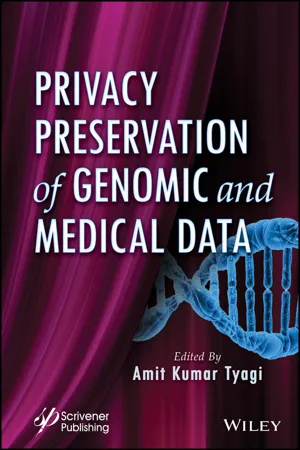
Privacy Preservation of Genomic and Medical Data
eBook - PDF

Privacy Preservation of Genomic and Medical Data

  1. 559 pages
  2. English
  3. PDF
  4. Available on iOS & Android
eBook - PDF

Privacy Preservation of Genomic and Medical Data

About this book

PRIVACY PRESERVATION of GENOMIC and MEDICAL DATA

Discusses topics concerning the privacy preservation of genomic data in the digital era, including data security, data standards, and privacy laws so that researchers in biomedical informatics, computer privacy and ELSI can assess the latest advances in privacy-preserving techniques for the protection of human genomic data.

Privacy Preservation of Genomic and Medical Data focuses on genomic data sources, analytical tools, and the importance of privacy preservation. Topics discussed include tensor flow and Bio-Weka, privacy laws, HIPAA, and other emerging technologies like Internet of Things, IoT-based cloud environments, cloud computing, edge computing, and blockchain technology for smart applications. The book starts with an introduction to genomes, genomics, genetics, transcriptomes, proteomes, and other basic concepts of modern molecular biology. DNA sequencing methodology, DNA-binding proteins, and other related terms concerning genomes and genetics, and the privacy issues are discussed in detail. The book also focuses on genomic data sources, analyzing tools, and the importance of privacy preservation. It concludes with future predictions for genomic and genomic privacy, emerging technologies, and applications.

Audience

Researchers in information technology, data mining, health informatics and health technologies, clinical informatics, bioinformatics, security and privacy in healthcare, as well as health policy developers in public and private health departments and public health.

Frequently asked questions

Yes, you can cancel anytime from the Subscription tab in your account settings on the Perlego website. Your subscription will stay active until the end of your current billing period. Learn how to cancel your subscription.
At the moment all of our mobile-responsive ePub books are available to download via the app. Most of our PDFs are also available to download and we're working on making the final remaining ones downloadable now. Learn more here.
Perlego offers two plans: Essential and Complete
  • Essential is ideal for learners and professionals who enjoy exploring a wide range of subjects. Access the Essential Library with 800,000+ trusted titles and best-sellers across business, personal growth, and the humanities. Includes unlimited reading time and Standard Read Aloud voice.
  • Complete: Perfect for advanced learners and researchers needing full, unrestricted access. Unlock 1.4M+ books across hundreds of subjects, including academic and specialized titles. The Complete Plan also includes advanced features like Premium Read Aloud and Research Assistant.
Both plans are available with monthly, semester, or annual billing cycles.
We are an online textbook subscription service, where you can get access to an entire online library for less than the price of a single book per month. With over 1 million books across 1000+ topics, we’ve got you covered! Learn more here.
Look out for the read-aloud symbol on your next book to see if you can listen to it. The read-aloud tool reads text aloud for you, highlighting the text as it is being read. You can pause it, speed it up and slow it down. Learn more here.
Yes! You can use the Perlego app on both iOS or Android devices to read anytime, anywhere — even offline. Perfect for commutes or when you’re on the go.
Please note we cannot support devices running on iOS 13 and Android 7 or earlier. Learn more about using the app.
Yes, you can access Privacy Preservation of Genomic and Medical Data by Amit Kumar Tyagi in PDF and/or ePUB format, as well as other popular books in Ciencia de la computación & Criptografía. We have over one million books available in our catalogue for you to explore.

Information

Table of contents

  1. Cover
  2. Title Page
  3. Copyright Page
  4. Contents
  5. Preface
  6. Acknowledgements
  7. Part 1: Fundamentals
  8. Part 2: Methods and Applications
  9. Part 3: Future-Based Applications
  10. Part 4: Issues and Challenges
  11. Index
  12. EULA