If I were asked to answer the following question: What is slavery? and I should answer in one word, It is murder!, my meaning would be understood at once. No extended argument would be required to show that the power to remove a man's mind, will, and personality, is the power of life and death, and that it makes a man a slave. It is murder. Why, then, to this other question: What is property? may I not likewise answer, It is robbery!, without the certainty of being misunderstood; the second proposition being no other than a transformation of the first? —?Pierre-Joseph Proudhon, What Is Property? Pierre-Joseph Proudhon (15 January 1809 – 19 January 1865) was a French socialist, politician, philosopher, and economist who founded mutualist philosophy and is considered by many to be the "father of anarchism". He was the first person to declare himself an anarchist, using that term, and is widely regarded as one of anarchism's most influential theorists. Proudhon became a member of the French Parliament after the Revolution of 1848, whereafter he referred to himself as a federalist. Proudhon described the liberty he pursued as "the synthesis of community and property". Some consider his mutualism to be part of individualist anarchism while others regard it to be part of social anarchism.
- English
- ePUB (mobile friendly)
- Available on iOS & Android
eBook - ePub
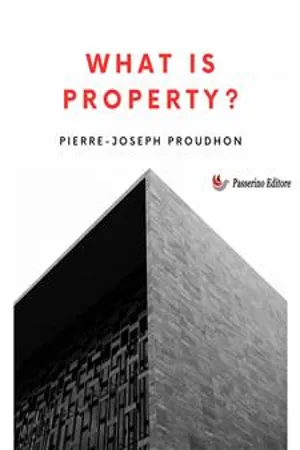
What Is Property?
About this book
Information
Table of contents
- Cover
- What Is Property?
- Table of contents
- P. J. Proudhon, His Life and His Works
- Preface
- First Memoir
- I
- II
- § 1. Property as a Natural Right
- § 2. Occupation, as the Title to Property
- § 3. Civil Law as the Foundation and Sanction of Property
- III
- § 1. The Land Cannot Be Appropriated
- § 2. Universal Consent No Justification of Property
- § 3. Prescription Gives No Title to Property
- § 4. Labor. That Labor Has No Inherent Power to Appropriate Natural Wealth
- § 5. That Labor Leads to Equality of Property
- § 6. That in Society All Wages Are Equal
- § 7. That Inequality of Powers Is the Necessary Condition of Equality of Fortunes
- § 8. That, from the Standpoint of Justice, Labor Destroys Property
- IV
- First Proposition
- Second Proposition
- Third Proposition
- Fourth Proposition
- Fifth Proposition
- Sixth Proposition
- Seventh Proposition
- Eighth Proposition
- Ninth Proposition
- Tenth Proposition
- V
- Part I
- Part II
- Second Memoir
Trusted by 375,005 students
Access to over 1.5 million titles for a fair monthly price.
Study more efficiently using our study tools.
Frequently asked questions
Yes, you can cancel anytime from the Subscription tab in your account settings on the Perlego website. Your subscription will stay active until the end of your current billing period. Learn how to cancel your subscription
No, books cannot be downloaded as external files, such as PDFs, for use outside of Perlego. However, you can download books within the Perlego app for offline reading on mobile or tablet. Learn how to download books offline
Perlego offers two plans: Essential and Complete
- Essential is ideal for learners and professionals who enjoy exploring a wide range of subjects. Access the Essential Library with 800,000+ trusted titles and best-sellers across business, personal growth, and the humanities. Includes unlimited reading time and Standard Read Aloud voice.
- Complete: Perfect for advanced learners and researchers needing full, unrestricted access. Unlock 1.5M+ books across hundreds of subjects, including academic and specialized titles. The Complete Plan also includes advanced features like Premium Read Aloud and Research Assistant.
We are an online textbook subscription service, where you can get access to an entire online library for less than the price of a single book per month. With over 1.5 million books across 990+ topics, we’ve got you covered! Learn about our mission
Look out for the read-aloud symbol on your next book to see if you can listen to it. The read-aloud tool reads text aloud for you, highlighting the text as it is being read. You can pause it, speed it up and slow it down. Learn more about Read Aloud
Yes! You can use the Perlego app on both iOS and Android devices to read anytime, anywhere — even offline. Perfect for commutes or when you’re on the go.
Please note we cannot support devices running on iOS 13 and Android 7 or earlier. Learn more about using the app
Please note we cannot support devices running on iOS 13 and Android 7 or earlier. Learn more about using the app
Yes, you can access What Is Property? by Pierre-Joseph Proudhon in PDF and/or ePUB format, as well as other popular books in Politics & International Relations & Communism, Post-Communism & Socialism. We have over 1.5 million books available in our catalogue for you to explore.