Contributions by Cynthia Baron, Elizabeth Binggeli, Kimberly Nichele Brown, Priscilla Layne, Eric Pierson, Charlene Regester, Ellen C. Scott, Tanya L. Shields, and Judith E. Smith
Intersecting Aesthetics: Literary Adaptations and Cinematic Representations of Blackness illuminates cultural and material trends that shaped Black film adaptations during the twentieth century. Contributors to this collection reveal how Black literary and filmic texts are sites of negotiation between dominant and resistant perspectives. Their work ultimately explores the effects racial perspectives have on film adaptations and how race-inflected cultural norms have influenced studio and independent film depictions. Several chapters analyze how self-censorship and industry censorship affect Black writing and the adaptations of Black stories in early to mid-twentieth-century America. Using archival material, contributors demonstrate the ways commercial obstacles have led Black writers and white-dominated studios to mask Black experiences. Other chapters document instances in which Black writers and directors navigate cultural norms and material realities to realize their visions in literary works, independent films, and studio productions. Through uncovering patterns in Black film adaptations, Intersecting Aesthetics reveals themes, aesthetic strategies, and cultural dynamics that rightfully belong to accounts of film adaptation.
The volume considers travelogue and autobiography sources along with the fiction of Black authors H. G. de Lisser, Richard Wright, Ann Petry, Frank Yerby, and Walter Mosley. Contributors examine independent films The Love Wanga (1936) and The Devil's Daughter (1939); Melvin Van Peebles's first feature, The Story of a Three Day Pass (1967); and the Senegalese film Karmen Geï (2001). They also explore studio-era films In This Our Life (1942), The Foxes of Harrow (1947), Lydia Bailey (1952), The Golden Hawk (1952), and The Saracen Blade (1954) and post-studio films The Learning Tree (1969), Shaft (1971), Lady Sings the Blues (1972), and Devil in a Blue Dress (1995).
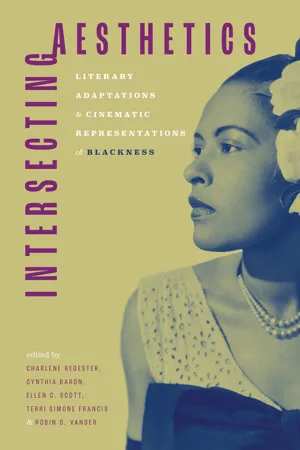
eBook - ePub
Intersecting Aesthetics
Literary Adaptations and Cinematic Representations of Blackness
- English
- ePUB (mobile friendly)
- Available on iOS & Android
eBook - ePub
Intersecting Aesthetics
Literary Adaptations and Cinematic Representations of Blackness
About this book
Information
Subtopic
Modern Literary CriticismTable of contents
- Cover
- Title Page
- Copyright
- Contents
- Preface
- Acknowledgments
- Part I: Black Literary/Film Adaptations in Scholarly and Historical Contexts
- Part II: Colonial Anxieties and Reclaimed Identities
- Part III: Hollywood’s Problematic Reconstructions
- Part IV: Black Literature’s Challenge for Screen Adaptations
- Part V: Black Auteurs Defying Dominant Norms
- About the Contributors
- Index
Trusted by 375,005 students
Access to over 1.5 million titles for a fair monthly price.
Study more efficiently using our study tools.
Frequently asked questions
Yes, you can cancel anytime from the Subscription tab in your account settings on the Perlego website. Your subscription will stay active until the end of your current billing period. Learn how to cancel your subscription
No, books cannot be downloaded as external files, such as PDFs, for use outside of Perlego. However, you can download books within the Perlego app for offline reading on mobile or tablet. Learn how to download books offline
Perlego offers two plans: Essential and Complete
- Essential is ideal for learners and professionals who enjoy exploring a wide range of subjects. Access the Essential Library with 800,000+ trusted titles and best-sellers across business, personal growth, and the humanities. Includes unlimited reading time and Standard Read Aloud voice.
- Complete: Perfect for advanced learners and researchers needing full, unrestricted access. Unlock 1.5M+ books across hundreds of subjects, including academic and specialized titles. The Complete Plan also includes advanced features like Premium Read Aloud and Research Assistant.
We are an online textbook subscription service, where you can get access to an entire online library for less than the price of a single book per month. With over 1.5 million books across 990+ topics, we’ve got you covered! Learn about our mission
Look out for the read-aloud symbol on your next book to see if you can listen to it. The read-aloud tool reads text aloud for you, highlighting the text as it is being read. You can pause it, speed it up and slow it down. Learn more about Read Aloud
Yes! You can use the Perlego app on both iOS and Android devices to read anytime, anywhere — even offline. Perfect for commutes or when you’re on the go.
Please note we cannot support devices running on iOS 13 and Android 7 or earlier. Learn more about using the app
Please note we cannot support devices running on iOS 13 and Android 7 or earlier. Learn more about using the app
Yes, you can access Intersecting Aesthetics by Charlene Regester,Cynthia Baron,Ellen C. Scott,Terri Simone Francis,Robin G. Vander in PDF and/or ePUB format, as well as other popular books in Media & Performing Arts & Modern Literary Criticism. We have over 1.5 million books available in our catalogue for you to explore.