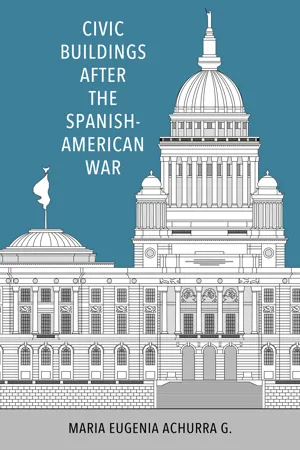
Following the 1898 Spanish-American War, the United States constructed federal buildings in its newly acquired territories, including Cuba, Puerto Rico, and the Philippines. Over a century later, many of these grand Beaux-Arts-style edifices are still in use. In Civic Buildings after the Spanish-American War, Maria Eugenia Achurra G. examines this architecture and urban design as a backdrop for US exceptionalism and expansionism.
The book defines exceptionalism and its role in US Beaux-Arts federal architecture. Subsequent chapters compare specific examples of Beaux-Arts civic architecture in the continental US and Latin America. The book also studies architectural and urban design from other US possessions of the Progressive Era, such as the former Panama Canal Zone and occupied territories like the Dominican Republic. Reviewing the work of relevant designers and architects, Achurra G. argues that architectural examples epitomize the rich, expansionist intentions of twentieth-century Progressive America. These lingering buildings function as intriguing material evidence of the United States' geopolitical, historical, and commercial meddling in the internal affairs of the Americas and elsewhere.
- English
- ePUB (mobile friendly)
- Available on iOS & Android
eBook - ePub
Civic Buildings after the Spanish-American War
About this book
Information
Print ISBN
9781496847577
Subtopic
Architecture GeneralTable of contents
- Cover Page
- Title Page
- Copyright Page
- Contents
- Acknowledgments
- Introduction
- Chapter 1: American Exceptionalism: Artistic and Architectural Precedents
- Chapter 2: Relevant Examples of US Civic Beaux-Arts Architecture
- Chapter 3: Relevant Designers from the Tarsney Act Era
- Conclusions
- Afterword: Guy Debord (1931–1994) and His Exceptionalist Spectacle
- Appendix 1: The Tarsney Act and the US Treasury Department’s 1915 Classification for Federal Buildings
- Appendix 2: Brief Chronology
- Appendix 3: Glossary of Architectural Terms
- Notes
- Bibliography
- Index
- About the Author
Trusted by 375,005 students
Access to over 1.5 million titles for a fair monthly price.
Study more efficiently using our study tools.
Frequently asked questions
Yes, you can cancel anytime from the Subscription tab in your account settings on the Perlego website. Your subscription will stay active until the end of your current billing period. Learn how to cancel your subscription
No, books cannot be downloaded as external files, such as PDFs, for use outside of Perlego. However, you can download books within the Perlego app for offline reading on mobile or tablet. Learn how to download books offline
Perlego offers two plans: Essential and Complete
- Essential is ideal for learners and professionals who enjoy exploring a wide range of subjects. Access the Essential Library with 800,000+ trusted titles and best-sellers across business, personal growth, and the humanities. Includes unlimited reading time and Standard Read Aloud voice.
- Complete: Perfect for advanced learners and researchers needing full, unrestricted access. Unlock 1.5M+ books across hundreds of subjects, including academic and specialized titles. The Complete Plan also includes advanced features like Premium Read Aloud and Research Assistant.
We are an online textbook subscription service, where you can get access to an entire online library for less than the price of a single book per month. With over 1.5 million books across 990+ topics, we’ve got you covered! Learn about our mission
Look out for the read-aloud symbol on your next book to see if you can listen to it. The read-aloud tool reads text aloud for you, highlighting the text as it is being read. You can pause it, speed it up and slow it down. Learn more about Read Aloud
Yes! You can use the Perlego app on both iOS and Android devices to read anytime, anywhere — even offline. Perfect for commutes or when you’re on the go.
Please note we cannot support devices running on iOS 13 and Android 7 or earlier. Learn more about using the app
Please note we cannot support devices running on iOS 13 and Android 7 or earlier. Learn more about using the app
Yes, you can access Civic Buildings after the Spanish-American War by Maria Eugenia Achurra G. in PDF and/or ePUB format. We have over 1.5 million books available in our catalogue for you to explore.