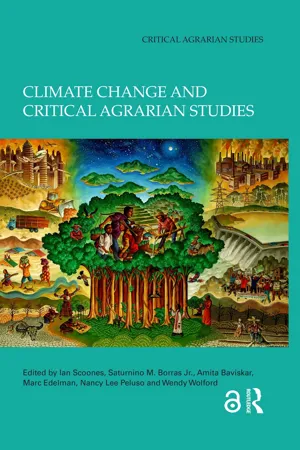
Climate Change and Critical Agrarian Studies
- 658 pages
- English
- ePUB (mobile friendly)
- Available on iOS & Android
Climate Change and Critical Agrarian Studies
About this book
Climate change is perhaps the greatest threat to humanity today and plays out as a cruel engine of myriad forms of injustice, violence and destruction. The effects of climate change from human-made emissions of greenhouse gases are devastating and accelerating; yet are uncertain and uneven both in terms of geography and socio-economic impacts. Emerging from the dynamics of capitalism since the industrial revolution â as well as industrialisation under state-led socialism â the consequences of climate change are especially profound for the countryside and its inhabitants.
The book interrogates the narratives and strategies that frame climate change and examines the institutionalised responses in agrarian settings, highlighting what exclusions and inclusions result. It explores how different people â in relation to class and other co-constituted axes of social difference such as gender, race, ethnicity, age and occupation â are affected by climate change, as well as the climate adaptation and mitigation responses being implemented in rural areas. The book in turn explores how climate change â and the responses to it - affect processes of social differentiation, trajectories of accumulation and in turn agrarian politics. Finally, the book examines what strategies are required to confront climate change, and the underlying political-economic dynamics that cause it, reflecting on what this means for agrarian struggles across the world.
The 26 chapters in this volume explore how the relationship between capitalism and climate change plays out in the rural world and, in particular, the way agrarian struggles connect with the huge challenge of climate change. Through a huge variety of case studies alongside more conceptual chapters, the book makes the often-missing connection between climate change and critical agrarian studies. The book argues that making the connection between climate and agrarian justice is crucial.
The chapters in this book were originally published in The Journal of Peasant Studies.
The Open Access version of this book, available at https://www.taylorfrancis.com/books/oa-edit/10.4324/9781003467960/climate-change-critical-agrarian-studies-ian-scoones-saturnino-borras-jr-amita-baviskar-marc-edelman-nancy-lee-peluso-wendy-wolford, has been made available under a Creative Commons [Attribution-Non Commercial-No Derivatives (CC-BY-NC-ND)] 4.0 license. A version of the open access title is also available on the OAPEN platform https://library.oapen.org/handle/20.500.12657/85297.
Frequently asked questions
- Essential is ideal for learners and professionals who enjoy exploring a wide range of subjects. Access the Essential Library with 800,000+ trusted titles and best-sellers across business, personal growth, and the humanities. Includes unlimited reading time and Standard Read Aloud voice.
- Complete: Perfect for advanced learners and researchers needing full, unrestricted access. Unlock 1.4M+ books across hundreds of subjects, including academic and specialized titles. The Complete Plan also includes advanced features like Premium Read Aloud and Research Assistant.
Please note we cannot support devices running on iOS 13 and Android 7 or earlier. Learn more about using the app.
Information
Table of contents
- Cover
- Half Title
- Series Page
- Title Page
- Copyright Page
- Table of Contents
- Citation Information
- Notes on Contributors
- Acknowledgements
- Preface: Climate Change and Critical Agrarian Studies
- 1 Climate change and agrarian struggles
- 2 The environmentalization of the agrarian question and the agrarianization of the climate justice movement
- 3 Violent silence: Framing out social causes of climate-related crises
- 4 Climate change and class conflict in the Anthropocene: Sink or swim together?
- 5 The political life of mitigation: From carbon accounting to agrarian counter-accounts
- 6 Imagined transitions: Agrarian capitalism and climate change adaptation in Colombia
- 7 Beyond bad weather: Climates of uncertainty in rural India
- 8 Climate rentierism after coal: Forests, carbon offsets, and post-coal politics in the Appalachian coalfields
- 9 Up in the air: The challenge of conceptualizing and crafting a post-carbon planetary politics to confront climate change
- 10 Power for the Plantationocene: Solar parks as the colonial form of an energy plantation
- 11 Oro blanco: Assembling extractivism in the lithium triangle
- 12 Adapting to climate change among transitioning Maasai pastoralists in southern Kenya: An intersectional analysis of differentiated abilities to benefit from diversification processes
- 13 Advocating afforestation, betting on BECCS: Land-based negative emissions technologies (NETs) and agrarian livelihoods in the global South
- 14 Food, famine and the free trade fallacy: The dangers of market fundamentalism in an era of climate emergency
- 15 Uneven resilience and everyday adaptation: Making Rwandaâs green revolution âclimate smartâ
- 16 Rethinking âjust transitionsâ from coal: The dynamics of land and labour in anti-coal struggles
- 17 Rescaling the land rush? Global political ecologies of land use and cover change in key scenario archetypes for achieving the 1.5°C Paris agreement target
- 18 Producing nature-based solutions: Infrastructural nature and agrarian change in San MartĂn, Peru
- 19 Climate refugees or labour migrants? Climate reductive translations of womenâs migration from coastal Bangladesh
- 20 Certificated exclusion: Forest carbon sequestration project in Southwest China
- 21 Resilience and conflict: Rethinking climate resilience through Indigenous territorial struggles
- 22 Resisting, leveraging and reworking climate change adaptation projects from below: Placing adaptation in Ecuadorâs agrarian struggle
- 23 Linking climate-smart agriculture to farming as a service: Mapping an emergent paradigm of datafied dispossession in India
- 24 Prefiguring buen sobrevivir: Lenca womenâs (e)utopianism amid climate change
- 25 Forest as ânatureâ or forest as territory? Knowledge, power, and climate change conservation in the Peruvian Amazon
- 26 Whose security? Politics, risks and alternatives for climate security practices in agrarian-environmental perspectives
- Index