Longlisted for the Financial Times and Schroders Business Book of the Year Award
A novel economic interpretation of how religions have become so powerful in the modern world
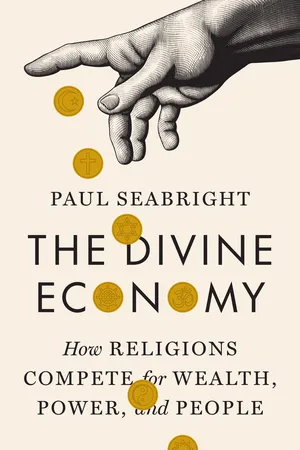
Religion in the twenty-first century is alive and well across the world, despite its apparent decline in North America and parts of Europe. Vigorous competition between and within religious movements has led to their accumulating great power and wealth. Religions in many traditions have honed their competitive strategies over thousands of years. Today, they are big business; like businesses, they must recruit, raise funds, disburse budgets, manage facilities, organize transportation, motivate employees, and get their message out. In The Divine Economy, economist Paul Seabright argues that religious movements are a special kind of business: they are platforms, bringing together communities of members who seek many different things from one another—spiritual fulfilment, friendship and marriage networks, even business opportunities. Their function as platforms, he contends, is what has allowed religions to consolidate and wield power.
This power can be used for good, especially when religious movements provide their members with insurance against the shocks of modern life, and a sense of worth in their communities. It can also be used for harm: political leaders often instrumentalize religious movements for authoritarian ends, and religious leaders can exploit the trust of members to inflict sexual, emotional, financial or physical abuse, or to provoke violence against outsiders. Writing in a nonpartisan spirit, Seabright uses insights from economics to show how religion and secular society can work together in a world where some people feel no need for religion, but many continue to respond with enthusiasm to its call.
- 480 pages
- English
- ePUB (mobile friendly)
- Available on iOS & Android
eBook - ePub
About this book
Information
Publisher
Princeton University PressYear
2024Print ISBN
9780691277875
9780691133003
eBook ISBN
9780691258782
Table of contents
- Cover Page
- More praise for the Divine Economy
- Title Page
- Copyright Page
- Dedication
- Contents
- Acknowledgments
- Introduction
- Part I. What Does Religion Look Like in the World Today?
- Part II. How Do Religions Gain Their Power?
- Part III. Religion and the Uses of Power
- Part IV. Conclusion
- Statistical Appendix
- Notes
- Bibliography
- Index
Trusted by 375,005 students
Access to over 1.5 million titles for a fair monthly price.
Study more efficiently using our study tools.
Frequently asked questions
Yes, you can cancel anytime from the Subscription tab in your account settings on the Perlego website. Your subscription will stay active until the end of your current billing period. Learn how to cancel your subscription
No, books cannot be downloaded as external files, such as PDFs, for use outside of Perlego. However, you can download books within the Perlego app for offline reading on mobile or tablet. Learn how to download books offline
Perlego offers two plans: Essential and Complete
- Essential is ideal for learners and professionals who enjoy exploring a wide range of subjects. Access the Essential Library with 800,000+ trusted titles and best-sellers across business, personal growth, and the humanities. Includes unlimited reading time and Standard Read Aloud voice.
- Complete: Perfect for advanced learners and researchers needing full, unrestricted access. Unlock 1.5M+ books across hundreds of subjects, including academic and specialized titles. The Complete Plan also includes advanced features like Premium Read Aloud and Research Assistant.
We are an online textbook subscription service, where you can get access to an entire online library for less than the price of a single book per month. With over 1.5 million books across 990+ topics, we’ve got you covered! Learn about our mission
Look out for the read-aloud symbol on your next book to see if you can listen to it. The read-aloud tool reads text aloud for you, highlighting the text as it is being read. You can pause it, speed it up and slow it down. Learn more about Read Aloud
Yes! You can use the Perlego app on both iOS and Android devices to read anytime, anywhere — even offline. Perfect for commutes or when you’re on the go.
Please note we cannot support devices running on iOS 13 and Android 7 or earlier. Learn more about using the app
Please note we cannot support devices running on iOS 13 and Android 7 or earlier. Learn more about using the app
Yes, you can access The Divine Economy by Paul Seabright in PDF and/or ePUB format, as well as other popular books in Social Sciences & Organisational Behaviour. We have over 1.5 million books available in our catalogue for you to explore.