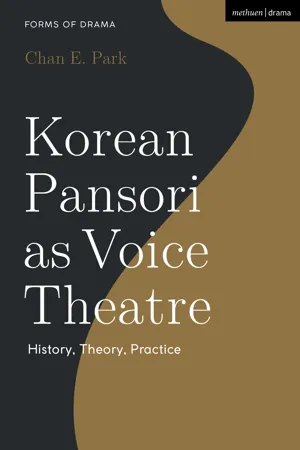
This book introduces readers to the historical, performative, and cultural context of pansori, a traditional Korean oral story-singing art.
Written by a scholar-practitioner of the form, this study is structured in three parts and begins by introducing readers to the technical, aesthetic, and theoretical components of pansori, as well as the synthesis of vocal and percussive elements that stage the narrative. It moves on to reflect on the historical contexts of pansori, alongside Korea's transformation from Joseon monarchy to modern statehood. It argues that with colonial annexation came modernist influences that Korean dramatists and audiences used to create new genres of performance, using the common thread of pansori.
The book's third part explores the interplay of preservation and innovation, beginning in the post-war period and continuing with developments in the 20th and 21st centuries that coincide with Korea's imprint on cultural globalization. Along with Korea's growth as a world economic center, a growing enthusiasm for Korean culture around the world has increased the transmission and visibility of pansori. This study argues that tradition and innovation are not as divergent as they are sometimes imagined to be and that tradition is the force that enables innovation. Drawing on Chan E. Park's ethnographic work and performance practice, this book interweaves expert knowledge of both the textual and performative aspects of pansori, rendering legible this dramatic tradition.
- 256 pages
- English
- ePUB (mobile friendly)
- Available on iOS & Android
eBook - ePub
About this book
Information
Table of contents
- Cover
- Half-Title Page
- Series Page
- Title Page
- Contents
- List of Illustrations
- List of Tables
- Series Preface
- Preface
- Acknowledgments
- Notes on Transcription
- Notes on Translation
- Introduction: Orality of Storysinging
- Part One Technique and Practice of Pansori
- 1 Voice, Drum, Listening Ear
- 2 Jangdan, the Heartbeats of Storytelling
- Part Two Historical Development
- 3 Eighteenth–Nineteenth Centuries
- 4 Negotiating Dramatic Modernization
- Part Three Beyond the Twentieth Century
- 5 Preservation and Reinvention, Mutually
- 6 Singing Who You Are: An Autoethnography
- Conclusion
- Notes
- Bibliography
- Index
- Copyright
Trusted by 375,005 students
Access to over 1.5 million titles for a fair monthly price.
Study more efficiently using our study tools.
Frequently asked questions
Yes, you can cancel anytime from the Subscription tab in your account settings on the Perlego website. Your subscription will stay active until the end of your current billing period. Learn how to cancel your subscription
No, books cannot be downloaded as external files, such as PDFs, for use outside of Perlego. However, you can download books within the Perlego app for offline reading on mobile or tablet. Learn how to download books offline
Perlego offers two plans: Essential and Complete
- Essential is ideal for learners and professionals who enjoy exploring a wide range of subjects. Access the Essential Library with 800,000+ trusted titles and best-sellers across business, personal growth, and the humanities. Includes unlimited reading time and Standard Read Aloud voice.
- Complete: Perfect for advanced learners and researchers needing full, unrestricted access. Unlock 1.5M+ books across hundreds of subjects, including academic and specialized titles. The Complete Plan also includes advanced features like Premium Read Aloud and Research Assistant.
We are an online textbook subscription service, where you can get access to an entire online library for less than the price of a single book per month. With over 1.5 million books across 990+ topics, we’ve got you covered! Learn about our mission
Look out for the read-aloud symbol on your next book to see if you can listen to it. The read-aloud tool reads text aloud for you, highlighting the text as it is being read. You can pause it, speed it up and slow it down. Learn more about Read Aloud
Yes! You can use the Perlego app on both iOS and Android devices to read anytime, anywhere — even offline. Perfect for commutes or when you’re on the go.
Please note we cannot support devices running on iOS 13 and Android 7 or earlier. Learn more about using the app
Please note we cannot support devices running on iOS 13 and Android 7 or earlier. Learn more about using the app
Yes, you can access Korean Pansori as Voice Theatre by Chan E. Park, Simon Shepherd in PDF and/or ePUB format, as well as other popular books in Media & Performing Arts & Korean History. We have over 1.5 million books available in our catalogue for you to explore.