Winner of the Ramnath Goenka Award 2020
On 26th January 1950 India became a republic, shedding its last links with its colonial past and inaugurating a new era of liberty and freedom. With fundamental rights and civil liberties guaranteed by the state, the new constitution was universally acclaimed as the 'world's greatest experiment in liberal government'.
This idealistic birth of a new republic meant a clean break with a repressive past. And yet, barely twelve months later, the very makers of the constitution were denouncing their own creation. Passed in June 1951, the First Amendment to the Constitution was a pivotal moment in Indian constitutional history.
Sixteen Stormy Days explores the contentious legacy of this First Amendment which drastically curbed freedom of speech, restricted freedom against discrimination and circumscribed the right to property.
It follows the sixteen days of debate that led up to it, the people that created it, the great battle waged against it and the immense consequences it has had for Indian democracy. It is a cautionary tale about an almost forgotten but hugely consequential piece of history that holds the key to understanding the position of civil liberties and individual freedoms in India today. It challenges conventional wisdom on iconic figures such as Jawaharlal Nehru, B.R. Ambedkar, Rajendra Prasad, Sardar Patel and Shyama Prasad Mookerji, and lays bare the vast gulf between the liberal promise of India's Constitution and the authoritarian impulses of her first government.
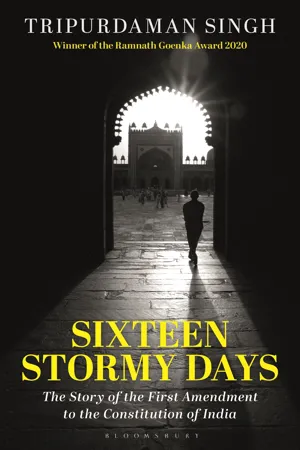
eBook - ePub
Sixteen Stormy Days
The Story of the First Amendment to the Constitution of India
- 272 pages
- English
- ePUB (mobile friendly)
- Available on iOS & Android
eBook - ePub
About this book
Key takeaways
AI-Generated Insights
Insight 1
Trace the historical developments and political pressures that culminated in the First Amendment to the Indian Constitution in 1951. This includes identifying the key events and crises that shaped the contentious legislative process.
Insight 2
Analyze the specific provisions of the First Amendment that curtailed fundamental rights, such as freedom of speech, protection against discrimination, and property rights. Evaluate the competing arguments and positions of prominent political figures involved in the debates surrounding its passage.
Insight 3
Assess the long-term impact of the First Amendment on the evolution of civil liberties and individual freedoms within Indian democracy. Compare the foundational liberal principles of the Indian Constitution with the early governmental actions that demonstrated authoritarian tendencies.
Information
Table of contents
- Cover
- Halftitle Page
- Title Page
- Contents
- List of Plates
- Acknowledgements
- Introduction
- 1 The Build-up
- 2 Will the People Wait?
- 3 The Deepening Crisis
- 4 The Gathering Storm
- 5 The Clouds Burst
- 6 The Battle Rages
- 7 The Aftermath
- Appendix 1: Articles 15, 19, 31 of the Constitution: 1950 v. 1951
- Appendix 2: Timeline of Major Events
- Notes
- Index
- Imprint
Trusted by 375,005 students
Access to over 1.5 million titles for a fair monthly price.
Study more efficiently using our study tools.
Frequently asked questions
Yes, you can cancel anytime from the Subscription tab in your account settings on the Perlego website. Your subscription will stay active until the end of your current billing period. Learn how to cancel your subscription
No, books cannot be downloaded as external files, such as PDFs, for use outside of Perlego. However, you can download books within the Perlego app for offline reading on mobile or tablet. Learn how to download books offline
Perlego offers two plans: Essential and Complete
- Essential is ideal for learners and professionals who enjoy exploring a wide range of subjects. Access the Essential Library with 800,000+ trusted titles and best-sellers across business, personal growth, and the humanities. Includes unlimited reading time and Standard Read Aloud voice.
- Complete: Perfect for advanced learners and researchers needing full, unrestricted access. Unlock 1.5M+ books across hundreds of subjects, including academic and specialized titles. The Complete Plan also includes advanced features like Premium Read Aloud and Research Assistant.
We are an online textbook subscription service, where you can get access to an entire online library for less than the price of a single book per month. With over 1.5 million books across 990+ topics, we’ve got you covered! Learn about our mission
Look out for the read-aloud symbol on your next book to see if you can listen to it. The read-aloud tool reads text aloud for you, highlighting the text as it is being read. You can pause it, speed it up and slow it down. Learn more about Read Aloud
Yes! You can use the Perlego app on both iOS and Android devices to read anytime, anywhere — even offline. Perfect for commutes or when you’re on the go.
Please note we cannot support devices running on iOS 13 and Android 7 or earlier. Learn more about using the app
Please note we cannot support devices running on iOS 13 and Android 7 or earlier. Learn more about using the app
Yes, you can access Sixteen Stormy Days by Tripurdaman Singh in PDF and/or ePUB format, as well as other popular books in History & 20th Century History. We have over 1.5 million books available in our catalogue for you to explore.